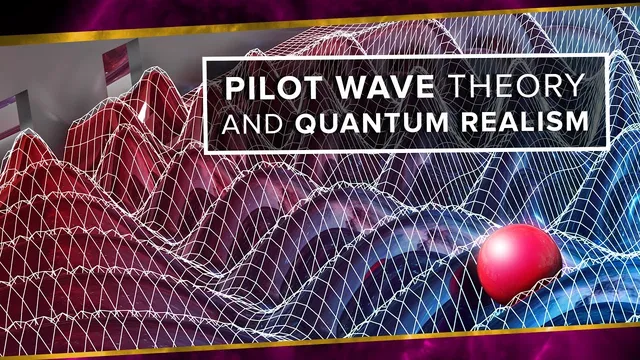
Pilot Wave Theory and Quantum Realism | Space Time | PBS Digital Studios
Based on PBS Space Time's video on YouTube. If you like this content, support the original creators by watching, liking and subscribing to their content.
Pilot-wave theory pairs a real guiding wave with a particle that always has a definite position, producing deterministic trajectories.
Briefing
De Broglie–Bohm pilot-wave theory offers a quantum interpretation that keeps the world firmly physical and deterministic: a real wave guides a real particle along a single trajectory, with no need for “observation” to manufacture outcomes. It reproduces the standard quantum predictions—like the interference pattern from a double-slit setup—while replacing the usual probabilistic story with a deterministic one where apparent randomness comes only from imperfect knowledge of a particle’s initial conditions.
That physical comfort is exactly why the interpretation has stayed on the fringe. Mainstream quantum orthodoxy took shape in the 1920s around Niels Bohr and Werner Heisenberg’s insistence that the wave function is not a physical wave but an abstract probability distribution. In their view, before measurement the system is best described as a set of possible states, and measurement outcomes are fundamentally random. Pilot-wave theory challenges that radical break from classical thinking by arguing there’s no need for a mystical transition between “non-real” waves and “real” particles. Instead, the wave function evolves according to the Schrödinger equation as a real guiding wave, while a particle with a definite position at all times is steered by that wave.
The theory’s deterministic structure comes with tradeoffs. It requires extra mathematical machinery beyond the Schrödinger equation: a separate guiding equation that specifies how the particle moves within the evolving wave. Critics also point to “hidden variables”—additional particle properties not contained in the wave function. A major historical obstacle came from John von Neumann’s influential argument that hidden-variable theories couldn’t work, but later work clarified that von Neumann’s no-go result applied specifically to local hidden variables. Grete Hermann’s analysis, later re-derived by John Bell in the 1960s, helped reopen the door by showing that non-local hidden-variable models aren’t ruled out. Bohmian mechanics embraces that non-locality: the wave function is global and can instantaneously affect the wave’s shape elsewhere, which in turn can influence distant particles—an idea that echoes what entanglement experiments already demand.
Even with those conceptual hurdles, pilot-wave theory remains incomplete in a deeper sense. It doesn’t fit neatly with relativity. Quantum field theory treats all possible trajectories as equally real, while pilot-wave theory insists on a single actual Bohm trajectory, leaving no fully consistent relativistic formulation yet. The transcript also notes that gravity remains unsolved for any quantum interpretation, and that pilot-wave’s original motivation—to preserve “real particles”—may reflect a classical bias.
Still, the core takeaway is that quantum mechanics can be interpreted without abandoning determinism or physical realism. Pilot-wave theory demonstrates a consistent alternative framework, even if it demands non-locality and still lacks a complete relativistic version. The discussion then pivots to related astrophysics questions—strange matter and strangelets, neutron-star magnetic-field generation, and a Wolverine-style comparison of “neutronium” to adamantium—before ending with a reminder of why scientific reasoning matters.
Cornell Notes
De Broglie–Bohm pilot-wave theory keeps quantum mechanics physical and deterministic by pairing a real guiding wave with a real particle that always has a definite position. The wave function still evolves via the Schrödinger equation, and the particle follows trajectories determined by an additional guiding equation. Standard quantum predictions (like double-slit interference) emerge because the particle’s path is constrained by the wave, while randomness reflects ignorance of the exact initial conditions. The interpretation’s main conceptual costs are extra math, hidden variables, and explicit non-locality—features that align with what entanglement experiments already suggest. It also remains incomplete because it doesn’t yet provide a fully consistent relativistic (and gravity-compatible) formulation.
How does pilot-wave theory reproduce quantum results while claiming determinism?
What does “hidden variables” mean in Bohmian mechanics, and why did it face early resistance?
Why is non-locality central to accepting pilot-wave theory?
What extra mathematical structure does pilot-wave theory add beyond the Schrödinger equation?
Why is pilot-wave theory considered incomplete from a modern physics standpoint?
What macroscopic analogy is used to illustrate pilot-wave behavior?
Review Questions
- What assumptions about measurement and randomness does pilot-wave theory replace, and what mechanism produces the same statistical outcomes?
- How do the transcript’s explanations of von Neumann, Grete Hermann, and John Bell relate to whether hidden-variable theories are ruled out?
- What specific incompatibility with quantum field theory prevents a fully relativistic Bohmian mechanics formulation, according to the transcript?
Key Points
- 1
Pilot-wave theory pairs a real guiding wave with a particle that always has a definite position, producing deterministic trajectories.
- 2
The wave function still follows the Schrödinger equation, but particle motion requires an additional guiding equation.
- 3
Quantum randomness is attributed to incomplete knowledge of initial conditions rather than fundamental indeterminism.
- 4
Historical “no hidden variables” arguments targeted local hidden-variable models; non-local hidden-variable theories like Bohmian mechanics evade that specific restriction.
- 5
Bohmian mechanics is explicitly non-local because the global wave function can change instantaneously and affect distant particles.
- 6
The interpretation remains incomplete because it lacks a fully consistent relativistic (and gravity-compatible) formulation compatible with quantum field theory.
- 7
Macroscopic droplet experiments provide an analogy for wave-guided behavior, though they aren’t treated as direct proof of microscopic quantum reality.