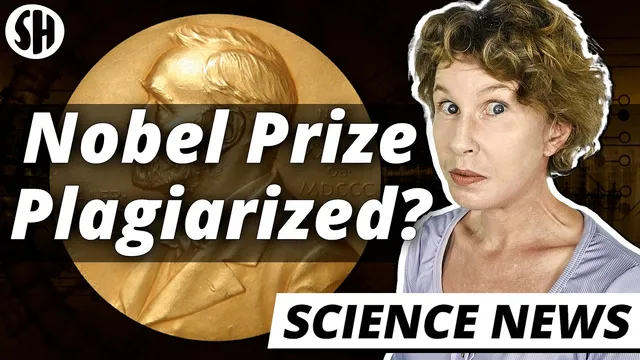
Plagiarism Charges Against Nobel Prize for Artificial Intelligence
Based on Sabine Hossenfelder's video on YouTube. If you like this content, support the original creators by watching, liking and subscribing to their content.
Jürgen Schmidhuber’s plagiarism allegations focus on alleged missing citations to Shun-Ichi Amari, Alexey Ivakhnenko, and work related to the Sherrington-Kirkpatrick model.
Briefing
The Nobel Prize in Physics awarded to John Hopfield and Geoffrey Hinton for foundational work enabling machine learning with artificial neural networks has triggered plagiarism accusations—yet the core issue looks less like copying and more like citation gaps within a field built on shared ideas.
Jürgen Schmidhuber, a prominent AI researcher, alleged that Hopfield “republished” Shun-Ichi Amari’s approach without proper citation and that Hinton failed to cite Alexey Ivakhnenko and also omitted credit for an idea tied to the Sherrington-Kirkpatrick model. The charge matters because it challenges how credit is assigned in AI, where many techniques emerged from overlapping lines of research.
A key complication is that Ivakhnenko died in 2007, making any question about whether he “should have received” the Nobel largely moot. More substantively, the citation criticism is partly accurate: Hopfield and Hinton did cite Amari and Ivakhnenko at times, but not consistently. That pattern can be framed as neglect rather than plagiarism, especially given how scientific writing often reflects uneven citation practices rather than deliberate copying.
The argument shifts when the Nobel context is considered. There is no Nobel Prize for computer science; Hopfield and Hinton received the Nobel Prize for physics because their work connected neural-network ideas to physical systems. Their contribution included introducing a generalized “energy” measure to quantify model performance and linking neural-network behavior to established physics frameworks, including the Sherrington-Kirkpatrick model. In this view, the Nobel committee’s decision hinges on the physics connection—an interpretation reinforced by Alfred Nobel’s 1895 will, which constrains the prize categories. If the committee wanted to recognize AI, physics was the available route.
Beyond the specific allegations, the controversy highlights a structural problem in evaluating individual contributions. Scientific progress typically builds on prior work, and independent teams with similar information and resources can reach comparable conclusions around the same time. The transcript points to historical near-simultaneous developments—such as Newton and Leibniz with calculus, and later cases like supersymmetry and the mathematics behind the Higgs mechanism—where multiple groups developed overlapping ideas independently.
As AI becomes more widely used in research, that “equalizer” effect may intensify. With labs increasingly sharing the same data, models, and even reviewer expectations, researchers may converge on similar results, making it harder to distinguish originality from parallel development. In that environment, citation disputes may become more common even when no one copied another’s work.
The broader takeaway is that calling the situation “plagiarism” may be misleading, but the debate still exposes how awards can simplify community achievements into a small set of individual winners. The Nobel Prize, the transcript suggests, is biased and sometimes politicized, yet it can still motivate future scientists—so its net impact may be positive despite its flaws.
Cornell Notes
The Nobel Prize in Physics awarded to John Hopfield and Geoffrey Hinton for neural-network machine learning has drawn plagiarism accusations from Jürgen Schmidhuber, who claims key prior work by Shun-Ichi Amari and Alexey Ivakhnenko was not properly credited. A closer look suggests the criticism is more about inconsistent citation than deliberate copying, and Ivakhnenko’s death in 2007 limits any “who should have won” argument. The Nobel committee’s physics framing matters: there is no Nobel Prize for computer science, so recognition required a connection to physics, including Hopfield and Hinton’s generalized “energy” approach and links to physical models like the Sherrington-Kirkpatrick model. More broadly, the controversy reflects how independent teams often develop similar ideas when they share information and tools—an effect likely to grow as AI standardizes research inputs.
What exactly were the plagiarism-related claims made about Hopfield and Hinton?
Why does Alexey Ivakhnenko’s death change how the accusations are interpreted?
How does the transcript distinguish “neglect” from “plagiarism” in this case?
Why did Hopfield and Hinton receive a Nobel Prize in Physics rather than a computer-science prize?
What broader scientific-credit problem does the transcript highlight beyond the specific citations?
How might AI change the odds of independent, overlapping discoveries?
Review Questions
- What specific connections to physics are credited to Hopfield and Hinton, and why do those connections matter for a Nobel Prize category?
- Why does inconsistent citation differ from plagiarism in the transcript’s assessment?
- Give one historical example of near-simultaneous discovery mentioned in the transcript and explain what it illustrates about assigning credit.
Key Points
- 1
Jürgen Schmidhuber’s plagiarism allegations focus on alleged missing citations to Shun-Ichi Amari, Alexey Ivakhnenko, and work related to the Sherrington-Kirkpatrick model.
- 2
Inconsistent citation is treated as neglect rather than plagiarism because Hopfield and Hinton cited the relevant researchers at least sometimes.
- 3
The Nobel Prize in Physics was used to recognize AI-related work because there is no Nobel Prize for computer science and Nobel’s 1895 will constrains categories.
- 4
Hopfield and Hinton’s physics-relevant contribution is framed around a generalized “energy” measure and linking neural networks to physical systems studied with models like Sherrington-Kirkpatrick.
- 5
The transcript argues that evaluating individual credit is inherently difficult because independent teams can reach similar results with shared information and tools.
- 6
AI may intensify this convergence by standardizing access to data and models across labs, increasing the likelihood of overlapping discoveries.
- 7
Despite criticism of fairness and politics, prizes can still motivate future scientists, creating a potential net positive effect.