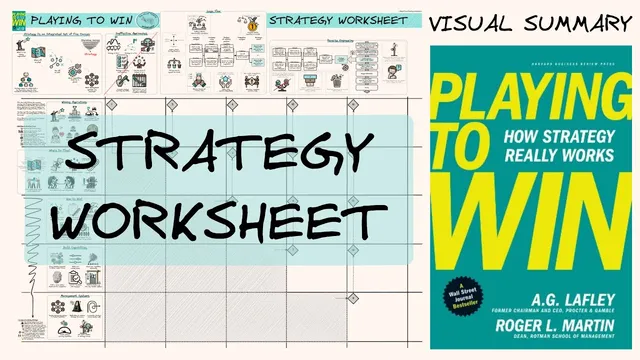
Playing to Win: Strategy Worksheet - Book on a Page
Based on Zsolt's Visual Personal Knowledge Management's video on YouTube. If you like this content, support the original creators by watching, liking and subscribing to their content.
Strategy is treated as an integrated set of five choices—aspirations, where to play, how to win, core capabilities, and management systems—rather than a vision or a static plan.
Briefing
A strategy worksheet built around Roger Martin’s “Strategic Cascade” reframes business strategy as a set of coordinated choices—then turns those choices into something teams can actually fill out, test, and revisit. The core message is that strategy isn’t a slogan, a long-term plan, or a reaction to trends; it’s an iterative system that links what a company wants (winning aspirations) to where it will compete (where to play), how it will win (how to play), what it must be uniquely good at (core capabilities), and how it will manage progress (management systems). That linkage matters because it forces tradeoffs: once the choices are made, options narrow, and the resulting activity system should start to look meaningfully different from competitors.
The session begins by rejecting common “strategy” substitutes. Treating strategy as mere vision is incomplete—vision is only a component. Detailed strategic plans can fail to add up to sustainable advantage. Benchmarking and imitation produce sameness, and chasing best practices or doing everything at once dilutes focus. Even the idea that fast change makes strategy impossible is challenged: uncertainty increases the need for a guiding strategy that shapes decisions rather than leaving them to chance.
From there, the Strategic Cascade is laid out as five integrated steps. First comes winning aspirations: craft a deep, purpose-driven aim grounded in customers, not products, and focused on winning rather than simply “playing.” Aspirations then cascade into where to play—defined by geography, supply chain, customer segment, distribution channel, or customer needs—while actively seeking niches where the company can win. The guidance is to avoid opening multiple fronts or attacking established leaders head-on, and to be skeptical of “empty” niches that may only look empty.
Next is how to play: choices about winning mechanisms must fit the chosen battlefield. A premium positioning, for example, typically conflicts with a low-cost sales-and-promotion approach; brand building and prestige become more aligned. Competitors also matter—if performance stalls, the rules of the game may need adjustment.
Then the cascade moves to core capabilities. Aspirations, where to play, and how to play are easier to copy; unique capabilities are harder to replicate and therefore underpin long-term advantage. The worksheet stresses realistic feasibility checks and testing so execution doesn’t collapse in the real world.
Finally, management systems keep the strategy alive through a rhythm of revisiting choices, clear internal communication, and metrics that track both capability development and the strategic choices themselves.
Two supporting tools—logic flow and reverse engineering—turn strategy into testable hypotheses. Logic flow helps assess segmentation, structure, customer/channel economics, and likely competitor reactions to generate strategic choices. Reverse engineering reframes issues as choices and asks “what would have to be true” for each strategic possibility to work, working backward from competitor reactions to required capabilities, costs, and channel/customer conditions. The worksheet is filled in sequence, but with deliberate back-and-forth: updating aspirations after choices, and revisiting where to play after refining how to win.
To keep the process sharp, six traps are flagged: trying to do everything, attacking strong incumbents, opening multiple fronts, building aspirations that can’t become choices, and following a “program of the month” trend cycle. Strategy quality shows up in distinct activity systems, customers who love the offering while non-customers don’t “get it,” profitable competitors who choose not to attack, and the ability to outspend rivals because the value equation holds. The end result is a one-page strategy worksheet designed to be downloaded, printed, or filled digitally—meant to be used repeatedly as an iterative strategy engine rather than a one-time document.
Cornell Notes
The worksheet operationalizes Roger Martin’s “Strategic Cascade,” treating strategy as five linked choices: winning aspirations, where to play, how to win, core capabilities, and management systems. It argues that vision, strategic plans, benchmarking, best practices, and “emergent strategy” aren’t enough; strategy must guide decisions and create tradeoffs. Aspirations should be purpose-driven and customer-centered, then narrowed into specific battlefields and winning mechanisms that fit together. Core capabilities are emphasized as the hardest part to copy, so feasibility testing matters. Logic flow and reverse engineering help turn strategic ideas into “what would have to be true” hypotheses, then test the weakest barriers first.
Why does the session treat “vision” and “strategic plans” as insufficient substitutes for strategy?
How does “where to play” differ from “how to play,” and why must they align?
What makes core capabilities the likely source of long-term competitive advantage?
What do logic flow and reverse engineering add to the worksheet process?
How does the “iterative” nature of the Strategic Cascade show up while filling the worksheet?
Which traps are highlighted as common ways strategies fail, and what do they have in common?
Review Questions
- In what ways can a “strategic plan” still fail to produce sustainable competitive advantage even if it is detailed?
- Pick one example of “where to play” and propose two contrasting “how to play” options; explain what alignment or misalignment would look like.
- Using reverse engineering, what would you need to identify first when asking “what would have to be true” for a strategic possibility to work?
Key Points
- 1
Strategy is treated as an integrated set of five choices—aspirations, where to play, how to win, core capabilities, and management systems—rather than a vision or a static plan.
- 2
Benchmarking, imitation, and best-practice copying tend to produce sameness and don’t reliably create sustainable advantage.
- 3
Uncertainty doesn’t eliminate strategy; it increases the need for a guiding set of choices that shapes decisions.
- 4
Core capabilities are emphasized as the hardest element for competitors to replicate, so feasibility testing and realistic assessment are essential.
- 5
Logic flow and reverse engineering convert strategic ideas into testable hypotheses by working backward from competitor reactions to required conditions.
- 6
The worksheet is designed for iteration: choices about how to win should trigger revisiting where to play and winning aspirations to keep the system coherent.
- 7
Common failure modes include trying to do everything, attacking strong incumbents, opening multiple fronts, and chasing trends without coherent choices.