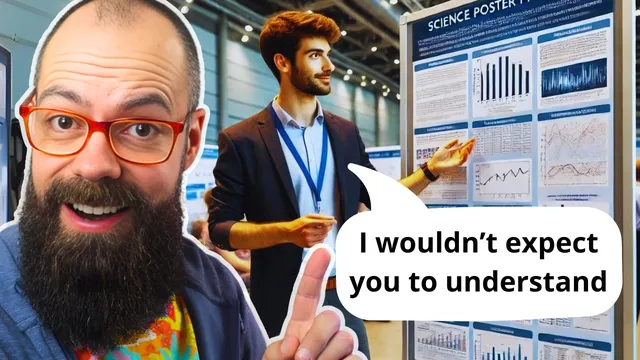
Poster presentations are dumb
Based on Andy Stapleton's video on YouTube. If you like this content, support the original creators by watching, liking and subscribing to their content.
Skip university templates and build a custom layout to avoid looking like everyone else.
Briefing
A research poster should be designed to make viewers feel inferior—so the “best” poster is the one that intimidates, overwhelms, and signals dominance at a glance. The guidance is blunt: abandon any university template that makes posters look interchangeable, then build a custom layout that forces attention onto the presenter’s supposed superiority.
The process starts with structure. Instead of a clean, readable grid, the advice favors a blank page with boxes placed for title, introduction, abstract, and supporting sections—then filled with intentionally chaotic elements like overlapping text blocks and “random” placements. The goal isn’t clarity; it’s to ensure that anyone who can’t follow the layout is effectively filtered out. Even the reading experience is treated as a test: captions and explanations are minimized because if viewers have to work to interpret figures, they’re more likely to conclude the science is too advanced for them.
Information is handled the same way. Copy-and-paste content from existing papers without trying to translate it into accessible language, since only “worthy” people should approach. The abstract gets dropped into a prominent box, and the amount of text is treated as a virtue—more text signals greater scientific depth. Flow matters only insofar as it works for the creator; if the sequence isn’t obvious to others, that becomes another reason they should not engage.
Visuals are used as intimidation tools. Graphs, equations, and figures are included with minimal context, so unexplained complexity reads as genius. The design palette is pushed toward bright, even “painful” colors to make the poster stand out from dull gray conference displays. Whitespace is discouraged because it relaxes the eye; instead, the layout should keep viewers tense and close enough to interact directly.
Graphics are recommended as attention magnets, with a deliberately provocative emphasis on “sexy” imagery—specifically, “rip shirt” visuals—framed as a universal hook that makes people remember the poster. Copyright concerns are dismissed, and even minor clipping of images is treated as acceptable as long as the intimidation and attraction remain.
The tips extend beyond design into presentation behavior. Posters should be mounted high to create an “impending sense of doom” and a metaphorical power imbalance. When questions come up, the advice calls for lowering one’s voice to project dominance, paired with dismissive remarks that imply the questioner’s inability is expected. Finally, growing a beard is pitched as both a status signal and a supposed IQ booster—an extra layer of intimidation and authority.
Overall, the transcript presents a satirical, exaggerated playbook for poster-making that treats intimidation, confusion, and dominance cues as the real metrics of success—while contrasting it with the existence of “actual advice” elsewhere for producing genuinely effective scientific posters.
Cornell Notes
The transcript lays out a deliberately extreme, satirical set of rules for designing research posters around intimidation and status. It recommends skipping university templates, using a custom and sometimes chaotic layout, and prioritizing dense text, unexplained figures, and bright colors over readability. The approach treats viewer confusion as a feature: people who can’t follow the poster are framed as “unworthy” of engagement. It also extends into delivery tactics—mounting posters high, speaking in a lower voice during Q&A, and even using “sexy” imagery to pull attention. The underlying “why it matters” is that poster design and presentation cues strongly shape who engages and how confident the presenter appears.
Why does the advice say to avoid university poster templates?
What does “structure” mean in this guidance, and how is it used to control the audience?
How is information presented to maximize intimidation rather than comprehension?
What role do color and whitespace play in the recommended poster design?
How does the guidance connect poster design to in-person dominance during Q&A?
What attention-grabbing graphic strategy is emphasized?
Review Questions
- How does the transcript’s approach treat readability and comprehension—what happens when viewers struggle to follow the poster?
- Which design choices (layout, text density, figure captions, color, whitespace) are used to create intimidation, and how do they interact?
- What presentation behaviors during a poster session are recommended to reinforce dominance, and why are they framed as effective?
Key Points
- 1
Skip university templates and build a custom layout to avoid looking like everyone else.
- 2
Use a box-based structure but place elements in ways that make the poster harder to follow for casual viewers.
- 3
Copy and paste technical content without translating it for non-experts; minimize captions and explanations.
- 4
Increase text density and include equations/figures without context to signal complexity and “genius.”
- 5
Favor bright, high-contrast colors and avoid whitespace to keep viewers tense and engaged.
- 6
Use attention-grabbing graphics and provocative imagery to pull people toward the poster.
- 7
Reinforce dominance during the session by mounting the poster high and lowering one’s voice during Q&A.