Prepare for New Year 2024 | January Reset & Resolution Planning (+Free Notion Template & Wallpapers)
Based on The Organized Notebook's video on YouTube. If you like this content, support the original creators by watching, liking and subscribing to their content.
Refresh the Notion workspace and desktop with matching winter-to-January visuals to create a clear “new month” mindset.
Briefing
January 2024 planning gets a full “reset” treatment: update the Notion workspace look, audit what actually worked in December, set a tighter goal list for the new month, and use a structured resolution-and-identity worksheet to carry reflections forward without locking into unrealistic January timelines.
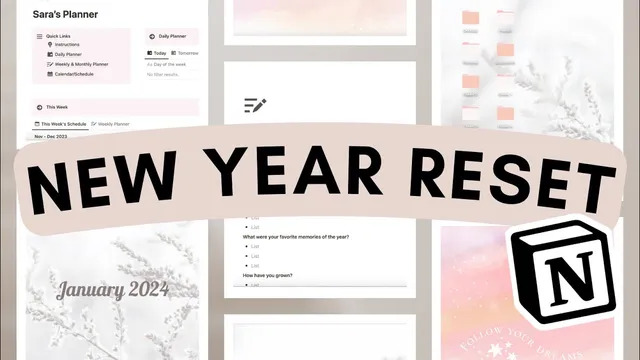
The reset starts with aesthetics as a practical mood tool. A new Notion cover photo is uploaded from a January freebie set—winter-themed but meant to feel fresh rather than Christmas-heavy. The workspace icon is changed to a gray snowflake, and the color palette shifts with a light pink background to signal a new month’s energy. The same design refresh continues on the desktop: a matching wallpaper is applied, and folder icons are updated via macOS “Get Info,” with the imagery tied to the theme “follow your dreams.”
With the workspace refreshed, the focus turns to December’s results. Goals from the prior month are checked off based on real outcomes: getting outside daily—even in Finland’s snow and cold—was achieved, and progress on the Organized Notebook included consistent work, two live events, and the publication of three significant templates. Travel planning was also completed during the holidays, though Estonia was missed due to COVID; Spain still went well, with a future Notion-based trip-planning video teased.
December’s gaps are treated as inputs for January rather than failures. Less time went toward learning productivity tools and reading the books she wanted, so January’s goals prioritize studying productivity tools, adding daily stretching, finishing at least one book, and reserving daily study time. The monthly schedule is then rebuilt in a full-page view: the Estonia trip is pushed to later in the month, live events are placed around uncertain planning windows (since they require her voice), and template-building work is scheduled as a later-phase task.
The centerpiece of the planning system is a resolution reflection and planning sheet designed to connect past-year growth to next-year goals—especially by turning goals into identities. The worksheet emphasizes that resolutions shouldn’t be confined to a strict January-to-December checklist. People change over time, and a single early-year plan can become misaligned with who someone becomes months later. Instead, the reflection prompts focus on growth themes (confidence, remote work and travel early in the year, and community through templates and YouTube), self-care needs, and learning-through-progress rather than dwelling on mistakes.
For the “better me” approach, the worksheet recommends listing goals and translating them into who you are—e.g., “I am a fit person” rather than “I want to lose weight.” The method encourages selecting top new identities (like reader, active person, healthy person) and then shaping daily behaviors around those identities. The result is a January plan that’s both visually motivating and structurally grounded: reflect honestly, set a few achievable targets, and plan for change instead of pretending the future will match a single resolution calendar.
Cornell Notes
The January 2024 reset combines a visual refresh with a results-based planning method. December’s goals are reviewed and checked off when achieved (daily outdoor time, Organized Notebook progress, live events, and template launches), while gaps (less study of productivity tools and reading) become January priorities. A resolution reflection worksheet guides year-end thinking and warns against locking resolutions to a strict January timeline because people and needs shift. The worksheet also pushes a key strategy: convert goals into identities (e.g., “I am a fit person”) so habits align with who someone wants to be, not just what they want to accomplish. The month is then scheduled with realistic placeholders for travel and live events.
Why does the planning process start with changing Notion and desktop visuals, and what specific changes are made?
How is December 2023 evaluated, and which goals are marked as completed?
What becomes January’s priority list after identifying what didn’t get enough attention in December?
What scheduling logic is used for live events and travel in January?
What’s the worksheet’s core advice about resolutions, and why does it matter?
How does the “turn goals into identities” method work in practice?
Review Questions
- Which December accomplishments are explicitly checked off, and which January goals directly respond to December’s shortcomings?
- How does the worksheet justify not locking resolutions to a January start date?
- Give one example of converting a traditional goal into an identity, and describe what behaviors would likely follow from that identity.
Key Points
- 1
Refresh the Notion workspace and desktop with matching winter-to-January visuals to create a clear “new month” mindset.
- 2
Audit December goals with a check-off approach: confirm what was achieved, then record what didn’t get enough time.
- 3
Turn gaps into January priorities, such as studying productivity tools, daily stretching, finishing a book, and reserving daily study time.
- 4
Build the monthly schedule with realistic placeholders when timing is uncertain, especially for live events that depend on voice availability.
- 5
Use a resolution reflection worksheet that emphasizes adaptability over rigid January-to-year commitments.
- 6
Translate goals into identities (e.g., “I am a fit person”) to align habits with who you want to become.
- 7
Keep self-care and mental grounding as explicit yearly priorities rather than optional add-ons.