Probability! | Mini Math Movies | Scratch Garden
Based on Scratch Garden's video on YouTube. If you like this content, support the original creators by watching, liking and subscribing to their content.
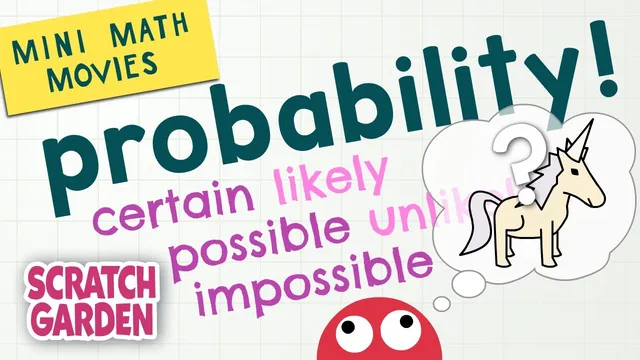
Probability vocabulary is organized into three categories: certain (will happen), possible (might happen), and impossible (won’t happen).
Briefing
Probability is presented as a way to sort outcomes into three practical categories: certain (will happen), impossible (won’t happen), and possible (might happen). The lesson starts with everyday examples—eating dinner every day makes “tomorrow I will eat dinner” certain. By contrast, “tomorrow I will eat rocks” is impossible because rocks are hard, unpleasant, and dangerous to eat. Between those extremes sits uncertainty: “tomorrow I will eat spaghetti” is possible because it has happened before and is something the person likes.
After establishing the core vocabulary, the lesson turns into a quick classification game. Learners are asked to judge whether specific after-dinner events are certain, possible, or impossible. Falling asleep after dinner is treated as certain because it happens every night. Flying to the moon and meeting a dwarf named Betty is labeled impossible due to lack of a rocket ship, no prior experience going to the moon, and the assumption that dwarves don’t live there. Reading a book is marked possible because it sometimes happens before bed, even if it’s not guaranteed.
The activity then expands with a second set of scenarios: having dessert, being carried to bed by a unicorn, brushing teeth, and dreaming about unicorns. The structure stays consistent—each prompt asks learners to decide which probability word fits best based on what is known from experience or what seems unrealistic. The lesson also notes that probability language can include other terms like likely and unlikely, but it focuses on building fluency with certain, possible, and impossible.
The takeaway is less about formal math and more about reasoning from evidence: past routines and realistic constraints push an outcome toward “certain” or “impossible,” while outcomes that sometimes occur land in “possible.” Even the playful unicorn and dwarf examples reinforce the same logic—fantastical events can be classified as impossible when there’s no plausible basis for them, while familiar habits can be treated as certain. By the end, probability is framed as a simple mental tool for predicting what will happen, what won’t, and what might—using clear, kid-friendly categories rather than complicated formulas.
Cornell Notes
Probability is taught as a way to label outcomes as certain, possible, or impossible. “Certain” means an event will happen based on reliable patterns (like eating dinner every day or falling asleep every night). “Impossible” means it cannot happen given constraints and common sense (like eating rocks or flying to the moon to meet a dwarf named Betty). “Possible” covers events that might happen because they sometimes occur (like eating spaghetti or reading a book before bed). The lesson uses short, interactive scenarios to practice choosing the right probability word.
How does the lesson distinguish “certain” from “possible”?
Why is “eating rocks” classified as impossible?
What makes the moon-and-dwarf scenario impossible?
What role does prior experience play in labeling events?
How are the unicorn scenarios used to practice probability words?
Review Questions
- Give one example from the lesson of an event labeled certain, and explain the reasoning used.
- Why is “meeting a dwarf named Betty on the moon” classified as impossible?
- Create your own after-dinner scenario and label it as certain, possible, or impossible—then justify your choice.
Key Points
- 1
Probability vocabulary is organized into three categories: certain (will happen), possible (might happen), and impossible (won’t happen).
- 2
Reliable routines and repeated experience support labeling an outcome as certain.
- 3
Strong constraints, danger, or lack of realistic means support labeling an outcome as impossible.
- 4
Outcomes that sometimes occur without being guaranteed are labeled possible.
- 5
Interactive scenarios after dinner are used to practice choosing the correct probability word.
- 6
Other probability terms like likely and unlikely are mentioned, but the lesson focuses on certain, possible, and impossible.