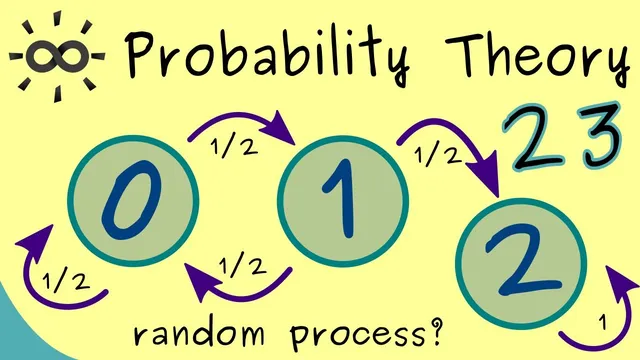
Probability Theory 23 | Stochastic Processes
Based on The Bright Side of Mathematics's video on YouTube. If you like this content, support the original creators by watching, liking and subscribing to their content.
A stochastic process is a family of random variables indexed by time, (X_t)_{t∈T}, all defined on the same sample space Ω.
Briefing
Stochastic processes are framed as a clean way to model randomness that evolves over time: they’re essentially random variables arranged in a sequence indexed by time. That simple structure matters because many real-world systems don’t just produce one random outcome—they change step by step, from biological growth to board games and other time-dependent phenomena.
The course begins with an intuitive definition. A stochastic process takes an index set of “time points” (often discrete, like natural numbers, or continuous, like real numbers) and assigns a random variable to each time point. All those random variables live on the same underlying sample space, so the randomness is consistent across time. Formally, one fixes a sample space Ω, chooses a time index set T, and defines a mapping X_t for each t in T. The collection (X_t)_{t∈T} is the stochastic process. When T is discrete, the result is a sequence of random variables across time steps; when T is continuous, it becomes a family of random variables across a continuum of times. In either case, the process can be viewed as a “path” traced by a particular outcome ω as time progresses.
To make the abstraction concrete, the transcript builds a coin-toss game designed to track when a specific pattern first appears: the first time two successive heads occur. The game runs indefinitely, and the random variable X_n is defined using three values—0, 1, and 2—based on the status after n tosses. After n tosses, if two successive heads have not yet occurred and the nth toss is tails (or the pattern hasn’t been achieved), the value is 0. If two successive heads still haven’t occurred but the nth toss is heads, the value is 1, capturing the “one heads in a row” partial progress. If two successive heads have occurred within the first n tosses, the value becomes 2. This middle value is crucial: it encodes the system’s memory of the most recent toss, which determines what can happen next.
With the sample space Ω taken as the set of all infinite sequences of heads and tails, the transcript then translates the game into a dynamic state picture. From state 0, the next toss is heads with probability 1/2, moving the process to state 1; tails with probability 1/2 keeps it in state 0. From state 1, a heads outcome with probability 1/2 completes the pattern and moves to state 2, while tails with probability 1/2 resets progress back to state 0. Once state 2 is reached, the process is absorbing: it stays at 2 with probability 1, because the condition “two successive heads have occurred” remains true forever.
The takeaway is that stochastic processes turn pattern-based randomness into a time-evolving model with states and transition probabilities. The coin game illustrates how indexing by time, choosing a suitable sample space, and defining meaningful state values together produce a rigorous framework for analyzing systems that evolve under uncertainty.
Cornell Notes
A stochastic process is built by indexing random variables by time and defining them on a shared sample space. The transcript emphasizes that time can be discrete (e.g., n ∈ ℕ) or continuous (e.g., t ∈ ℝ), and the process is the collection (X_t)_{t∈T}. To illustrate, it defines a coin-toss game that runs indefinitely until two successive heads occur. After n tosses, the random variable X_n takes values 0, 1, or 2: 0 means the pattern hasn’t happened and the latest toss doesn’t set up progress, 1 means the latest toss is heads but the pattern still hasn’t completed, and 2 means two successive heads has already occurred. The resulting state transitions use probabilities 1/2 and make state 2 absorbing.
What makes a sequence of random variables a “stochastic process” rather than just a list of unrelated random variables?
How is the sample space Ω chosen for the “two successive heads” coin game?
Why does the random variable X_n use three values (0, 1, 2) instead of just “pattern achieved or not”?
What are the transition probabilities between states 0, 1, and 2?
What does it mean that state 2 is absorbing in this model?
Review Questions
- How would you formally define a stochastic process given a time index set T and a sample space Ω?
- In the coin game, what specific information does state 1 encode about the last toss, and how does that affect the next-step probabilities?
- Why must Ω include infinite sequences rather than only finite sequences for defining X_n for all n?
Key Points
- 1
A stochastic process is a family of random variables indexed by time, (X_t)_{t∈T}, all defined on the same sample space Ω.
- 2
Time can be discrete (e.g., T = ℕ) or continuous (e.g., T = ℝ), changing how the process is interpreted.
- 3
A concrete model requires choosing a meaningful state space for X_t (in the coin game: {0,1,2}).
- 4
The coin-toss example uses three states to track both whether the target pattern occurred and the partial progress needed for the next step.
- 5
From state 0, the process moves to state 1 with probability 1/2 and stays at 0 with probability 1/2.
- 6
From state 1, the process moves to state 2 with probability 1/2 and returns to state 0 with probability 1/2.
- 7
State 2 is absorbing: once reached, the process stays there with probability 1.