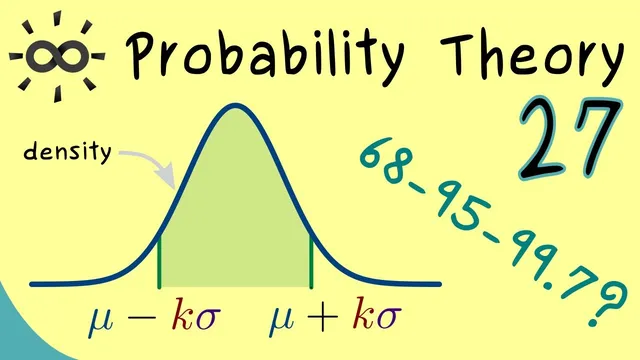
Probability Theory 27 | kσ-intervals
Based on The Bright Side of Mathematics's video on YouTube. If you like this content, support the original creators by watching, liking and subscribing to their content.
Define the kσ interval as [μ − kσ, μ + kσ], where μ = E[X] and σ = √Var(X].
Briefing
K-sigma intervals give a distribution-agnostic way to bound how much probability mass lies near the mean: for any random variable with finite expectation and variance, the probability of landing within μ ± kσ is at least 1 − 1/k². The key tool behind this guarantee is Chebyshev’s inequality, which turns variance information into a universal statement about deviations from the mean—no assumption of normality required.
Start with a random variable X whose expectation μ and variance σ² are finite. The kσ interval is defined as the set of outcomes where X stays within k standard deviations of the mean, i.e., X ∈ [μ − kσ, μ + kσ] (typically a closed interval). The question becomes: what is P(μ − kσ ≤ X ≤ μ + kσ)? Chebyshev’s inequality bounds the probability of large deviations, but it naturally targets events of the form |X − μ| > ε. Setting ε = kσ and converting to the complement yields the bound
P(|X − μ| ≤ kσ) ≥ 1 − Var(X)/ε² = 1 − σ²/(k²σ²) = 1 − 1/k².
This estimate is weak for k = 1 (it becomes non-informative), but it becomes meaningful for k ≥ 2. For k = 2, the lower bound is 1 − 1/4 = 3/4, so at least 75% of outcomes fall inside the “two sigma” interval. For k = 3, the bound becomes 1 − 1/9 = 8/9, meaning at least about 88.9% of outcomes lie within μ ± 3σ.
The universality matters: these percentages hold for any distribution with finite variance, even if the true probability could be much higher. The normal distribution is the benchmark case where the actual coverage is far better than Chebyshev’s guarantee. For a standard normal variable (μ = 0, σ = 1), the familiar empirical/known probabilities are approximately 68% within 1σ, about 95% within 2σ, and about 99.7% within 3σ.
To illustrate the improvement over Chebyshev’s bound, the transcript describes a simulation in R using the standard normal distribution (via Norm). By drawing n samples (e.g., 1,000), then counting the fraction that fall between −k and +k, the observed proportions cluster around the classic normal-rule values: roughly 68% for k = 1, around 95% for k = 2, and near 99% for k = 3, converging toward 99.7% as sample size grows. The takeaway is practical: Chebyshev provides a conservative, distribution-free safety net, while the normal distribution delivers much tighter concentration around the mean—especially for the 1σ/2σ/3σ intervals that recur throughout statistics.
Cornell Notes
K-sigma intervals define a “near the mean” region for any random variable with finite mean μ and variance σ²: X ∈ [μ − kσ, μ + kσ]. Using Chebyshev’s inequality with ε = kσ and taking complements gives a universal lower bound: P(|X − μ| ≤ kσ) ≥ 1 − 1/k². This bound is non-useful for k = 1, but it guarantees at least 75% coverage for k = 2 and at least 8/9 (≈88.9%) for k = 3, regardless of the distribution. For the normal distribution, actual coverage is much higher—about 68% (1σ), 95% (2σ), and 99.7% (3σ)—which can be confirmed via simulation in R. These numbers are widely used in statistics because they reflect how tightly normal data concentrates around μ.
How is a kσ interval defined, and what does it mean operationally?
What universal probability guarantee comes from Chebyshev’s inequality for kσ intervals?
Why does the Chebyshev bound fail to be informative at k = 1?
What coverage guarantees does Chebyshev’s inequality give for k = 2 and k = 3?
How does the normal distribution compare to Chebyshev’s conservative bounds, and how is it checked in practice?
Review Questions
- What lower bound does Chebyshev’s inequality give for P(|X − μ| ≤ kσ), and how does it depend on k?
- Why is the Chebyshev-based estimate for the 1σ interval not useful in the distribution-free setting?
- In a simulation of a standard normal distribution, what fraction of samples should fall within μ ± 3σ, and why does increasing sample size improve the estimate?
Key Points
- 1
Define the kσ interval as [μ − kσ, μ + kσ], where μ = E[X] and σ = √Var(X].
- 2
Chebyshev’s inequality converts variance information into a bound on deviation probabilities from the mean.
- 3
For any distribution with finite mean and variance, P(|X − μ| ≤ kσ) is at least 1 − 1/k².
- 4
The distribution-free Chebyshev bound is non-informative for k = 1 because it yields a lower bound of 0.
- 5
Chebyshev guarantees at least 75% coverage for k = 2 and at least 8/9 (≈88.9%) coverage for k = 3.
- 6
Normal data concentrates far more tightly than Chebyshev predicts: about 68% (1σ), 95% (2σ), and 99.7% (3σ).
- 7
Monte Carlo simulation in R can estimate these normal-interval coverages by sampling from Norm and counting values within ±k.