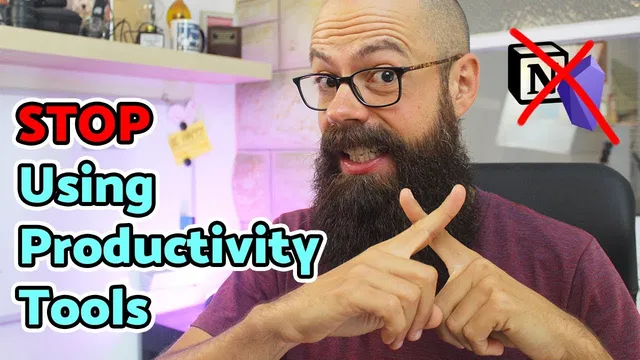
Productivity tools are ruining your PhD and research!
Based on Andy Stapleton's video on YouTube. If you like this content, support the original creators by watching, liking and subscribing to their content.
Productivity boards can intensify PhD anxiety by implying linear momentum when research progress is often non-linear.
Briefing
Productivity tools can backfire in PhD research by turning messy, exploratory work into a rigid checklist—fueling anxiety when progress inevitably stalls. The core problem isn’t that tools like Notion, Obsidian, or Kanban boards are inherently bad; it’s that they often get used to impose linear momentum (“move cards forward,” “tick boxes”) on a process that rarely moves in a straight line. Early PhD work depends on trial, failure, curiosity, and creative recombination of ideas. When a board shows little movement for weeks, it can make researchers feel stuck, even though that stagnation is part of how discovery actually happens.
The argument draws a sharp distinction between research and the more linear parts of academic work. Writing a paper after results are in can be relatively straightforward—type the story, structure the draft, and finish. Research itself is different: it moves forward and backward, sometimes with long stretches producing nothing visible. Productivity systems measure what’s easy to track (tasks completed, cards moved), but research progress often shows up as what’s been tried and failed, or as new data and analysis that gradually accumulates into a thesis. Monitoring the wrong thing can shift attention away from thinking and experimentation toward administration of science.
A better way to gauge progress, the transcript suggests, is to focus on outputs that reflect actual research activity: producing and analyzing data, then presenting it. The recommended method is a recurring two-week reporting rhythm to supervisors, where each check-in includes a formal presentation with graphs and tables built from the latest work. This approach treats progress as a chain of evidence—each meeting produces a new figure or dataset, even when the final outcome is uncertain. Over time, those incremental analyses and stories compound into the thesis, without requiring researchers to pretend they can predict where the work will go.
The transcript also argues that most “productivity” software is unnecessary during the PhD. The one tool framed as genuinely essential is a reference manager—specifically Mendeley (with EndNote offered as an alternative). Reference managers reduce the pain of managing citations and make stored sources searchable, replacing tedious manual citation work. Everything else should be chosen for a specific, linear task rather than adopted as a universal workspace that forces the PhD into someone else’s workflow.
Ultimately, the transcript’s takeaway is cautionary: don’t use productivity tools to soothe anxiety about uncertainty. Use tools to support concrete steps—especially those tied to data, analysis, and communication—while accepting that early research progress often looks chaotic because that’s where the interesting results come from.
Cornell Notes
Productivity tools can worsen PhD anxiety by encouraging researchers to treat progress like a linear task board, even though research is inherently non-linear and exploratory. The transcript contrasts measurable “task completion” with real research progress, which often appears through failures, new data, and analysis that accumulate over time. A practical alternative is a strict two-week supervisor reporting cycle that culminates in a presentation with new graphs/tables, turning uncertainty into a steady evidence-building routine. For tools, the transcript singles out reference managers (Mendeley or EndNote) as genuinely useful, while warning against adopting a single workspace to manage the entire PhD workflow. The goal is to keep attention on thinking and experimentation, not on optimizing checklists.
Why do productivity boards often increase anxiety during early PhD work?
What’s the key mismatch between how productivity tools measure progress and how research actually progresses?
What alternative progress-tracking method is proposed for staying on course?
Which tool is singled out as worth using during a PhD, and why?
When should productivity tools be used, according to the transcript’s framework?
Review Questions
- How does a two-week supervisor presentation with graphs/tables function as a progress metric compared with a task-board approach?
- What kinds of research activities are poorly captured by “cards moved” or “checkboxes ticked,” and why?
- Why does the transcript treat reference managers as fundamentally different from general productivity workspaces?
Key Points
- 1
Productivity boards can intensify PhD anxiety by implying linear momentum when research progress is often non-linear.
- 2
Research progress is better reflected by evidence-building—data collection, analysis, and presentation—than by task completion.
- 3
Measuring what’s easy to track (ticks, moved cards) can distract from the exploratory work that produces results.
- 4
A practical alternative is a recurring two-week cycle of supervisor reporting using new graphs/tables to build the thesis over time.
- 5
Reference managers like Mendeley (or EndNote) are framed as the main “must-have” tool because they simplify citations and improve source retrieval.
- 6
Productivity tools should be reserved for specific linear tasks (such as writing after results), not used to force the entire PhD into a single workflow.
- 7
Trying to optimize away uncertainty can undermine the creative, trial-and-error nature of early research.