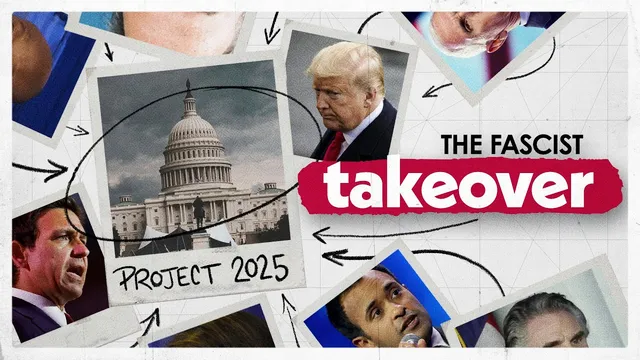
Project 2025: The New Fascist Playbook
Based on Second Thought's video on YouTube. If you like this content, support the original creators by watching, liking and subscribing to their content.
Project 2025 is described as a candidate-agnostic, rapid-implementation plan built around a 920-page manifesto plus an “180-day Playbook.”
Briefing
Project 2025 lays out a sweeping plan to concentrate power in the presidency, dismantle large parts of the administrative state, and replace career governance with ideologically vetted personnel—an approach framed as ready to be implemented immediately after a conservative election win. The centerpiece is a 920-page manifesto spearheaded by the Heritage Foundation, paired with an “180-day Playbook” designed to move quickly once a new conservative president takes office. The plan is presented as candidate-agnostic: even if Donald Trump is the favored figure, the machinery is meant to function regardless of who sits in the Oval Office.
The blueprint is organized into four pillars. First is the policy agenda in the manifesto, which calls for major rollbacks across education, environmental regulation, immigration enforcement, and protections tied to LGBTQ expression. Second is a “Personnel database” described as a conservative talent pipeline—likened to a “conservative LinkedIn”—to identify and place vetted right-leaning candidates into federal and state roles. Third is a training program modeled as an online institute for producing compliant government “soldiers,” aimed at fighting “woke” ideology across agencies. Fourth is the 180-day implementation schedule, a step-by-step guide for rapidly converting the agenda into government action.
The policy priorities are broad and explicitly hierarchical. They include restoring the family as the centerpiece of American life, dismantling the administrative state and returning “self-governance” to the public, defending national sovereignty and borders against global threats, and securing “god-given individual rights.” In practice, that translates into proposals to gut agencies such as the EPA, FEMA, HUD, and DHS—described as the “fourth branch of government” because they handle day-to-day regulation and enforcement. The argument for dismantling these bodies hinges on claims that federal agencies are unconstitutional or overreaching; the counterpoint raised is that many protections—like food safety and environmental safeguards—depend on expert-run regulatory structures.
Beyond regulation, the plan leans on personnel and executive power. It calls for extensive use of Schedule F, a Trump-era mechanism that allows the president to fire federal officials more easily, and it pushes a theory of a “unitary executive” in which the executive branch dominates the relationship among branches of government. The goal is to make presidential action difficult for Congress to block, even when policies are extreme. The transcript links this approach to past expansions of executive authority under Ronald Reagan, George W. Bush, Barack Obama, and Donald Trump, arguing that “technically legal” moves can later reshape what is legally possible.
The agenda also targets cultural and social institutions. It calls for removing “cultural Marxists” from the Department of Education, combating “woke” ideology at all levels of government, and restricting discussion of gender identity and related topics—framed as lacking First Amendment protections. It further includes proposals to criminalize LGBT expression, end economic engagement with China, and escalate immigration crackdowns.
Finally, the transcript argues that electoral outcomes alone won’t stop the shift. It points to economic pressures—rising costs, weaker labor protections, and the gig economy—as structural conditions that can fuel reactionary politics. The proposed counter is mass organizing: unionizing, building community defense, learning legal rights, and preparing for online and offline threats. In that framing, Project 2025 is less a standalone document than a coordinated political project backed by institutions, staffing pipelines, and a rapid implementation plan.
Cornell Notes
Project 2025 is presented as a coordinated conservative program to seize control of the federal government by concentrating authority in the presidency, dismantling the administrative state, and staffing agencies with ideologically vetted personnel. Its structure combines a 920-page policy manifesto, a “Personnel database” for recruiting right-leaning candidates, an online training institute to prepare government operatives, and an “180-day Playbook” for rapid implementation. The agenda emphasizes Schedule F to enable easier firing of federal officials and leans on “unitary executive” theory to reduce Congress’s ability to check presidential power. The transcript frames the plan as candidate-agnostic and argues that stopping it requires sustained organizing, not just voting, alongside attention to underlying economic conditions.
What are the four pillars of Project 2025, and how do they work together?
Why does the transcript focus so heavily on dismantling the administrative state?
How does Schedule F and “unitary executive” theory fit into the power grab described?
What cultural and social policy targets are highlighted, and what constitutional issue is raised?
Who is credited with contributing to the project, and what pattern is suggested about ideology and religion?
What solution does the transcript propose beyond elections, and why?
Review Questions
- How do the “Personnel database” and training pillar change the way policy is implemented compared with relying only on election results?
- What mechanisms in the transcript are used to reduce Congress’s ability to check presidential power (name both and describe how they function)?
- Why does the transcript argue that dismantling the administrative state would have real-world consequences, and what examples are used to illustrate that?
Key Points
- 1
Project 2025 is described as a candidate-agnostic, rapid-implementation plan built around a 920-page manifesto plus an “180-day Playbook.”
- 2
The four pillars—policy, a personnel pipeline, training, and scheduled execution—are presented as a coordinated system for taking over government operations quickly.
- 3
The agenda emphasizes dismantling the administrative state by targeting agencies such as the EPA, FEMA, HUD, and DHS, shifting control away from expert regulation.
- 4
Schedule F and “unitary executive” theory are portrayed as tools to make presidential action harder for Congress to block and easier to staff with ideologically aligned personnel.
- 5
The transcript highlights cultural and social policy targets including education, restrictions on gender-related discussion, and proposals to criminalize LGBT expression.
- 6
The plan’s religious framing is questioned on the grounds that Christian language appears more prominent than religious credentials among contributors.
- 7
Stopping the shift is framed as requiring sustained organizing and community defense, alongside attention to economic conditions that fuel reactionary politics.