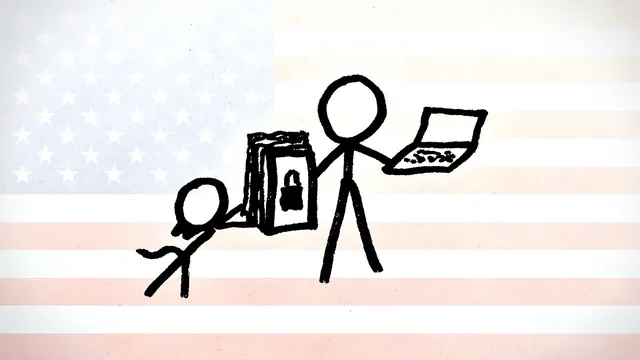
Protecting Privacy with MATH (Collab with the Census)
Based on minutephysics's video on YouTube. If you like this content, support the original creators by watching, liking and subscribing to their content.
Privacy can’t be perfectly preserved while publishing useful, accurate statistics derived from private responses; some privacy leakage is mathematically inevitable.
Briefing
The core finding is that privacy in large surveys can’t be perfectly preserved while still publishing exact, highly informative statistics—and the only way to publish anything useful with a mathematically guaranteed privacy bound is to deliberately add randomness (“jitter”) to the released numbers. That tradeoff matters because census-style data drive political representation, district boundaries, and a wide range of public decisions, yet the underlying records are sensitive at the individual level.
The transcript frames the problem as an unavoidable tension: any published statistic derived from private responses can, in principle, help an attacker narrow down what any particular person answered. Removing names or publishing only aggregates doesn’t fully solve it, because modern computation can re-link patterns to individuals, and a mathematical theorem implies that releasing accurate information—even small pieces—inevitably leaks some privacy. The more information released, the more privacy is eroded.
To make “privacy loss” measurable, the discussion shifts from direct hacking to inference attacks. An attacker can take the published results and brute-force through many possible combinations of answers that participants could have provided, then rank those combinations by how well they match the released statistics. If only a few answer-combinations look plausible, the attacker can be confident the true underlying data are close to one of them—meaning privacy is badly compromised. If many combinations remain similarly plausible, the attacker can’t distinguish the truth, and privacy is better protected.
A small illustrative example shows how this works: with a tiny group and enough published constraints (counts by category plus mean/median ages), the plausible set of answers can collapse to a single consistent reconstruction, producing a complete privacy breach. The transcript then describes privacy protection as controlling the “plausibility landscape.” Mathematically, the risk is tied to whether the plausibility graph has sharp peaks—quantified by the maximum slope. If peaks are too steep, the most plausible scenario stands out and is likely close to the truth.
The practical remedy is to add carefully calibrated noise to the published statistics. Jittering the released values—such as adding a random offset to an average—spreads out the plausible underlying answers so no single scenario dominates. This improves privacy but reduces accuracy, creating a tunable balance: more noise yields more privacy but less precision; less noise yields more accuracy but weaker protection. The transcript emphasizes that this isn’t just “lying with randomness.” The noise must be mathematically structured so repeated releases can’t be averaged together to recover the original data.
It also notes that earlier census-era methods lacked rigorous guarantees about privacy loss. The US 2020 Census is presented as a turning point: it uses modern, mathematically guaranteed privacy safeguards designed to limit inference risk and to ensure that privacy loss compounds in a predictable way across multiple published statistics. The transcript closes by arguing that society must choose an acceptable accuracy-versus-privacy balance, and that organizations should only publish sensitive-derived statistics when they can provide provable bounds—otherwise participants shouldn’t consent to share their data.
Cornell Notes
Large surveys face an unavoidable privacy-versus-utility tradeoff: any accurate statistic derived from private responses can help an attacker infer sensitive details. Privacy loss can be quantified by how confidently an adversary can narrow down the true underlying answers using the published results—modeled as a “plausibility” landscape where sharp peaks indicate high certainty. To prevent those peaks, the transcript says the only mathematically guaranteed approach is to add calibrated randomness (“jitter”) to published statistics, which spreads plausible underlying answers. This improves privacy at the cost of accuracy, and the noise must be designed so multiple releases can’t be combined to reconstruct the original data. The US 2020 Census is highlighted as adopting mathematically rigorous privacy safeguards with predictable privacy-loss accounting across multiple statistics.
Why doesn’t simply removing names from census-style data fully protect privacy?
How does the transcript define an “inference attack” on survey results?
What does the plausibility-peak idea mean, and how is it measured?
Why does adding “jitter” to published statistics help?
What’s the danger of adding random noise repeatedly, and how do rigorous methods address it?
What changes with the US 2020 Census compared with earlier approaches?
Review Questions
- How does the transcript connect privacy loss to the shape of a plausibility graph rather than to direct access to private records?
- Explain the accuracy-versus-privacy tradeoff using the jitter/noise “hat” example and relate it to plausibility peaks.
- Why must privacy-preserving noise be designed to prevent averaging across multiple releases?
Key Points
- 1
Privacy can’t be perfectly preserved while publishing useful, accurate statistics derived from private responses; some privacy leakage is mathematically inevitable.
- 2
Inference attacks can be mounted using only published aggregates by brute-forcing possible underlying answer combinations and ranking them by fit to the released results.
- 3
Privacy loss can be quantified by how sharply the most plausible underlying scenarios stand out—modeled as peaks in a plausibility landscape.
- 4
Mathematically guaranteed privacy protection requires adding calibrated randomness (“jitter”) to released statistics to flatten plausibility peaks.
- 5
More jitter increases privacy but reduces accuracy; less jitter improves accuracy but increases privacy risk.
- 6
Noise mechanisms must be designed so multiple published jittered outputs can’t be combined (e.g., averaged) to recover the original data.
- 7
The US 2020 Census is presented as using mathematically rigorous privacy safeguards with predictable privacy-loss accounting across multiple statistics.