Proven process to present qualitative results for Q1 journals
Based on Academic English Now's video on YouTube. If you like this content, support the original creators by watching, liking and subscribing to their content.
Replace long quotation blocks with shorter excerpts that can be embedded inside paragraphs.
Briefing
Qualitative results that read like a wall of quotations often get trimmed down—not by removing evidence, but by packaging it more precisely. The core fix is to replace very long quote blocks with shorter, journal-friendly excerpts that can be woven directly into the narrative of each paragraph. In a live feedback example, the manuscript had one big quote for every small theme; the revision strategy was to use multiple shorter quotes (sometimes as brief as 5–10 words or even a single striking word) and introduce them with one or two sentences that state the main finding first, then provide an illustrative quote as support.
That shift also improves readability and helps the paper stay concise without losing meaning. Feedback emphasized that quotes can be embedded inside paragraphs rather than occupying entire sections by themselves. For instance, instead of placing a lengthy quote-heavy paragraph, the results section can begin with a clear claim (e.g., the main result), followed by an example quote that demonstrates the claim. Additional quotes can then be added as needed for other sub-points, but only after the paragraph’s purpose is established. The approach is especially useful when journals impose formatting constraints—such as requiring quotes in italics—because shorter excerpts are easier to see and integrate cleanly.
The transcript also flags practical formatting details that can derail otherwise strong qualitative writing. Quote punctuation and bracket style may vary by journal, so the safest move is to check a recently published paper in the target journal and mirror its conventions. The feedback noted that some journals want italics for quotations, and that quotation marks and bracket types (regular vs. other bracket styles) can differ; the correct choice depends on the journal’s style guide.
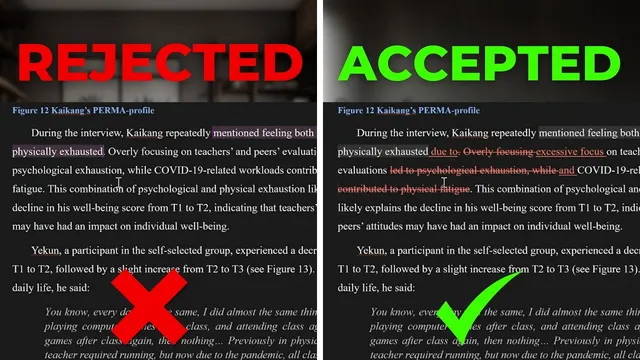
Beyond quote length and placement, the feedback targets redundancy in the wording of results. Repeated descriptions—such as restating the same concept in multiple sentences—can often be tightened by using short quotes at the exact point where the meaning is needed. The example showed how a paragraph could shrink dramatically (from roughly 200 words down to around 80) by condensing repeated phrasing and using brief excerpts to carry the evidence. The key is that concision should not change the underlying interpretation: the same finding (such as a decline in wellbeing from T1 to T2) remains intact, but the writing becomes more direct.
Overall, the process is a concrete checklist for making qualitative results Q1-ready: state the main result up front, support it with short embedded quotes, avoid quote blocks that dominate every theme, and follow the target journal’s formatting rules for italics and punctuation. The transcript positions this as a proven pathway to clearer, more publishable qualitative reporting, and it tees up a follow-on focus on writing methodology to the same Q1 standard.
Cornell Notes
The transcript’s central message is that qualitative results become more publishable when quotes are used as evidence inside the paragraph rather than as long blocks. A practical revision example shows replacing lengthy quotations with shorter excerpts (often 5–10 words, sometimes even a single word) that are introduced by one or two sentences stating the main finding. It also stresses journal-specific formatting—such as italics for quotes and correct bracket/quotation mark styles—by recommending authors mirror conventions from recently published papers in the target journal. Finally, concision comes from removing redundancy and tightening descriptions while preserving the original interpretation (e.g., maintaining the same claim about changes from T1 to T2).
How should qualitative quotes be positioned in the results section to improve clarity and concision?
What’s the recommended strategy for handling very long quotes that cover small themes?
Why does quote formatting matter, and how can authors avoid mistakes?
How can authors reduce word count in qualitative results without changing meaning?
What does a “main claim + evidence quote” paragraph look like in practice?
Review Questions
- When revising qualitative results, what signals that a quote is too long or too dominant in a paragraph?
- What journal-specific elements should be checked before final submission for quotations (e.g., italics, bracket style, quotation marks)?
- How can you rewrite a results paragraph to state the main finding first and then use short quotes as evidence without losing interpretive meaning?
Key Points
- 1
Replace long quotation blocks with shorter excerpts that can be embedded inside paragraphs.
- 2
Start each results paragraph with the main finding, then add one or more short quotes as supporting evidence.
- 3
Use multiple short quotes (sometimes as brief as 5–10 words or even a single word) instead of one large quote per minor theme.
- 4
Follow the target journal’s quotation formatting rules by copying punctuation/bracket and italics conventions from recently published papers.
- 5
Reduce word count by removing redundant phrasing and tightening descriptions while keeping the same interpretation (e.g., changes from T1 to T2).
- 6
Include codes/quotations within the results narrative when appropriate, rather than assuming they must be deleted or isolated.
- 7
Treat concision as an evidence-writing task: quotes should carry proof, while sentences carry the argument.