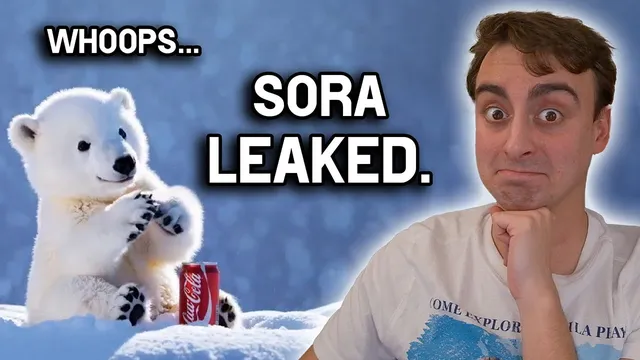
Public Access to Open AI's Sora Video Generator just Leaked...
Based on MattVidPro's video on YouTube. If you like this content, support the original creators by watching, liking and subscribing to their content.
A free Hugging Face space reportedly enabled public generation using a leaked Sora access path, with OpenAI branding and watermarks cited as authenticity signals.
Briefing
OpenAI’s Sora video generator appears to have leaked into public access through a Hugging Face space, sparking both excitement over new AI video demos and backlash over how the access was obtained. The leaked material is framed as “Sora generations” with visible OpenAI branding and a watermark, and early examples—shared via Twitter—range from walking-through-a-portal scenes and smooth city footage to more character-driven clips like a cat chasing a mouse. The access is described as free and tied to an open letter accusing OpenAI of “artwashing,” where artists were used as unpaid testers and then asked to share outputs for marketing value.
The open letter, addressed to “corporate AI overlords,” claims artists were granted early access under promises of being “early testers, red teamers and creative partners,” but were instead pulled into a PR pipeline. It argues that artists are effectively “unpaid R&D,” with compensation limited to the possibility of a small selection of films being screened after a competition—while OpenAI gains substantial marketing and validation from the resulting content. The letter also alleges that outputs require OpenAI approval before sharing, and it criticizes the imbalance between the scale of unpaid contributions and the value of OpenAI as a 150 billion company.
Alongside the ethics dispute, the leaked access is portrayed as limited and technical: the generations are said to come from a “Sora turbo” variant capped at 10 seconds per generation at 30 FPS, with output up to 1080p. The repeated emphasis on “turbo” suggests a larger, more capable Sora model remains undisclosed. The transcript also notes that the Hugging Face space became overwhelmed and that OpenAI may have pressured Hugging Face to remove or disable the generation function, even if the space link still exists.
Quality assessments in the transcript are mixed but generally favorable for motion consistency. Clips are praised for stable camera movement, coherent physics (shirts, tails, fur, reflections), and fewer “mushing” errors in body parts—especially in animal and walking scenes. Still, some examples are described as weaker, including glitches in spatial understanding (a robot-like figure with duplicated head/arm issues), blurry or inconsistent eating scenes (spaghetti/burger attempts), and occasional oddities like a cat’s foot/tail behavior that later corrects.
The fallout extends beyond the leak itself. The transcript claims OpenAI’s Discord reportedly banned Sora as a topic, and it frames the situation as a reputational hit for OpenAI—especially given earlier delays and the company’s shift from nonprofit roots toward a more closed, for-profit posture. While the transcript condemns the leak as potentially illegal and risky for those involved, it also argues that the incident reveals how much remains hidden behind closed doors—leaving open the question of what the full, larger Sora model can do and whether it will be released publicly on a timeline that matches expectations.
Cornell Notes
A leaked Hugging Face space reportedly enabled free public generation using OpenAI’s Sora, accompanied by an open letter accusing OpenAI of “artwashing.” The letter claims artists were recruited as early testers and bug-finders but used for PR value, with limited compensation and approval requirements for sharing outputs. The generations circulating in the leak are described as coming from “Sora turbo,” limited to 10-second clips at 30 FPS and up to 1080p, implying a larger, undisclosed Sora model exists. Quality impressions emphasize strong temporal consistency and physics in some scenes (especially walking and animal motion), while other demos show glitches or weaker performance in complex actions like eating. The episode raises both ethical/legal concerns and questions about how open OpenAI’s access really is.
What does the open letter claim about how artists were used in Sora’s early access program?
How is the leaked Sora access characterized in technical terms?
What kinds of leaked examples are used to judge whether the generations are real and how good they are?
Why did the Hugging Face space stop being usable, according to the transcript?
What broader community and reputational issues are raised beyond the leak itself?
Review Questions
- What specific claims does the open letter make about compensation, approval, and the purpose of early access?
- How do the transcript’s technical limits for “Sora turbo” (10 seconds, 30 FPS, 1080p) shape expectations about a larger undisclosed Sora model?
- Which categories of demos (walking, animals, eating, stylized scenes) are described as strongest or weakest, and what errors or strengths are cited?
Key Points
- 1
A free Hugging Face space reportedly enabled public generation using a leaked Sora access path, with OpenAI branding and watermarks cited as authenticity signals.
- 2
An open letter accuses OpenAI of “artwashing,” arguing artists were used as unpaid testers and constrained by approval requirements before sharing outputs.
- 3
The leaked generations are described as “Sora turbo,” limited to 10-second clips at 30 FPS and up to 1080p, implying a larger Sora model remains undisclosed.
- 4
Quality impressions emphasize temporal consistency and physics coherence in some scenes (especially walking and animal motion), while eating and certain spatial tasks show more failures.
- 5
The Hugging Face generation function reportedly became unavailable after heavy traffic, suggesting intervention to limit further spread of the leak.
- 6
The incident intensifies debate about how open OpenAI is with access, how artist programs are structured, and what remains hidden behind closed doors.