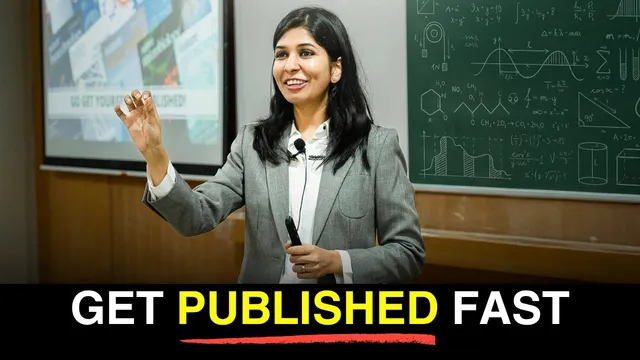
Publish Your Research Paper Fast in 2026 | My Detailed Guide
Based on WiseUp Communications's video on YouTube. If you like this content, support the original creators by watching, liking and subscribing to their content.
If lab infrastructure is missing, shift to computational or simulation-based research using tools like Ansys, COMSOL, and MATLAB rather than waiting for wet-lab access.
Briefing
Publishing a first research paper doesn’t have to take years—using the right workflow and tools can compress the timeline from a multi-year grind into weeks, even for students without strong research infrastructure. Neha Aggarwal, founder of WiseUp Communications and an alumnus of Nanyang Technological University Singapore, traces her own path from a stalled start to a published paper, then lays out a practical roadmap for others aiming to publish faster in 2026.
Her central lesson is that delays often come from avoidable bottlenecks: waiting for “hand-holding,” struggling to access papers behind paywalls, and not knowing how to run experiments or interpret results. Early on, she spent a full year trying to begin a project because she lacked facilities and consistent faculty guidance. The key pivot came when she realized that in 2025 and beyond, students can start without traditional lab support by choosing computational or simulation-based projects—using tools such as Ansys, COMSOL, and MATLAB—rather than waiting for clean rooms, chemical labs, or synthesis setups.
Topic selection is the next leverage point. Instead of relying on a professor to assign a research area, she recommends using AI chat tools to generate topic ideas based on personal interests, then narrowing to something specific enough to produce measurable novelty. After that, a deep literature review is essential to confirm the chosen topic is genuinely new or at least not already saturated, and to ground claims in prior work.
Accessing literature used to be a major obstacle. She described months of outreach to seniors, emailing authors, and hunting for PDFs to read quality research. Now, she argues, the landscape is different: many universities provide subscriptions to major journals, and when they don’t, researchers can start with open access papers. Tools like Consensus and Semantic Scholar can filter for open access and provide PDFs directly, saving time. For paywalled work, she points to arXiv, noting that preprints are not peer-reviewed yet but often remain sufficient for literature review purposes.
Once reading is under control, she says the next bottleneck is writing and conducting research. For writing, she emphasizes that publishing is not just about having solid results—it’s about communicating them clearly. Her own paper was rejected multiple times, partly because her writing mirrored published literature styles without understanding how to make each section persuasive, how to design visuals that attract attention, and how to support claims properly. A course on research writing and presentation helped her learn what belongs in each section and how to make charts, graphs, and results “speak.”
For experimental work, she highlights a practical gap: many students don’t know how to prepare samples, select settings, or analyze outputs even when equipment exists. Her breakthrough came after training at NTU Singapore, and she suggests using AI tools like ChatGPT and Perplexity to ask for equipment-specific preparation steps, common errors, and interpretation guidance—for example with instruments such as SCM and XRD.
Finally, she argues that community reduces friction. She created a supportive research ecosystem via a WhatsApp channel for research opportunities (internships, conferences, fellowships), AI tool updates with exclusive discounts, and an interactive community where students and early-career researchers can ask questions, network, and avoid feeling isolated. The overall message: speed comes from smart choices—open access workflows, AI-assisted topic and method planning, better writing structure, and a community that answers questions quickly.
Cornell Notes
Neha Aggarwal’s path to publishing a first research paper highlights a repeatable workflow: pick a feasible project type, choose a specific topic, master literature review efficiently, then write and present results with clarity. When lab access is limited, she recommends computational or simulation-based projects (e.g., using Ansys, COMSOL, MATLAB) instead of waiting for clean rooms or chemical labs. For literature, she stresses open access first—using tools like Consensus and Semantic Scholar to filter for free PDFs—and using arXiv preprints when paywalls block access. She also credits faster writing and better research communication to structured learning and AI-assisted guidance on equipment use and interpretation. The payoff is a timeline that can shrink from years to weeks when the process is managed with the right tools and support.
What should a student do if they lack research infrastructure like clean rooms or chemical labs?
How can researchers select a topic without relying on a professor to assign one?
What’s the fastest way to access enough literature for a literature review when paywalls block papers?
Why did her early paper get rejected, and what changed after that?
How can students handle experimental research when they don’t know how to operate equipment or analyze outputs?
What role does community play in speeding up research and publishing?
Review Questions
- If you don’t have lab facilities, what project strategy would you choose and which tools would you use?
- How would you verify that a chosen research topic is novel before starting to write?
- What specific writing improvements (sections, visuals, claim support) does Aggarwal say matter for acceptance?
Key Points
- 1
If lab infrastructure is missing, shift to computational or simulation-based research using tools like Ansys, COMSOL, and MATLAB rather than waiting for wet-lab access.
- 2
Generate and narrow research topics using AI chat tools, then validate novelty through a deep literature review.
- 3
Use open access discovery tools such as Consensus and Semantic Scholar to filter for free PDFs and speed up reading.
- 4
When paywalls block access, search arXiv for preprints; treat them as useful for literature review even though they aren’t peer-reviewed yet.
- 5
Treat research writing as a communication problem: structure each section correctly, design visuals that attract attention, and support claims with evidence.
- 6
For experimental work, address the operational and interpretation gap with equipment-specific guidance from AI tools like ChatGPT and Perplexity, ideally alongside training.
- 7
Build momentum with a supportive research community that shares opportunities, tool updates, and answers to practical questions.