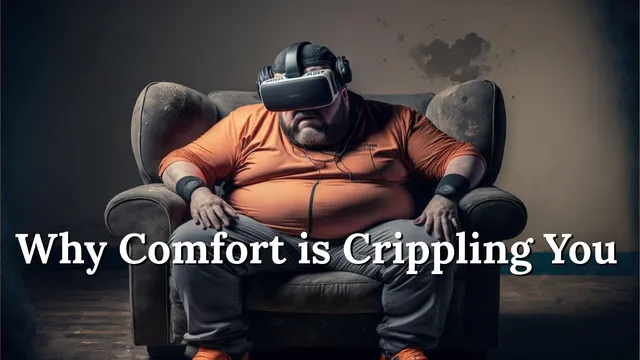
Pursue Pain, Not Pleasure - Why Comfort is Crippling You
Based on Academy of Ideas's video on YouTube. If you like this content, support the original creators by watching, liking and subscribing to their content.
Pleasure and pain are linked through overlapping brain systems and homeostatic balance, so overindulgence can produce an after-effect of pain.
Briefing
Modern comfort is increasingly linked to modern suffering: chronic stress, anxiety, depression, and physical decline. The core claim is that pleasure and pain are tightly coupled in the body and brain, so a life built around constant comfort doesn’t just reduce discomfort—it can also weaken the capacity to endure pain and enjoy pleasure. That matters because many people now live in an environment of abundance where the inherited drive for comfort has no natural “off switch,” making overindulgence a persistent risk rather than a rare event.
The argument starts with an old warning from Dio Chrysostom: people who avoid pain entirely eventually become unable to tolerate pain—and even lose the ability to feel pleasure. Michael Easter’s “Comfort Crisis” is used to frame the mechanism in contemporary terms: modern life offers countless ways to numb out—comfort food, cigarettes, alcohol, pills, smartphones, and TV—while removing the physical struggles that once shaped daily living. In that view, the result is not relief without cost. Numbing out trades short-term comfort for long-term physical and mental health problems.
To show how different human life used to be, the transcript contrasts modern routines with hunter-gatherer existence. Ancestors reportedly walked long distances for water and food, hunted through persistence that could involve running and tracking until prey collapsed, and carried heavy meat back to camp. Easter’s cited numbers suggest that in roughly three-quarters of a day, early humans logged more activity than many people do in a week or two—then maintained that level until death. Alongside physical strain, they faced mental stress without today’s technological and pharmaceutical distractions, endured weather without climate control, and dealt with infections without modern medicine.
This historical mismatch is central: humans evolved in scarcity, where comfort was brief and survival depended on balancing rest with real effort. In today’s abundance, comfort is constant, and the drive for it becomes insatiable. The transcript calls this “comfort creep,” a gradual shift where each new convenience makes yesterday’s baseline feel insufficient. Because the change happens unconsciously, people fail to notice how their comfort zone shrinks.
Physical inactivity is presented as the clearest example. Cars, delivery services, and at-home convenience reduce daily movement; the transcript cites that 27% of people report doing no physical activity at all. That inactivity, it argues, helps fuel obesity and chronic ailments because the human body evolved to require movement. Mayo Clinic researchers are quoted to underline the point: humans were not designed to sit all day.
The mental side follows a similar logic: pleasure and pain move together through overlapping brain systems and homeostatic “balance.” When pleasure is overused, the brain compensates by producing pain—physical or emotional. Over time, tolerance and “neuroadaptation” can make the after-effects stronger and longer. Anne Lembke’s “Dopamine Nation” is used to describe how habitual indulgence can end in anhedonia, where people crave the substance or behavior not for enjoyment but to feel normal. Opioid-induced hyperalgesia is offered as a concrete example of pain intensifying after prolonged opioid exposure.
The prescription is paradoxical but practical: abstinence can reset reward pathways, with the transcript citing Lembke’s clinical experience that about four weeks is enough to regain capacity for simpler pleasures. Then, instead of chasing comfort, people should deliberately reintroduce discomfort—through exercise, cold water immersion, hard goals, and other controlled stressors—so homeostatic mechanisms shift back toward pleasure. The transcript closes by invoking Diogenes the Cynic and later thinkers who treated pain-seeking as a route to stronger, more authentic pleasure: “a bit of Cynicism” and “a little bit of the tub,” meaning a willingness to welcome discomfort rather than escape it.
Cornell Notes
The transcript argues that pleasure and pain are biologically linked through overlapping brain systems and homeostatic “balance.” When people rely on constant comfort and repeated indulgence, the brain compensates by producing more pain, tolerance grows, and the ability to enjoy pleasure can diminish. Modern abundance also creates “comfort creep,” where each new convenience makes older levels of discomfort feel unacceptable—often resulting in physical inactivity and weaker bodies. Recovery is framed as starting with abstinence to reset reward pathways, then rebuilding healthier pleasure by intentionally choosing controlled discomfort (exercise, cold exposure, and challenging goals). The stakes are mental health, physical health, and the capacity to feel joy without an aftershock of pain.
What does “comfort creep” mean, and why does it matter for health?
How does the brain turn pleasure into pain?
Why is abstinence presented as a turning point?
What are “self-binding” strategies, and how do they work against compulsive overconsumption?
How does the transcript justify seeking pain after stopping overindulgence?
What historical examples are used to reinforce the “pain, not pleasure” message?
Review Questions
- How does “opponent-process” homeostasis explain why repeated pleasure can lead to increased pain or anhedonia?
- What practical steps does the transcript recommend to counter “comfort creep,” and how are they connected to physical inactivity?
- Why does the transcript claim abstinence should be followed by intentional discomfort rather than a return to constant comfort?
Key Points
- 1
Pleasure and pain are linked through overlapping brain systems and homeostatic balance, so overindulgence can produce an after-effect of pain.
- 2
Constant comfort can weaken both the ability to endure pain and the ability to enjoy pleasure, echoing ancient warnings about avoiding discomfort entirely.
- 3
“Comfort creep” describes how each new convenience raises the baseline of what feels acceptable, shrinking comfort zones without people noticing.
- 4
Modern abundance enables near-total physical inactivity; the transcript cites 27% of people doing no physical activity, contributing to obesity and chronic ailments.
- 5
Habitual indulgence can drive tolerance and neuroadaptation, making the original pleasure harder to access and the pain after-effect stronger.
- 6
Abstinence is presented as a reset mechanism for reward pathways, with the transcript citing about four weeks to regain capacity for simpler pleasures.
- 7
After abstinence, controlled discomfort—especially exercise, cold exposure, and challenging goals—can shift the pleasure-pain balance back toward healthier equilibrium.