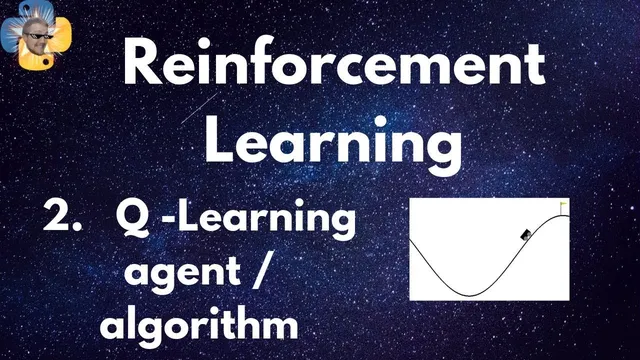
Q Learning Algorithm and Agent - Reinforcement Learning p.2
Based on sentdex's video on YouTube. If you like this content, support the original creators by watching, liking and subscribing to their content.
Convert continuous MountainCar observations into discrete (position, velocity) tuples so a tabular Q-table can be indexed reliably.
Briefing
The core breakthrough is turning a Q-learning agent from “random Q values” into a working policy by discretizing MountainCar’s continuous state, then updating a Q-table with the standard temporal-difference rule that propagates future value backward through the state-action chain. With a learning rate of 0.1 and a discount factor of 0.95, the agent repeatedly steps through the environment, converts each new continuous observation into a discrete (position, velocity) tuple, and updates exactly one Q-table entry: the value for the previous discrete state and the action taken, using reward plus discounted best future Q from the new discrete state.
That discretization step is the hinge. MountainCar provides continuous observations, but the Q-table needs discrete indices. A helper function computes a discrete state by scaling each component of the observation relative to the environment’s observation-space bounds and the chosen window size, then returns the result as a NumPy integer tuple. The agent can then index the Q-table directly with that tuple, retrieve the best action via argmax over Q-values, and compute the “current Q” and “max future Q” needed for the update.
Once the loop runs, the update rule is the engine of learning: new_Q = (1 - learning_rate) * current_Q + learning_rate * (reward + discount * max_future_Q). Because the environment’s reward is mostly negative until the goal is reached, meaningful positive outcomes arrive late; the discount factor determines how strongly those late successes influence earlier states. In practice, the agent’s success rate rises in a “snowball” pattern: after it stumbles into a successful trajectory once, the Q-values along that path become more favorable, making future attempts more likely to repeat and improve.
The training setup then scales from a single run to thousands of episodes (25,000). Rendering is throttled to every 2,000 episodes to keep training fast, and the code prints when the car reaches the goal. A key practical issue emerges: even if the agent can solve the task quickly, it may do so inefficiently or get stuck optimizing one discovered route.
That’s where exploration enters. The transcript introduces epsilon-greedy exploration: start with epsilon = 0.5 so random actions sometimes override the greedy argmax choice, then decay epsilon over time so the agent gradually shifts from exploration to exploitation. A bug/oversight is corrected: epsilon must actually be used when selecting actions, not just computed. After fixing that, learning becomes slower at first (e.g., success around episode ~1200 instead of ~200), but the agent continues exploring long enough to find better strategies rather than locking onto the first workable path.
By the end, the agent is reliably learning to climb the mountain, and the remaining work is tuning epsilon decay and other hyperparameters—plus adding better metrics—to measure time-to-completion and efficiency more systematically. The central lesson is that Q-learning only becomes effective once continuous states are discretized and the Q-table update is driven by both reward and discounted future value, with exploration managed via epsilon-greedy action selection.
Cornell Notes
Q-learning becomes effective once continuous MountainCar observations are converted into discrete state tuples so a Q-table can be indexed. Each step computes the “current Q” for the previous discrete state and action, the “max future Q” from the new discrete state, then updates the table using: new_Q = (1−α)·current_Q + α·(reward + γ·max_future_Q), with learning rate α = 0.1 and discount γ = 0.95. Because rewards are mostly negative until the goal is reached, success propagates backward slowly through the chain, producing a snowball effect after the first successful episode. Training runs across many episodes (25,000) with rendering throttled for speed. Finally, epsilon-greedy exploration (epsilon starting at 0.5 and decaying) is required to avoid locking onto inefficient solutions and to keep searching for better routes.
Why is discretizing the continuous MountainCar state necessary for a Q-table?
How does the Q update rule propagate future success backward?
What do learning rate (α) and discount (γ) do in practice?
Why does the agent’s success often appear suddenly after many failures?
What problem does epsilon-greedy exploration solve, and what happens if epsilon isn’t used correctly?
How does epsilon decay change learning behavior over time?
Review Questions
- How would changing the discount factor from 0.95 to a smaller value likely affect how quickly value from reaching the goal propagates backward through earlier states?
- What exact Q-table entry gets updated each step, and why does the update use the discrete state from before the environment step rather than the new discrete state?
- In epsilon-greedy action selection, what is the decision rule for choosing between argmax and a random action, and how does epsilon decay alter that rule over episodes?
Key Points
- 1
Convert continuous MountainCar observations into discrete (position, velocity) tuples so a tabular Q-table can be indexed reliably.
- 2
Use the standard temporal-difference Q-learning update: new_Q = (1−α)·current_Q + α·(reward + γ·max_future_Q).
- 3
Set learning rate α (0.1) to control how quickly Q-values change, and set discount γ (0.95) to determine how strongly future value influences earlier decisions.
- 4
Train across many episodes (25,000) and throttle rendering to keep learning fast while still monitoring progress.
- 5
Recognize that mostly negative rewards make success propagate slowly; the first successful trajectory often triggers a snowball improvement pattern.
- 6
Apply epsilon-greedy exploration by actually using epsilon in action selection; otherwise exploration never happens and learning can stall or converge to inefficient routes.
- 7
Decay epsilon over episodes to shift from exploration to exploitation once the agent has found at least one workable strategy.