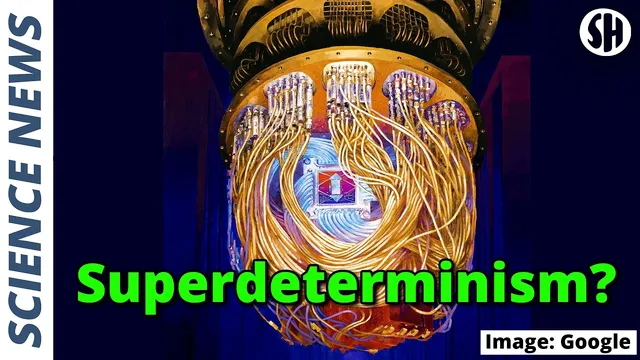
Quantum Computers Could Test Free Will, Researchers Claim
Based on Sabine Hossenfelder's video on YouTube. If you like this content, support the original creators by watching, liking and subscribing to their content.
Entanglement correlations can exceed classical bounds derived from Bell’s theorem under standard assumptions.
Briefing
Quantum entanglement—already central to the weirdness of quantum physics—may also be leveraged to probe a long-debated assumption tied to “free will.” The key idea is that tests of entanglement correlations rely on an assumption called measurement independence, sometimes nicknamed the “free choice” assumption. If that assumption fails, it can be reframed as a constraint on what measurement settings are effectively available in an experiment, a viewpoint known as superdeterminism.
Entanglement is described as a correlation between particles whose properties are not independent. While ordinary correlations are common—like two billiard balls whose trajectories are linked by a collision—entanglement becomes striking when measured correlations exceed what any model of particles as classical objects with definite properties could produce. Physicists use Bell’s theorem to formalize this: under “local” classical assumptions, correlations have an upper bound. Quantum behavior can violate that bound, which is why Bell tests and related experiments have been treated as evidence that quantum particles do not carry definite properties until measurement.
But there’s an alternative escape hatch. Instead of denying definite properties, one can claim the experimental setup violates measurement independence: the measurement choices are not statistically independent of the hidden variables governing the particles. Bell connected this loophole to superdeterminism, the notion that the experiment is not free to choose measurement settings in the way the standard analysis assumes. That’s where the “free will” headline comes from—measurement independence is sometimes framed as a free-choice requirement for experimenters.
The new proposal discussed in the transcript links this loophole to quantum computers. The argument runs that making an experiment more complex—and generating more entanglement—would require a larger violation of measurement independence to reproduce the observed correlations. A quantum computer, by virtue of producing substantial entanglement, is therefore suggested as a tool to stress-test whether measurement independence holds. If the required violation grows with entanglement, then a sufficiently entangling quantum-computing experiment could, in principle, make superdeterministic explanations harder to maintain.
Still, the transcript raises a practical concern: the proposal reportedly does not analyze specific superdeterministic models that would generate the needed measurement-independence violations. Without concrete models, even a “ruling out” result can be hard to interpret—more like setting a trap without knowing what kind of ghost might be caught. The overall takeaway is cautious optimism: the approach is scientifically worthwhile because it targets a real assumption behind Bell-style reasoning, but the connection to “free will” is more about constraints on experimental measurement settings than about human agency as philosophers typically define it.
Cornell Notes
Entanglement produces correlations that can violate Bell’s theorem, which under standard assumptions implies quantum particles lack definite properties until measurement. A loophole—measurement independence—assumes experimenters’ measurement settings are statistically independent of hidden variables. If measurement independence fails, the situation can be reframed as superdeterminism, where experimental choices are effectively constrained. A new proposal suggests using quantum computers to generate large amounts of entanglement, which would require increasingly large violations of measurement independence to match observed correlations. The transcript also notes a limitation: the proposal reportedly doesn’t test against specific superdeterministic models, making interpretation of any “exclusion” less concrete.
What is measurement independence, and why is it sometimes linked to “free will” in Bell-test discussions?
How does Bell’s theorem connect entanglement to limits on correlations?
What does “violation of measurement independence” mean in practice?
Why does the proposal focus on quantum computers and entanglement?
What criticism is raised about the proposal’s interpretability?
Review Questions
- In Bell-test reasoning, which assumption besides locality is crucial for interpreting entanglement correlations, and how is it reframed as “free choice”?
- How does increasing entanglement in the proposed quantum-computing experiment change the size of the measurement-independence violation needed for superdeterministic explanations?
- Why might ruling out a general measurement-independence violation be less informative if no specific superdeterministic models are analyzed?
Key Points
- 1
Entanglement correlations can exceed classical bounds derived from Bell’s theorem under standard assumptions.
- 2
Measurement independence is the assumption that measurement settings are statistically independent of hidden variables.
- 3
Superdeterminism is the loophole where measurement independence fails, effectively constraining what measurement settings can occur.
- 4
A proposed strategy uses quantum computers to generate large entanglement, which would require larger measurement-independence violations to match observed correlations.
- 5
The “free will” framing is about constraints on experimental measurement choices, not about human free will as philosophers define it.
- 6
A major limitation noted is the lack of analysis of specific superdeterministic models, which weakens how directly exclusions map onto physical theories.