Rainbow Science! ... AND Why Headphones Get So Tangled.
Based on Vsauce's video on YouTube. If you like this content, support the original creators by watching, liking and subscribing to their content.
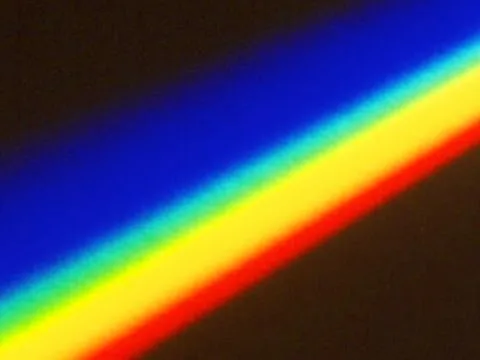
A rainbow is an angle-dependent optical effect: only light leaving raindrops at specific directions reaches an observer’s eyes.
Briefing
A rainbow isn’t a fixed object in the sky—it’s an optical geometry that depends on where an observer stands. Sunlight enters raindrops in front of you, gets refracted and split into colors, and only the wavelengths that leave the droplet at a narrow set of angles reach your eyes. That’s why the rainbow you see is slightly different from the rainbow someone nearby sees: each person’s head position and shadow define the viewing angle. The primary rainbow appears at roughly 40–42 degrees from the direction of your head to your head’s shadow, and the secondary rainbow comes from light that reflects twice inside the droplet, showing up around 50–53 degrees. Between those two bands lies a darker region called Alexander’s Dark Band, created because spherical raindrops can’t send light to your eyes from the angles in between.
The same angle constraint explains several “weird” rainbow behaviors. If the sun is low or the lighting conditions change, other phenomena can appear—like a moon bow when moonlight is strong enough. Reflection rainbows can also form when a normal rainbow is accompanied by one generated by sunlight reflected off a surface such as a lake; because the light source effectively shifts, the two rainbows don’t line up or stay parallel.
Movement adds another twist: since the rainbow is tied to the angle relative to your shadow, it appears to follow you. Walking forward doesn’t make the rainbow “get closer”; instead, the set of raindrops that satisfy the viewing geometry changes, so the rainbow seems to recede as you approach. This effect becomes dramatic in airplanes. High above the ground, the entire circular rainbow is visible because the horizon no longer blocks the lower part of the arc, letting the rainbow appear as a full circle centered around the shadow.
After the rainbow physics, the discussion pivots to tangles—why headphones, Christmas tree lights, and wires so often end up knotted. The cause isn’t an “evil elf,” but probability and persistence: experiments that jiggle strings inside containers show that knotted configurations are far more common than perfectly unknotted ones. Once a knot forms, it resists untying because the geometry of the knot locks itself in place, so it stays twisted until a person deliberately untangles it.
Finally, the video links rain to smell through a named phenomenon: petrichor. During dry spells, plants release oils that help slow growth and seed germination. When rain arrives, those oils are washed into the air and produce the characteristic scent. The takeaway is that a rainbow is a viewer-dependent optical pattern, knots are a statistical inevitability, and even the smell of rain has a specific chemical origin—nature’s physics and chemistry working together in everyday moments.
Cornell Notes
Rainbows depend on observer position because raindrops refract and reflect sunlight into your eyes only at specific angles. The primary rainbow forms around 40–42° from the direction of your head to your head’s shadow, while the secondary rainbow appears around 50–53° due to light reflecting twice inside droplets. The gap between them is darker—Alexander’s Dark Band—because droplets don’t send light to your eyes from intermediate angles. As you move, the rainbow seems to follow you because the required viewing angle stays tied to your shadow. The same “geometry and constraints” theme continues with knots, where experiments show knotted states are more likely and once formed are hard to undo, and with rain smell (petrichor), caused by plant oils released during dry periods and carried into the air by rainfall.
Why does every person see a slightly different rainbow?
What determines the angles of the primary and secondary rainbow?
Why is the region between the two rainbows darker?
How does the “rainbow follows you” effect work, and why does it look circular from an airplane?
Why do headphones and wires so often end up knotted?
What causes the smell of rain, called petrichor?
Review Questions
- If you move forward, why doesn’t the rainbow appear to get closer even though you’re approaching the raindrops?
- What physical difference leads to the secondary rainbow being visible at a different angle than the primary rainbow?
- How do probability and “knot resistance” explain why tangled wires are common after being stored?
Key Points
- 1
A rainbow is an angle-dependent optical effect: only light leaving raindrops at specific directions reaches an observer’s eyes.
- 2
The primary rainbow is visible at about 40–42° from the direction of the head to the head’s shadow; the secondary rainbow appears around 50–53° due to double internal reflection.
- 3
Alexander’s Dark Band forms because raindrops don’t send light to the observer from the intermediate angles between the primary and secondary rainbows.
- 4
As an observer moves, the rainbow appears to follow because the required viewing geometry stays tied to the observer’s shadow.
- 5
Reflection rainbows can occur when sunlight reflected from a surface (like a lake) creates a second rainbow that doesn’t line up with the primary one.
- 6
Knots in strings and wires are more likely than unknotted states in random jiggling experiments, and once formed they resist being untied.
- 7
Petrichor—the smell of rain—comes from plant oils released during dry periods and carried into the air when rain washes them out.