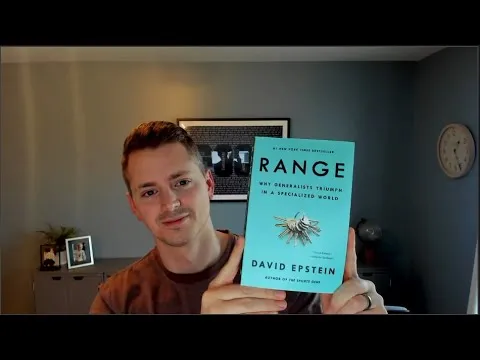
Range: Why Generalists Triumph in a Specialized World (Book Review 001)
Based on Joshua Duffney's video on YouTube. If you like this content, support the original creators by watching, liking and subscribing to their content.
Wicked learning environments are high-complexity and low-predictability, so adaptability matters more than mastering fixed rules.
Briefing
“Range” argues that the best performers in a fast-changing world aren’t the most narrowly trained specialists—they’re generalists who build broad “range” across domains and then selectively narrow into deep skill. That matters because many modern environments are too complex to predict success from a fixed set of rules, so adaptability becomes a competitive advantage.
A central distinction in the book is between “kind” and “wicked” learning environments. In kind environments—where conditions are stable and effort reliably maps to outcomes—people can master patterns and rely on intuition. Wicked environments are the opposite: complexity is high, conditions shift, and past experience becomes a weaker guide to future success. In those settings, the book’s core claim is that general knowledge across related areas prepares people to operate when the rules keep changing.
The argument isn’t that specialization is useless. It’s that hyper-specialization can lock people into “cognitive entrenchment,” making it harder for experts to switch roles or adjust when circumstances demand new approaches. As complexity rises across fields, the demand shifts toward generalized competence—often described as “T-shaped” knowledge. The “T” combines broad understanding across a domain (the top bar) with deep expertise in a specific area (the vertical stem). A practical example comes from the narrator’s experience as a Site Reliability Engineer: team members had distinct responsibilities—monitoring, infrastructure as code, databases—but also cross-trained enough to debug applications and use monitoring tools. That mix increased the team’s flexibility when incidents or requirements evolved.
The book also frames this shift as a response to automation. With computers increasingly taking over repetitive tasks, human value moves toward creativity and higher-level judgment. The discussion points to chess as an illustration of augmentation rather than replacement: after Deep Blue’s early breakthroughs, later “freestyle” chess experiments showed that humans working with computers tended to focus more on broad strategy while offloading detailed tactical calculations to the machine. The result is a model for how people can use tools to expand what they can do—without needing decades to internalize every fine-grained rule.
From there, “Range” turns to how to build range in real life. It introduces “match quality,” defined as the overlap between who someone is and what they do—especially how genuinely interested they are. Higher match quality tends to drive better engagement and performance. To find that overlap, the book recommends a “sample period”: a time-boxed, lightly structured exploration across multiple options within a similar domain (try several instruments, or test multiple programming languages in short bursts) to build competence and discover what feels right.
Exploration can’t last forever. The sample period should be followed by narrowing focus—more structure, more practice volume, and eventually deliberate practice once a promising direction emerges. The book also reframes “amateur” as someone who pursues an endeavor out of genuine interest, not as a label for incompetence. A parable about a hawk and a hound reinforces the career takeaway: when destinations are uncertain, it’s better to follow signals (interest, “scent”) and pivot as you learn, rather than insisting on a single predetermined path.
Cornell Notes
“Range” argues that wicked environments—high complexity with shifting conditions—reward generalists who build broad “range” across domains and then narrow into deep skill. Hyper-specialization can create cognitive entrenchment, making it harder to adapt when roles and requirements change. The book promotes “T-shaped” knowledge: a broad base plus deep expertise, illustrated by cross-trained teams where specialists can still debug and respond outside their narrow lane. It also links range-building to automation-era creativity, using chess as an example of human-computer augmentation. Finally, it offers a practical method: use “match quality” and a “sample period” of exploratory practice, then transition into deliberate practice once interest and fit become clear.
What makes a learning environment “wicked,” and why does that change what people need to learn?
How does “cognitive entrenchment” explain the downside of being too specialized?
What is “T-shaped” knowledge, and how does it work in practice?
Why does the book treat technology as an opportunity for human creativity rather than a pure threat?
How do “match quality” and a “sample period” help someone find the right direction?
What’s the book’s redefinition of “amateur,” and how does it connect to career planning?
Review Questions
- How do kind and wicked learning environments differ in predictability, and what learning strategy follows from that difference?
- In what ways can cognitive entrenchment limit a specialist, and how does T-shaped knowledge counter that risk?
- Design a sample period for a skill you want to explore: what would you test, for how long, and what would “high match quality” look like?
Key Points
- 1
Wicked learning environments are high-complexity and low-predictability, so adaptability matters more than mastering fixed rules.
- 2
Generalists build range across domains to stay effective when conditions change, while hyper-specialists risk cognitive entrenchment.
- 3
T-shaped knowledge pairs broad competence with deep expertise, enabling people to switch roles and debug beyond their narrow lane.
- 4
Automation shifts value toward creativity and higher-level strategy; human-machine teaming can accelerate learning rather than eliminate human judgment.
- 5
Match quality—how well work aligns with identity and interest—predicts engagement and performance more reliably than credentials alone.
- 6
A sample period uses short, lightly structured exploration to find fit; it should then transition into deliberate practice once match quality is clear.
- 7
Career planning works better as iterative pivoting than as committing to a single predetermined destination.