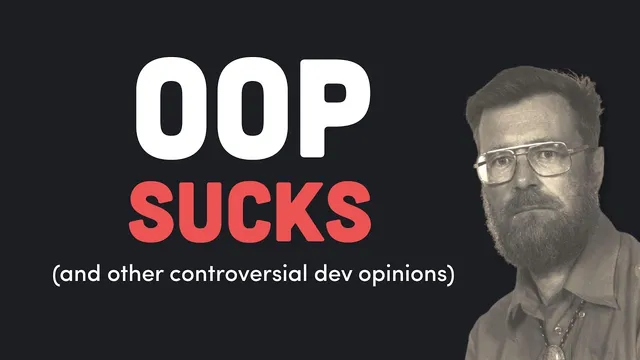
Reacting to Controversial Opinions of Software Engineers
Based on Fireship's video on YouTube. If you like this content, support the original creators by watching, liking and subscribing to their content.
OOP’s reputation is tied to practical costs like boilerplate and mutable state, but classes can still be effective when frameworks and patterns make them predictable.
Briefing
A cluster of controversial software-engineering takes boils down to one recurring theme: many “best practices” are context-dependent, and the strongest developers adapt their tools and habits to the problem rather than worshiping a single ideology. Object-oriented programming (OOP) is the headline target—criticized for boilerplate, mutable state, and code that’s harder to test, refactor, and reason about. The counterpoint is equally pragmatic: OOP can be a clean fit when it’s used deliberately, especially in frameworks built around classes and predictable patterns, while JavaScript developers often avoid heavy OOP by using modules, plain objects, and function exports to keep bundles tree-shakeable and reduce complexity from constructors, getters/setters, and inheritance.
The discussion then shifts from code structure to developer behavior. “Lazy programmers are the best programmers” lands as “work smarter, not harder,” with a concrete example: stepping away for a short break can turn hours of debugging into a quick fix when fresh attention returns. The same mindset extends to learning—when stuck or working inefficiently, spending a few hours on a targeted skill (like understanding the modulus operator instead of endlessly expanding if/else logic) can pay off, though the speaker cautions that learning isn’t always worth it.
Another practical skill gets elevated: googling. The transcript frames search as a core competency of real-world development—solving business problems day after day—while also distinguishing between “using Google effectively” and treating it as a cure-all. Relatedly, the value of formal education is debated. A computer science degree isn’t required to succeed, and self-taught developers can reach high salaries; still, the argument for a degree is that it can fast-track opportunities like internships and provide a foundational knowledge base that may improve long-term capability. The tradeoff—time and student debt—keeps the conclusion from being absolute.
Teaching quality and testing philosophy also get the same context-first treatment. Bad teaching exists regardless of whether someone has a degree, and teaching styles vary; dogmatic instructors who insist there’s only one right way are a particular turnoff. Unit testing is treated as neither sacred nor useless: writing tests up front can become wasted effort when requirements shift, and rigid targets like “95% code coverage” can incentivize pointless tests and even worse code. When requirements are unclear or change often, quality may matter more than test volume, and teams can use dedicated QA resources to validate behavior.
Finally, the transcript lands on communication and maintainability. Comments are defended as “why” documentation rather than redundant restatements of “what” the code already shows. Readability is prioritized over micro-optimizations in JavaScript, with performance tuning deferred until it’s actually a bottleneck. Across the opinions—from OOP to unit tests to comments—the throughline is clear: experienced engineering is less about following rules and more about making the right tradeoffs for the constraints at hand.
Cornell Notes
The transcript challenges several popular “rules” in software engineering by treating them as tools, not dogma. OOP is criticized for boilerplate and mutable state, but it’s also defended as useful when frameworks and design patterns make classes predictable—especially in class-centric ecosystems like Angular or Nest. Developer effectiveness is framed as a mix of problem-solving and communication: taking breaks can break debugging deadlocks, and efficient googling is a core job skill. Education and testing are also presented as conditional: a computer science degree can help but isn’t required, and unit tests can be valuable or wasteful depending on how stable requirements are. The overall message favors readability, “why” comments, and optimizing only when performance truly matters.
Why does the transcript treat OOP as both a target and a viable option?
What does “lazy programmers are the best programmers” mean in actionable terms?
How is googling positioned—skill, crutch, or something else?
What’s the nuanced stance on computer science degrees?
When does unit testing become counterproductive according to the transcript?
What’s the transcript’s practical view on comments and readability?
Review Questions
- In what situations does the transcript argue that OOP (or inheritance) is likely to be beneficial versus harmful?
- How does the transcript connect debugging success to break-taking and learning new targeted skills?
- What conditions make unit tests less effective, and what alternative validation strategies are suggested?
Key Points
- 1
OOP’s reputation is tied to practical costs like boilerplate and mutable state, but classes can still be effective when frameworks and patterns make them predictable.
- 2
In JavaScript, many teams can avoid inheritance-heavy OOP by using modules that export functions and plain objects, improving tree-shaking and reducing complexity.
- 3
Short breaks can materially improve debugging outcomes by restoring attention and enabling quicker pattern recognition.
- 4
Efficient googling is framed as a core professional skill because most work involves solving business problems, not proving theory.
- 5
A computer science degree can accelerate opportunities and foundational knowledge, but it’s not required for success and may not be worth the time and debt for everyone.
- 6
Unit testing is most useful when requirements are stable; rigid coverage targets can incentivize low-value tests and degrade code quality.
- 7
Comments should focus on “why,” and readability should generally come before micro-optimizations unless performance becomes a proven bottleneck.