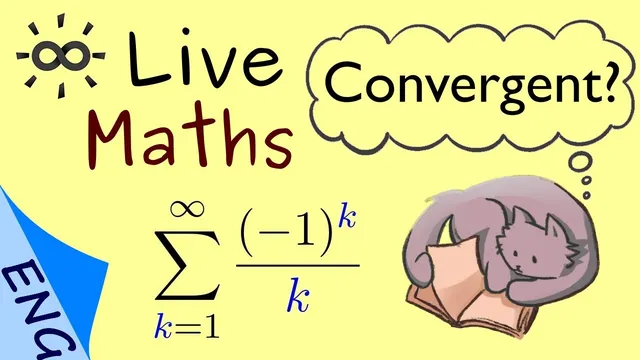
Real Analysis Live - Problem Solving - Series and Convergence Criteria (see tbsom.de/live)
Based on The Bright Side of Mathematics's video on YouTube. If you like this content, support the original creators by watching, liking and subscribing to their content.
Start convergence/divergence by inspecting the term structure and bounding it against a known series like ∑ 1/n² or ∑ 1/n.
Briefing
A pair of classic real-analysis series problems gets solved end-to-end using two workhorse techniques: comparison tests for convergence/divergence and partial-fraction decomposition plus telescoping for exact sums. The central takeaway is practical: when a series looks messy, the fastest path is often to (1) estimate its terms against a known benchmark like 1/n² or 1/n, or (2) rewrite it into a form where most terms cancel.
The first series has terms of the form a_n = n! / n^n. Rather than trying to sum it directly, the solution inspects the term structure by writing out early values and then bounding the general term. The factorial in the numerator can be paired with factors in n^n, leading to an inequality that places a_n under a multiple of 1/n² for sufficiently large n. With that majorant in hand, the comparison test applies: since the p-series ∑ 1/n² converges, the original series ∑ n!/n^n converges absolutely. Along the way, the discussion emphasizes why absolute convergence matters in general (it requires comparing |a_n|), even though positivity makes it automatic here.
A second example shifts from “does it converge?” to “what is the sum?” The series is engineered to be computable. By performing partial fraction decomposition, the term is rewritten as 1/n − 1/(n+1). Summing these partial fractions produces a telescoping effect: in the partial sums, nearly everything cancels, leaving only the first term and the last term. Taking the limit of the remaining expression yields an exact value: the series converges to 1. The session highlights a key conceptual point: a “series” question can secretly be a “limit of partial sums” question, and telescoping makes that limit straightforward.
The stream then adds more convergence practice with variations. One series is shown to converge by comparison to a known convergent form using inequalities that bound the rational term by something like 1/n². Another series is shown to diverge by comparing its terms to the harmonic series: after factoring the dominant polynomial growth, the terms are found to behave like 1/n. A lower bound of the form a_n ≥ 1/n (eventually) triggers the comparison test against ∑ 1/n, proving divergence.
Finally, a more advanced “compute the sum” problem again uses partial fractions and telescoping, but with a different rational structure. The decomposition produces two shifted reciprocal terms whose partial sums collapse. Solving a small linear system for the coefficients and then applying telescoping gives the exact limit of the partial sums as 1/2. The overall message is exam-ready: convergence proofs often hinge on bounding against 1/n² or 1/n, while exact evaluation frequently depends on rewriting terms into a telescoping difference.
Cornell Notes
The session solves several real-analysis series problems by matching each to the right tool. For convergence/divergence, it uses comparison tests: one series with terms n!/n^n is bounded above by a constant multiple of 1/n², so it converges absolutely. Another rational series is shown to diverge because its terms behave like 1/n, allowing a lower bound comparison with the harmonic series. For exact sums, partial fraction decomposition turns a term into a difference of reciprocals (e.g., 1/n − 1/(n+1)), producing telescoping partial sums. This yields closed-form limits such as 1 and 1/2, illustrating that series evaluation often reduces to computing a simple limit of partial sums.
How does the comparison test prove that ∑ n!/n^n converges?
Why does partial fraction decomposition lead to telescoping in the “sum equals 1” example?
What’s the practical difference between convergence and absolute convergence in these exercises?
How do the rational-series examples decide between convergence and divergence?
How is the exact value 1/2 obtained in the final “compute the sum” problem?
Review Questions
- For a_n = n!/n^n, what kind of inequality must be established to compare it to a known convergent series, and which benchmark series is used?
- In a telescoping series created by partial fractions, what cancels across consecutive indices, and how do you compute the remaining boundary terms?
- When a rational term behaves asymptotically like 1/n, what comparison test conclusion should follow, and what inequality direction (upper vs lower bound) is needed?
Key Points
- 1
Start convergence/divergence by inspecting the term structure and bounding it against a known series like ∑ 1/n² or ∑ 1/n.
- 2
For ∑ n!/n^n, show a_n is eventually dominated by a constant multiple of 1/n², then apply the comparison test.
- 3
Absolute convergence comparisons require |a_n| in general; positivity makes absolute convergence immediate.
- 4
Partial fraction decomposition can rewrite a term as a difference of shifted reciprocals, enabling telescoping partial sums.
- 5
Telescoping turns S_N into a simple expression involving only the first and last terms; the series sum is the limit of that expression.
- 6
When a term is asymptotically comparable to 1/n, comparison with the harmonic series typically yields divergence.
- 7
If the problem asks for the exact sum, convergence alone isn’t enough—use algebraic rewriting (partial fractions) to compute the limit of partial sums exactly.