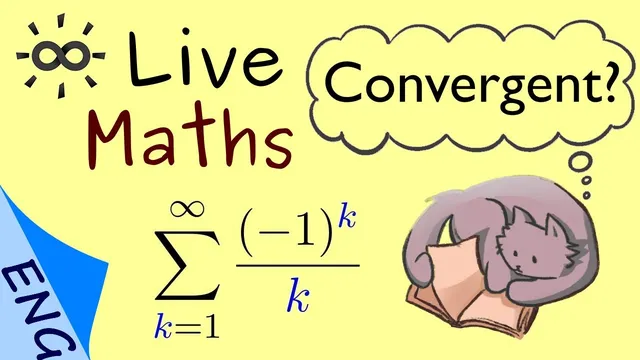
Real Analysis Live - Problem Solving - Series and Convergent Criteria
Based on The Bright Side of Mathematics's video on YouTube. If you like this content, support the original creators by watching, liking and subscribing to their content.
Use the comparison test by bounding a complicated term above (for convergence) or below (for divergence) with a simpler series whose behavior is known.
Briefing
A live real-analysis problem session zeroed in on two core skills for series: proving convergence/divergence with comparison and then, when possible, computing an exact sum using partial fractions and telescoping. The most important takeaway came early from the series
Rather than guessing from the first few terms, the solution builds a rigorous upper bound by comparing the factorial ratio to a multiple of . The key move is to expand as a product and compare factor-by-factor with , showing that for sufficiently large the term is bounded by something like . Since converges, the comparison test forces to converge (and because all terms are positive, absolute convergence follows automatically).
The session then pivoted to a second series designed to be computable:
Here the value is not just “convergent,” but exactly determined. The method starts with partial fraction decomposition: . Plugging this into partial sums produces a telescoping cancellation: most intermediate terms cancel, leaving . Taking yields the exact sum . A related exercise reinforced the same theme: once the series is rewritten into a telescoping form, convergence and the limit become straightforward.
A third example pushed in the opposite direction—divergence. The series
was analyzed by asymptotic behavior: factoring the highest powers shows the term behaves like a constant multiple of for large . Since is the harmonic series and diverges, the solution uses a lower bound of the form (for all sufficiently large ) and applies the comparison test to conclude divergence.
Finally, a more advanced “compute the limit” exercise used partial fractions again, but with a different rational function. After decomposing into two simpler fractions with linear factors, the partial sums telescoped, producing an exact limit of . Throughout, the session emphasized practical exam strategy: first identify whether the terms resemble (likely convergent) or (likely divergent), then choose the right tool—comparison for convergence, and partial fractions plus telescoping when an exact value is attainable.
Cornell Notes
The session trains three linked moves for real-analysis series. First, it proves convergence of by bounding above with a convergent majorant like , then applying the comparison test. Second, it computes an exact sum for by partial fraction decomposition into , which makes partial sums telescope to and hence limit . Third, it proves divergence for a rational series by showing its terms dominate and comparing to the harmonic series. The overall lesson: convergence tests decide “yes/no,” while partial fractions + telescoping can deliver exact values.
How does one prove convergence for without relying on the first few terms?
Why does partial fraction decomposition make computable?
What’s the practical difference between convergence and absolute convergence in these exercises?
How does the divergence proof work for the rational series ?
When is telescoping the right tool, and what must be true for it to work?
Review Questions
- For , what majorant series is used for comparison, and what inequality is established between and that majorant?
- Show how decomposes into partial fractions and compute the resulting partial sum . What limit does it approach?
- In the divergence example, what asymptotic behavior of leads to comparing it with the harmonic series?
Key Points
- 1
Use the comparison test by bounding a complicated term above (for convergence) or below (for divergence) with a simpler series whose behavior is known.
- 2
For , factor and compare products to show is eventually bounded by a multiple of , forcing convergence.
- 3
Partial fraction decomposition can turn rational summands into differences like , enabling telescoping cancellation.
- 4
Telescoping turns the computation of an infinite series into the limit of a simple expression for partial sums.
- 5
When a term behaves like for large , comparing to the harmonic series is a reliable route to divergence.
- 6
Always read the question carefully: convergence/nonconvergence is one task; computing the exact sum requires additional structure (often telescoping).