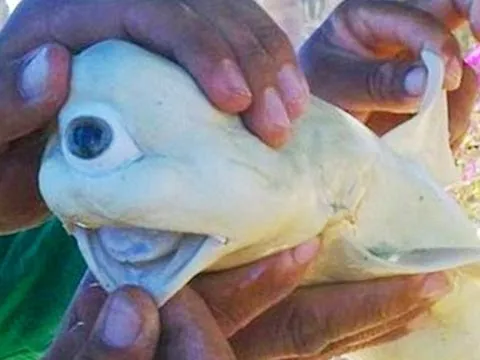
REAL CYCLOPS SHARK and more great images -- IMG! #46
Based on Vsauce's video on YouTube. If you like this content, support the original creators by watching, liking and subscribing to their content.
Worthington jets describe structured splash streams formed when a droplet hits a pool, and their breakup into droplets can enable striking optical refraction effects.
Briefing
Episode 46 of IMG rounds up striking internet images and the science, art, and odd facts hiding behind them—ranging from medical-style scans of candy to physics tricks that turn droplets into whole worlds. The segment opens with an infographic about New Year’s resolutions, noting that 88% fail, then pivots to a visual treat: “cat scans,” which are cross-sectional images of cats. It also spotlights SCANDYBARS, a Tumblr built around high-resolution candy scans, and follows with a rare “albino shark cyclops” image—an example of how the web’s most compelling visuals often come from niche, painstaking photography.
From there, the episode leans into tactile, almost edible oddities and the physics behind them. It name-checks Kyle Bean’s soft-gorilla photographs and then strings together a sequence of food-like but clearly engineered objects: a jello hand grenade, a feather knife, brass knuckles toast, and a melting time bomb. The show also turns to a classic fluid-dynamics term: the splash pattern from a droplet hitting a pool is called a Worthington jet. In a mind-bending twist, the jet can break into droplets, and one droplet’s refraction can form a globe-like world map—an optical effect that makes a flat image feel three-dimensional.
The roundup then shifts from physics to visual perception and design. Imgur’s 2011 “most loaded images” and the site’s most viewed GIF—cafeteria ninja—anchor the discussion in what people actually click and share. Behance’s top “most appreciated projects” adds a design angle, including “honest logos” for YouTube, Facebook, and others, plus “brand-versations,” where logos are constructed from competing brands. Another standout is a dual-image illusion using negative space: it can simultaneously read as two different scenes depending on cultural expectations. A late-1800s psychology study is invoked to explain why Western viewers tend to interpret a box-like interior as a family indoors with a window, while participants from East Africa interpret the same image as a family outdoors under a tree.
The episode keeps stacking visual puzzles: a field of squares where a moving dot makes the center appear to rise and fall, finger drawings that morph into recognizable forms, and a global cloud-cover map averaged over October 2009—made more intriguing by unusual cloud shapes. It also brings in real-world danger and survival through William Rankin, a Marine Corps pilot who ejected from a failing aircraft and skydived through a thunderstorm, with pressure fluctuations triggering his parachute early and leaving him tumbling inside clouds for over 40 minutes before landing in a tree.
Finally, the segment ends with web-driven community content and art: a Reddit-sourced “scarier weather” image of a T-Rex about to eat Iowa, and Guy Laramee’s carved books that become landscapes. Viewers are invited to submit images and questions on Facebook.com/VsauceGaming, closing the loop between internet culture and the surprising science and creativity that images can carry.
Cornell Notes
IMG #46 is a fast-moving gallery of internet images tied to real science, design, and perception. It pairs striking visuals—cat scans, candy cross-sections, optical “world map” refraction, and negative-space illusions—with explanations ranging from fluid dynamics (Worthington jets) to cultural effects on how people interpret ambiguous scenes. The episode also highlights web culture metrics (Imgur’s loaded images and top GIFs) and design practices like “honest logos” and “brand-versations.” It finishes with community submissions and carved-book landscapes, showing how online art and curiosity feed back into scientific thinking.
Why does a droplet splash in a pool sometimes form a jet, and how can that lead to a “globe” effect?
How can the same ambiguous picture be interpreted differently by people from different regions?
What makes a field of squares appear to rise and fall when a dot moves?
What do “honest logos” and “brand-versations” have in common?
What survival detail stands out about William Rankin’s storm encounter?
How does the episode connect internet popularity to specific image formats?
Review Questions
- Which visual illusion in the episode depends on cultural expectations, and what two interpretations does it produce?
- Explain the chain from droplet impact to Worthington jet to the apparent globe effect.
- What role does motion (like a moving dot) play in making a static grid appear to rise and fall?
Key Points
- 1
Worthington jets describe structured splash streams formed when a droplet hits a pool, and their breakup into droplets can enable striking optical refraction effects.
- 2
Cultural experience can change how ambiguous images are interpreted, as shown by a late-1800s study contrasting Western indoor assumptions with East African outdoor interpretations.
- 3
Negative space can create dual images, letting one composition be read as two different scenes at once.
- 4
Online engagement can be quantified through rankings like Imgur’s “most loaded images” and top-view GIFs, revealing what formats capture attention.
- 5
Design projects such as “honest logos” and “brand-versations” remix familiar brand marks to create layered, meaning-shifting visuals.
- 6
Real-world accounts like William Rankin’s thunderstorm skydiving add a survival-and-physics dimension to otherwise purely visual content.
- 7
Community submissions and carved-book art (Guy Laramee) show how internet platforms turn viewer curiosity into new creative outputs.