Relativistic Addition of Velocity | Special Relativity Ch. 6
Based on minutephysics's video on YouTube. If you like this content, support the original creators by watching, liking and subscribing to their content.
Lorentz transformations preserve the invariant speed of light, so light always travels along 45° worldlines on spacetime diagrams for all inertial observers.
Briefing
Special relativity forces a hard limit on how speeds combine across different moving perspectives: relative velocities never add in the simple Newtonian way once speeds approach light speed. The key reason is the Lorentz transformation—an effective squeeze-stretch rotation of spacetime—that preserves the experimentally verified constancy of light speed. On a spacetime diagram, light always travels along a 45° line for any observer, so changing frames cannot “rotate” a light ray into a different angle.
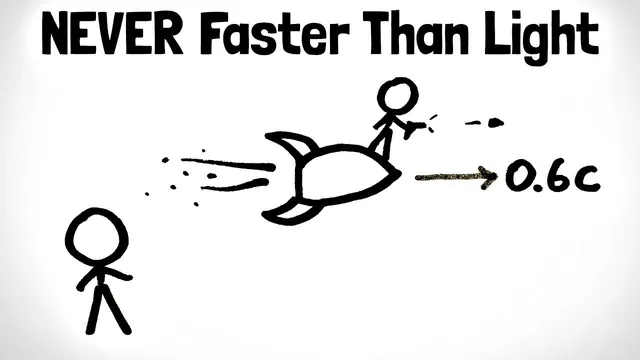
That constraint becomes vivid when comparing an intuitive but wrong calculation for slower-than-light objects. Suppose an observer sees a “death-pellet” moving right at 60% of light speed, and another observer is also moving right at 60% of light speed relative to the first. A naive addition would double the speed to 120% of light speed, which would violate the light-speed limit. Spacetime diagrams correct that intuition: when the frame shifts, the pellet’s worldline changes angle, but it cannot cross the 45° light-speed boundary. For a pellet at 50% of light speed, the worldline in the new frame is still rightward but not steep enough to become a 45° line; at 60%, the same frame change keeps the worldline just shy of lightlike.
The underlying geometric picture is that Lorentz transformations “squeeze and stretch” along the lightlike directions. Stretching a line on a rubber sheet can rotate its angle toward the stretching direction, but it can’t flip it past the lightlike boundary. That means even repeated “boosts” (adding 60% relative speeds again and again) can only drive the result closer to light speed—not to or beyond it. The constancy of light speed therefore implies a global rule: no sequence of perspective changes can turn a sub-light relative speed into a lightlike or superluminal one.
Mathematically, the relativistic velocity-addition formula encodes the same limit. If an object moves at speed v relative to one observer, and that observer moves at speed u relative to another, then the object’s speed relative to the second observer is
v′ = (v + u) / (1 + vu/c²).
Plugging in c for either velocity always returns c, matching the invariant light-speed postulate. If both v and u are less than c, the denominator’s 1 + vu/c² term prevents the result from reaching c. In the low-speed regime where v and u are much smaller than c, vu/c² becomes negligible, and the formula reduces to the familiar Newtonian sum v′ ≈ v + u. The takeaway is that ordinary velocity addition is an approximation that works only when speeds are far from light speed; near light speed, spacetime geometry and the invariant c reshape how motion transforms between frames.
Cornell Notes
Relativistic velocity addition replaces simple “add the speeds” intuition with a formula that guarantees light speed stays the same for every inertial observer. Lorentz transformations act like squeeze-stretch rotations of spacetime that preserve the 45° lightlike directions on spacetime diagrams, so worldlines for slower objects can rotate closer to lightlike but never cross it. The result is that combining two sub-light velocities cannot produce a speed equal to or greater than c. The exact rule is v′ = (v + u)/(1 + vu/c²), which reduces to v′ ≈ v + u when speeds are much smaller than c. This matters because it explains why nothing can accelerate to light speed and why “frame changes” can’t create superluminal motion.
Why does the naive rule “relative speeds add” fail when velocities approach light speed?
How does the spacetime-diagram picture enforce the speed limit?
What does the relativistic velocity-addition formula guarantee?
When do velocities behave almost like they add normally?
What happens if you keep applying boosts that each involve 60% of light speed?
Review Questions
- Use the formula v′ = (v + u)/(1 + vu/c²) to show what happens when v = c or u = c.
- Explain, using the 45° spacetime-diagram picture, why a sub-light worldline cannot become lightlike after a frame change.
- In the limit v, u ≪ c, derive the approximation v′ ≈ v + u from the relativistic formula.
Key Points
- 1
Lorentz transformations preserve the invariant speed of light, so light always travels along 45° worldlines on spacetime diagrams for all inertial observers.
- 2
Simple Newtonian velocity addition fails near light speed because frame changes cannot rotate worldlines past the lightlike boundary.
- 3
A sub-light object’s worldline can get closer to the 45° lightlike direction under a frame shift, but it cannot cross it.
- 4
Relativistic velocity addition is v′ = (v + u)/(1 + vu/c²), not v′ = v + u.
- 5
If either input speed equals c, the output speed is always c, matching the constancy of light speed.
- 6
If both input speeds are less than c, the output speed stays less than c, preventing superluminal results.
- 7
For speeds much smaller than c, the formula reduces to ordinary addition because vu/c² becomes negligible.