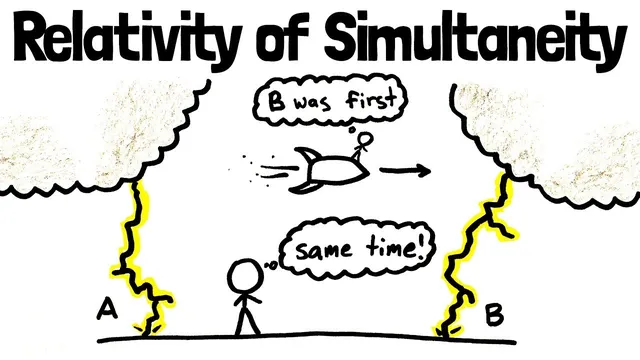
Relativity of Simultaneity | Special Relativity Ch. 4
Based on minutephysics's video on YouTube. If you like this content, support the original creators by watching, liking and subscribing to their content.
Lorentz transformations mix space and time, so simultaneity depends on the observer’s relative motion.
Briefing
Switching between a rest frame and a moving one doesn’t just change how fast things happen—it scrambles which distant events count as “simultaneous.” In spacetime diagrams (space on the horizontal axis, time on the vertical), a Lorentz transformation acts like a squeeze-stretch rotation of spacetime, turning one observer’s set of worldlines into another’s. The immediate consequence is that events that occur at different locations at the same time for one observer generally occur at different times for another observer moving relative to the first.
A concrete example makes the point: if two boxes spontaneously combust at the same time in one observer’s frame, then an observer moving to the right at one-third the speed of light will see the right-hand box combust first and the left-hand box combust second. The “order” of simultaneity flips because the transformation mixes space and time. The key term is the time transformation, written as t_new = γ times t − v times x / c^2, where x is the event’s position relative to the observer. The farther an event is from the observer (larger |x|), the larger the time shift between frames; the c^2 in the denominator makes the effect tiny unless speeds and distances are extreme.
That tiny factor explains why relativity of simultaneity is hard to notice in everyday life. Even then, the effect becomes measurable when either the relative speed is a significant fraction of light speed or the events are separated by enormous distances. The transcript gives a sense of scale: you’d need something like half the speed of light and comparisons across distances larger than the Earth–Moon separation before the mismatch grows beyond about one second. Under those conditions, events that were simultaneous for one observer truly would not be simultaneous for another.
The deeper message is that the universe has no absolute, frame-independent notion of “now.” Simultaneity depends on the observer’s motion, and the breakdown grows with spatial separation. The same logic also mirrors what defines motion in the first place: an object at a fixed position for one observer (same x at different times) appears at different positions at different times for a moving observer. Relativity of simultaneity is essentially the other side of that coin—events that share a time coordinate in one frame fail to share a time coordinate in another when their spatial positions differ.
Ultimately, changing frames causes previously aligned events—whether they were aligned by sharing a location or by sharing a time—to fall out of alignment. That’s the practical meaning of the Lorentz transformation: it preserves the spacetime structure while changing how simultaneity and simultaneity-based comparisons map onto time.
Cornell Notes
Lorentz transformations mix space and time, so simultaneity is not absolute. Events that occur at the same time but at different locations for one observer generally occur at different times for an observer moving relative to them. The time shift depends on the event’s position through the term t_new = γ(t − v x / c^2), meaning larger spatial separation produces a bigger mismatch. Because c^2 is huge, the effect is usually negligible unless speeds are a large fraction of light speed and distances are enormous. The result is that “now” and the ordering of simultaneous events depend on the observer’s motion.
Why do two events that are simultaneous for one observer become non-simultaneous for another?
How does the formula t_new = γ(t − v x / c^2) predict the size of the simultaneity shift?
What does the “two boxes combust” example illustrate about simultaneity?
Why is relativity of simultaneity hard to notice in daily life?
How is relativity of simultaneity connected to what it means for something to be “moving”?
Review Questions
- If two events have the same time coordinate t in one frame but different positions x, what does the term v x / c^2 imply about their time coordinates in another frame?
- What conditions (speed and distance scale) make the simultaneity mismatch large enough to be noticeable, according to the transcript’s estimates?
- How does the idea that simultaneity depends on observer motion relate to the way motion itself is defined through changes in position over time?
Key Points
- 1
Lorentz transformations mix space and time, so simultaneity depends on the observer’s relative motion.
- 2
Events that are simultaneous for one observer can occur in a different time order for another observer when the events are spatially separated.
- 3
The time transformation t_new = γ(t − v x / c^2) shows that the simultaneity shift grows with both relative speed v and spatial separation x.
- 4
The c^2 factor in the denominator makes simultaneity effects extremely small unless speeds are a large fraction of light speed and distances are enormous.
- 5
Relativity of simultaneity implies there is no absolute, frame-independent notion of “now.”
- 6
The same spacetime logic that makes a stationary object appear moving in another frame also makes simultaneous events appear non-simultaneous when their positions differ.
- 7
Changing frames causes previously aligned events (by shared time or shared position) to fall out of alignment in the new perspective.