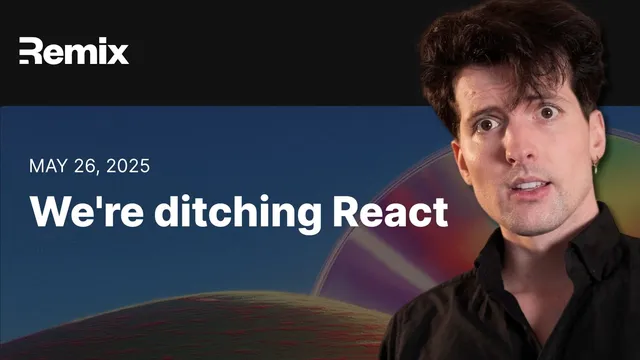
Remix is ditching React (and I think that's a good thing)
Based on Theo - t3․gg's video on YouTube. If you like this content, support the original creators by watching, liking and subscribing to their content.
Remix v3 will not be built on React; it will use a fork of Pact to own more of the stack.
Briefing
Remix is making a dramatic break from React: Remix v3 will be built without React, using a fork of Pact instead. The shift matters because it signals a broader reset in how full-stack web frameworks might be designed—less as “React plus routing plus bundling,” and more as a framework that owns the full stack, aligns tightly with web standards, and is ready for new interaction models driven by AI.
The story starts with Remix’s origin as a React-focused upgrade path. Remix grew out of React Router’s limitations: React Router turned URLs into the right UI, but the React ecosystem lacked a cohesive, recommended “full-stack” approach. React Router itself was created by Michael Jackson and Ryan Florence, who came from the Ember community and built routing for React to fill gaps around performance and page-level rendering. Despite React Router’s dominance, the React team never officially endorsed it—never included in create React app and not highlighted in React docs—creating long-running resentment in the community.
Remix initially tried to fix the “React at scale” pain companies were hitting: slow builds, unreliable hot reloads, and data-fetching patterns that caused waterfall delays. It began as a paid, closed-source template alternative to create React app, betting heavily on modern tooling like esbuild and on route-level data loaders that moved fetching logic out of components and into the routing layer. That approach made Remix feel like “React Router, but for the whole stack,” with server-side rendering patterns designed to improve SEO and performance.
Over time, Remix’s business model and architecture collided with market realities. Next.js surged, and Shopify acquired Remix to support its own React-based direction—especially after Shopify’s Hydrogen project ran into trouble with early server component assumptions. After the acquisition, Remix effectively got absorbed into React Router’s evolution: React Router V7 absorbed the bundler and server runtime pieces, added server component support, and created a migration path for Remix users. That success also meant Remix v2 became a thin wrapper—and Remix was effectively put to sleep to make room for a new iteration.
The new plan, laid out in “Wake up Remix,” reframes the framework as a full-stack platform rather than a React-adjacent wrapper. React Router V7 is positioned as the stable, battle-tested home for server component adoption, with a smooth incremental path for existing Remix and React Router users. React Router’s governance is also shifting toward open governance to avoid single-vendor control, and it’s already powering major production apps across Shopify and other well-known sites.
Remix v3 then uses that freedom to pursue a different foundation: owning critical dependencies (including avoiding React), minimizing reliance on compiler tricks, and keeping runtime behavior close to source code. The framework’s design principles emphasize model-first development for LLM-driven UX and developer workflows, heavy use of web APIs to avoid server/client divergence, strict composition rules for replaceable abstractions, and a cohesive distribution model that packages the ecosystem into a single toolbox. The result is a bet that the next decade of web frameworks should rethink the route-to-response model from first principles—potentially making it easier for both humans and AI systems to build and stream modern experiences.
Cornell Notes
Remix v3 is set to break from React entirely, built on a fork of Pact rather than React. The change follows Remix’s earlier arc: it started as a paid, React-centric alternative to create React app, then gradually merged into React Router’s evolution after Shopify acquired it. React Router V7 now carries the server component momentum with an incremental adoption path, and it’s moving toward open governance to keep it community-driven. With Remix no longer tied to React or a specific paradigm, the framework aims to own the full stack—minimizing compiler magic, leaning on web APIs, and designing for AI-era interaction patterns. The move could reshape expectations for what a “web framework” should be beyond React-based routing and rendering.
Why did Remix originally exist, and what problem did it try to solve for React teams?
What was the relationship between React Router and Remix, and how did Remix end up “killed” in practice?
How did React Router become so dominant even without official React endorsement?
What does React Router V7 add that matters for server components and Remix users?
What’s the core technical shift in Remix v3, and why is Pact central to it?
How do Remix v3’s principles connect to AI-era development?
Review Questions
- What specific pain points in React app development did Remix’s original design try to address, and how did route-level loaders change data-fetching behavior?
- How did Shopify’s acquisition alter the trajectory of Remix, and what role did React Router V7 play in absorbing Remix’s core runtime pieces?
- Which Remix v3 principles (model-first, web APIs, runtime closeness, composition) are most likely to improve AI streaming experiences, and why?
Key Points
- 1
Remix v3 will not be built on React; it will use a fork of Pact to own more of the stack.
- 2
Remix’s early identity was a paid, React-centric alternative to create React app, built around esbuild bets and route-level data loaders.
- 3
Shopify’s acquisition shifted Remix’s core runtime into React Router V7, enabling Remix users to migrate and effectively pausing Remix as a standalone framework.
- 4
React Router V7 now provides server component support with an incremental adoption path, including server-only routes and loader/action integration.
- 5
React Router is moving toward open governance to keep it from being controlled by a small set of individuals or a single company.
- 6
Remix v3’s design principles emphasize model-first development, heavy reliance on web APIs, minimal compiler magic, and strict composition rules for replaceable abstractions.
- 7
Remix v3 aims to rethink the server-to-URL-to-response model from first principles, targeting both human and LLM workflows.