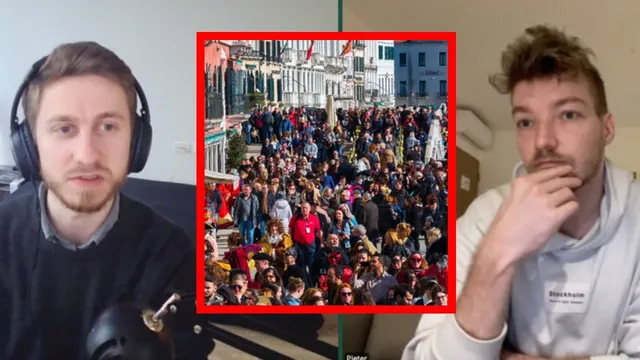
Remote Workers Are 200x More Profitable Than Tourists for Cities
Based on @levelsio's video on YouTube. If you like this content, support the original creators by watching, liking and subscribing to their content.
Remote work can generate similar spending and tax revenue with far fewer people than mass tourism, reducing crowding and disruption.
Briefing
Remote work can deliver far more economic value to cities and countries than traditional tourism because it concentrates spending and tax revenue in fewer visitors—without the same crowding and disruption. A concrete example comes from Tenerife, where a resident who lives there estimates the island receives about 20 million tourist visitors per year. He contrasts that with the spending needed to support roughly 100,000 remote workers, arguing that the same money could be generated with 200 times fewer people. The payoff, in his framing, is twofold: governments collect similar tax revenue while experiencing less of tourism’s “annoying stuff,” such as rolling suitcases, heavy partying, and drunken behavior.
That argument ties into a broader principle about economic impact: what matters most is who shows up and how they behave locally, not just the headline number of arrivals. The discussion emphasizes that remote workers are often “high quality” in the sense that they tend to have more stable income and spend differently than short-stay tourists. Tourism, by contrast, is portrayed as increasingly unpopular and structurally harmful—especially in European city centers where visitor demand reshapes neighborhoods into replicas of themselves. Amsterdam is cited as an example where the entire center is dominated by tourism, turning familiar places into a kind of permanent theme-park atmosphere. The same pattern is described in Barcelona, London, and Leicester Square, where iconic areas become homogenized and less distinctive.
The conversation also distinguishes between low-cost, short-duration tourism and longer, community-integrated stays. Airbnb-style “live like a local” travel is presented as a direction of travel that better matches how people want to experience places now. Instead of a two-day weekend trip—cheap flights, quick consumption, and minimal engagement—the preferred model is staying for a month or two and becoming part of the local rhythm. Even if any outsider changes a place, the claim is that remote-work migration changes it less because the volume is lower and the behavior is more compatible with everyday life.
Personal experience during quarantine reinforces the social dimension of longer stays. After moving around between cities such as Chicago, the narrator describes living in places for about a month and forming relationships with local restaurant owners and residents—connections that would be difficult to build in a three-day visit or from a hotel with luggage and constant turnover. The key difference is time: longer stays reduce the “dehumanizing” effect of treating people as temporary service interactions and instead allow genuine conversation and community ties.
Overall, the economic and cultural case for remote work is that it can replace mass tourism with fewer, higher-spending residents who integrate more deeply. The ideal form of “digital nomadism,” as framed here, is not chasing cheap destinations and stereotypes, but choosing places where longer stays support local life and community participation while reducing tourism’s ecological and cultural costs.
Cornell Notes
Remote work can be more profitable for cities than tourism because it can generate similar spending and tax revenue with far fewer people. A Tenerife example contrasts 20 million tourist visitors per year with the spending equivalent of about 100,000 remote workers—framed as roughly 200x fewer visitors for the same government take. The argument links money to behavior: remote workers are described as higher-quality, less disruptive, and more likely to spend steadily. Longer stays also create social integration, letting newcomers form relationships with locals in ways short trips rarely allow. The discussion positions “digital nomadism” at its best as living like a local for weeks or months, not cheap, high-turnover tourism.
How does the Tenerife example quantify the economic advantage of remote workers over tourists?
Why does the discussion treat tourism as economically and culturally damaging?
What travel model is presented as a better alternative to classic tourism?
How does the quarantine-era personal experience support the social argument for longer stays?
What does “digital nomadism” mean in the best-case version described here?
Review Questions
- What specific comparison (numbers and ratio) is used to argue that remote workers can outperform tourists economically?
- Which city examples are used to illustrate how tourism can homogenize or damage local culture, and what mechanism is implied?
- How does length of stay change the social dynamics between visitors and locals according to the quarantine experience described?
Key Points
- 1
Remote work can generate similar spending and tax revenue with far fewer people than mass tourism, reducing crowding and disruption.
- 2
The Tenerife example claims 20 million tourist visitors could be replaced by about 100,000 remote workers for comparable government revenue—framed as a 200x difference in visitor volume.
- 3
Tourism is described as increasingly harmful to city character, with city centers becoming repetitive and less distinctive.
- 4
Longer stays that mimic local life—rather than short weekend trips—are presented as a more sustainable and culturally respectful model.
- 5
Personal experience during quarantine suggests that staying for a month enables real relationships with locals that short visits cannot.
- 6
The preferred version of digital nomadism emphasizes community integration over cheap, high-turnover travel.