Research Paper Writing - How to Analyze Research Papers using Literature Critique
Based on Enago Read (Previously Raxter.io)'s video on YouTube. If you like this content, support the original creators by watching, liking and subscribing to their content.
Use a critique template to structure notes around explicit research questions, preventing context loss later.
Briefing
Literature analysis often collapses under the weight of scattered, cryptic notes—especially when researchers return to papers weeks later and can’t recall why a specific scribble mattered. A structured “critique template” approach aims to fix that by forcing every note into the right analytical context, so ideas remain usable for summaries, comparisons, and future writing.
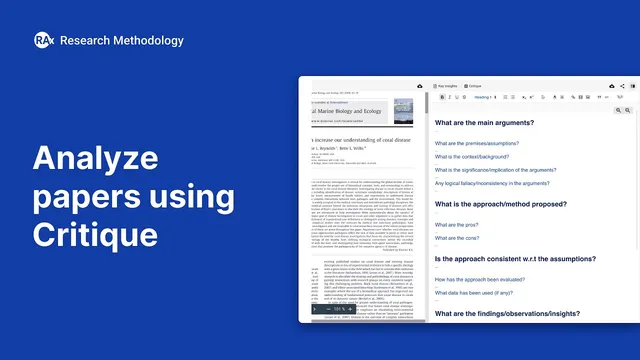
The workflow centers on a critique template generated when a paper is uploaded to Raxter.io. The template comes with a set of default questions designed to guide critical reading. Researchers can modify these questions to match their discipline, research topic, or specific research problem, and they can even build the template collaboratively with an advisor or lab group. A split-view mode supports simultaneous reading and answering: the paper stays open while the researcher works through the template questions, keeping note-taking tightly coupled to what’s being read.
Rather than relying on free-form highlighting and notes—which often strips away context—the template anchors each comment to core analytical categories. Example prompts include identifying the paper’s main arguments, extracting the promises or assumptions the author relies on, checking whether the method or approach aligns with those assumptions, and isolating key findings, observations, limitations, or weaknesses in the claims. The practical payoff is that notes become retrievable later: when researchers revisit a section, they can see the reasoning framework they used at the time, making recap writing and synthesis less time-consuming.
The system also supports targeted exploration while writing. If a researcher is drafting about a particular argument, they can select the relevant section and use a “literature” function to fetch related papers with narratives connected to that section’s theme. Those related materials can then be attached directly to the critique context, helping researchers build a tighter literature map instead of collecting disconnected references.
For collaborative work, the template can be shared with collaborators. After an email invite is accepted, teammates can join a discussion thread tied to the paper, enabling a focused, remote “journal club” style exchange. This is positioned as a way to avoid losing important assessment points that can happen in less structured group discussions.
Finally, the critique template is framed as something different from a full narrative literature review. It’s meant for bullet-pointed, question-driven note capture—crystallizing a researcher’s analysis and critique in a form that can later be expanded into summaries, comparisons, and writing. The central idea: structure the notes at the moment of reading, and the context stays intact when the time comes to compile and synthesize.
Cornell Notes
A critique template turns messy, hard-to-reuse notes into structured analysis by tying every comment to specific research questions. When a paper is uploaded to Raxter.io, the platform generates a default set of prompts (which can be customized by discipline or research problem) and supports split-view reading while answering them. Notes are organized by categories such as main arguments, underlying assumptions, whether methods match those assumptions, key findings, and limitations—so later revisits preserve the original context. The template also enables linking related literature to specific sections and supports collaborative discussion threads for journal-club-style critique. It’s designed for question-based bullet notes, not a full detailed review.
Why do free-form highlights and scribbles become a problem during later synthesis?
What kinds of questions should a critique template include to guide critical reading?
How does split view change the note-taking process?
How can the template help researchers find related papers while writing?
How does sharing a critique template support collaborative journal-club discussions?
What is the critique template’s intended output—an article-length review or something else?
Review Questions
- How does organizing notes under specific research questions improve recall when revisiting a paper weeks later?
- Which critique categories (arguments, assumptions, method consistency, findings, limitations) are most important for evaluating whether a paper’s claims hold up?
- What are two ways the template supports collaboration or synthesis beyond individual note-taking?
Key Points
- 1
Use a critique template to structure notes around explicit research questions, preventing context loss later.
- 2
Customize the default critique questions to match the discipline, research topic, or research problem.
- 3
Take notes in split view so analysis stays synchronized with the exact passages being read.
- 4
Record each note under categories like main arguments, assumptions, method consistency, key findings, and limitations to make recap writing easier.
- 5
Use the literature function to pull related papers tied to specific sections you’re writing about, then attach them to the relevant critique context.
- 6
Share the critique with collaborators to run focused discussion threads, enabling a remote journal-club style workflow.
- 7
Treat the template as bullet-pointed, question-driven critique—not as a substitute for a full narrative literature review.