Research With Me | Swedish Household Examination Records | Swedish Genealogy
Based on Roam Your Roots's video on YouTube. If you like this content, support the original creators by watching, liking and subscribing to their content.
Start with the last household examination book where the ancestor appears to establish an emigration endpoint and then work backward to fill in earlier residences.
Briefing
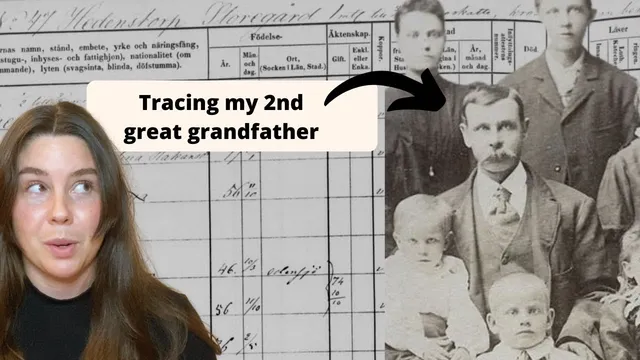
Swedish household examination records can be used to reconstruct an ancestor’s exact farm-to-farm path before emigration—by working backward through successive record books, capturing the page-level “residence” clues, and then translating those dates into a structured timeline on an ancestry profile. In a research-with-me session, Lisa traces her second great-grandfather, Carl (Charles) Bergeron—listed as Carl Gustafson in Sweden—by starting with the last household examination book where he appears and then stepping back through earlier volumes until his family’s locations are accounted for.
The process begins with the 1877–1881 household examination book, where Carl, his wife Charlotte, and their children are grouped under the farm listing for Staffio (spelled in the record as “stuff/stuffio” in her notes). This volume is treated as the endpoint: it’s the last Swedish record before Carl emigrates to the United States. From there, she moves backward to the prior book, 1871–1876, using a practical “page trick” common to these records—farm pages tend to remain consistent across books. She starts at page 226, finds the family quickly, and notes that Carl’s listing indicates he came from page 36 within the same time span.
That page-level breadcrumb becomes the next target. In the 1871–1876 book, Carl’s family is found on page 36, showing Carl living with his father, Gustav (Gustav Abraham Nicholason), and his wife (listed as Carl’s wife). The record indicates arrival and movement timing: Carl arrives with his family in 1874 and then moves again in 1876 to the farm listing where he appears with his wife and children in the later part of the 1871–1876 window. She then corrects how those dates are represented on Carl’s ancestry profile—avoiding an overly broad “1871–1876” residence label when the record supports only a one-year stay at a specific location.
Next, she follows the chain to page 20, still within the earlier 1871–1874 segment, where Carl and his father are again located in Angostad (and where the record’s “arrival” column does not specify an origin for the family). Because the arrival-from field is blank at this stage, she infers that the family’s earlier movement is captured in the prior record set. She then jumps to the preceding time frame (1866–1870) and finds the family again on page 20, confirming the continuity of their Angostad/Norgard area residence.
After establishing the farm locations across multiple books, she shifts from transcription to timeline building. Using the household examination records as source-backed evidence, she adds structured facts to Carl’s ancestry profile: residence/arrival in Staffio in 1876, and then emigration details tied to the departure date (May 16, 1881). She notes that Swedish records often provide both “arrival/departure” and “residence” style information, and she chooses arrival/departure to match the specificity of the dates. The session ends with a clear takeaway: tracing Swedish ancestors is less about reading every column at once and more about repeatedly linking the right page-level entries, then converting those movements into a clean, date-accurate timeline that can be extended further back.
Cornell Notes
Household examination books let researchers track where a Swedish ancestor lived—often by farm and page—across multiple time windows. The key method is to start with the last book where the person appears (here, 1877–1881 for Carl/Charles Bergeron, listed as Carl Gustafson), then work backward to earlier volumes using the “same farm pages stay the same” pattern. Each earlier book reveals a new page reference (e.g., page 36, then page 20), along with movement timing such as Carl arriving in 1874 and moving in 1876. Those dates and locations are then converted into arrival/departure or residence facts on an ancestry profile, including emigration (May 16, 1881). This matters because it turns scattered record entries into a coherent, source-backed migration timeline.
Why does starting with the last household examination book where Carl appears make the research easier?
How does the “page trick” work when moving between household examination books?
What do the record’s movement clues (arrival/move dates) contribute beyond just a location name?
Why does the researcher treat the “arrival” column being blank as meaningful?
How are household examination findings translated into an ancestry profile timeline?
What is the practical research strategy described for learning without getting overwhelmed?
Review Questions
- When working backward from 1877–1881, what specific record feature helps identify the next earlier page to check?
- How should a researcher handle a situation where a record indicates a person moved in 1876, but an earlier profile entry currently claims they lived somewhere from 1871–1876?
- What does a blank “arrival from” field imply about where to search next in earlier household examination books?
Key Points
- 1
Start with the last household examination book where the ancestor appears to establish an emigration endpoint and then work backward to fill in earlier residences.
- 2
Use the record’s page-level clues (e.g., “came from page X”) to jump efficiently between volumes instead of scanning blindly.
- 3
Treat farm-page consistency across books as a navigation tool; begin near the expected page and flip until the family listing is found.
- 4
Convert movement information into precise timeline facts (arrival, departure, emigration) rather than broad residence ranges that the record doesn’t support.
- 5
If the arrival-from field is blank, infer that the family’s earlier movement is captured in the preceding time window and search backward accordingly.
- 6
Link each discovered household examination entry to the ancestor’s profile as you go, then return later for deeper contextual reading.