Researchers thought this was a bug (Borwein integrals)
Based on 3Blue1Brown's video on YouTube. If you like this content, support the original creators by watching, liking and subscribing to their content.
The Borwein sinc-product integrals equal exactly for many steps, then drop slightly below only after a specific threshold index (15 in the basic sequence, 113 when is included).
Briefing
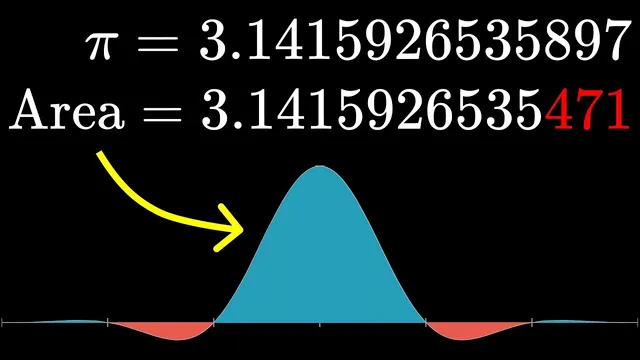
A family of integrals built from the “engineer sinc” function— —keeps landing exactly on for a surprisingly long run, even after repeatedly multiplying in more stretched sinc factors. The catch is that the equality eventually fails, but only after a threshold: with the classic Borwein-style sequence it holds until a specific odd stretch factor (15), and with an added term it holds until much later (113). The size of the eventual drop is so tiny that it can look like a numerical glitch—until the exact arithmetic reveals it’s a real, structured phenomenon.
The integrals start with the signed area under from to , which equals . Then the sequence multiplies in additional sinc terms, each time stretching the argument by an odd number: first , then , and so on. Intuition suggests the area should shrink because each factor is less than 1 away from , yet the area stubbornly stays for many steps. When it finally breaks, the exact value is a fraction of with an astronomically large numerator and denominator, ruling out floating-point error.
This behavior traces back to a paper by Jonathan Borwein and David Borwein, who noted that a colleague using a computer algebra system dismissed the pattern as a bug. It wasn’t. The integrals remain exactly as long as a related “budget” stays under control; once the budget is exceeded, the value slips below by a barely perceptible amount.
To make that budget concrete, the video builds an analogy using moving averages of a step function. Start with a rectangle (a “rect” function) that equals 1 on and 0 outside. Each new function is formed by averaging the previous one over a shrinking window whose width is an odd reciprocal (). At , the output stays exactly 1 as long as the averaging window fits entirely inside the plateau where the function equals 1. The plateau shrinks by the window width each round; the first time the window becomes wider than the remaining plateau, the value at drops slightly below 1.
The “break index” matches the integral’s break index because the plateau survives until the sum of the odd reciprocals exceeds the initial plateau length. For the -length plateau, the threshold occurs at , while for a longer plateau (length 2, corresponding to the extra factor) the threshold is delayed until . The same mechanism—plateau erosion under repeated averaging—explains why the integral stays locked to for so long, then finally slips.
The final bridge between the two worlds comes from Fourier transforms and the convolution theorem. The sinc/rect relationship under Fourier transform turns “integral of sinc products” into “repeated averaging” in a dual domain. In that language, multiplying sinc factors corresponds to convolving (i.e., averaging) rect-shaped objects, so the integral’s stability becomes a statement about how long a rectangular plateau persists under successive windowing. The result isn’t just a curiosity: it’s a clean example of how shifting perspectives with Fourier analysis can turn a hard global quantity (an infinite signed area) into something governed by simple geometric constraints.
Cornell Notes
The Borwein-style integrals built from stay exactly equal to for many steps, even as more stretched sinc factors are multiplied in. The equality fails only when a threshold is crossed: for the basic sequence it breaks at 15, and when an extra factor is included it holds until 113. A parallel moving-average model explains the timing: start with a step (“rect”) function, repeatedly average it over windows of widths , and track the value at . The value stays at the plateau height until the cumulative window widths eat through the plateau; the break happens when the sum of the chosen reciprocals exceeds the plateau length. Fourier transforms and the convolution theorem connect this averaging picture to the sinc integral products.
Why does multiplying more sinc factors not immediately change the integral’s value away from ?
What is the moving-average analogy, and how does it predict when the value drops?
How does the “break at 15” connect to a sum of reciprocals of odd numbers?
Why does adding a factor delay the breakdown until 113?
How do Fourier transforms and the convolution theorem turn integrals into plateau/averaging behavior?
Review Questions
- In the moving-average model, what condition ensures the value at stays exactly at the plateau height after each averaging step?
- How does changing the effective plateau length (from 1 to 2) alter the index where the sequence first drops below the constant value?
- What roles do Fourier transform duality and the convolution theorem play in translating a sinc-product integral into an averaging/plateau picture?
Key Points
- 1
The Borwein sinc-product integrals equal exactly for many steps, then drop slightly below only after a specific threshold index (15 in the basic sequence, 113 when is included).
- 2
The “it must be a numerical bug” intuition fails because the eventual deviation has an exact closed-form value involving with extremely large integer numerator and denominator.
- 3
A moving-average model with a rect (step) function predicts the same breakpoints: the value at the center stays constant until shrinking averaging windows erode the plateau.
- 4
The break occurs when the sum of the selected odd reciprocal window widths exceeds the plateau length (1 for the basic setup, 2 for the modified setup).
- 5
Fourier transforms connect sinc and rect functions, turning integrals of sinc products into evaluations tied to rect-shaped objects.
- 6
The convolution theorem provides the mechanism: multiplying sinc factors corresponds to convolving/averaging rect functions, making the plateau-erosion explanation mathematically precise.