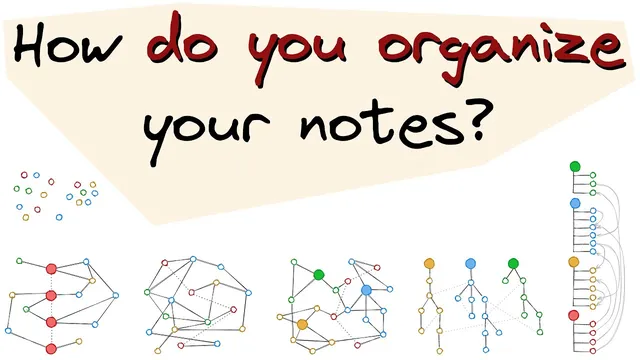
Rethinking my PKM part 5: How do you organize your notes?
Based on Zsolt's Visual Personal Knowledge Management's video on YouTube. If you like this content, support the original creators by watching, liking and subscribing to their content.
Note organization is a fit problem: the same ingredients (tags, pages, links, tasks, sketches) can be arranged into different systems that work for different minds and workflows.
Briefing
Note organization in personal knowledge management isn’t a search for a “best” system so much as a match between how someone thinks, how they want to act, and the habits they’re willing to maintain. The core idea is that note-taking has building blocks—tags, folders, block references, headings, text, pages, links, tasks, sketches—and the real question is how those ingredients should be arranged into a workflow that supports the person’s evolving needs. Over time, preferences and methods shift; the system that works today may feel wrong a few years from now.
The transcript lays out five distinct organization approaches, each with a different center of gravity. The “random mess” approach relies on minimal structure—post-it notes scattered everywhere, or a mailbox handled through keyword tagging and search rather than folders and tags. It can work surprisingly well when retrieval is fast and the user trusts search, but it’s also a reminder that organization can be informal and still functional.
A more structured alternative is “daily notes first,” where the daily page is the backbone. Tools like Rome Research encourage starting from an empty daily page, and the method leans on chronology: people often remember when and where something happened more reliably than the event itself. That temporal anchor then becomes the navigation path.
Another approach is “content first” (often implemented as atomic notes). The system creates small pages for individual topics or moments—separate notes for each meeting in a recurring series, separate pages for a book, a project task, or a hobby plan. Navigation happens through links between these atomic nodes, with a daily notes page optionally acting as an entry point.
“Topic first” shifts the starting point again: instead of building from days or individual atoms, it begins with larger index or map pages—quick capture pages for each research area, or “12 favorite problems” style hubs. A special case is Zettelkasten (slip box), where permanent notes accumulate and link laterally as research advances, forming a network of cross-references across the same topic.
Finally, “action first” organizes notes around what they’ll be used for next. Thiago Forte’s PARA-style workflow is cited as an example: store information under projects if it supports a project, under areas of responsibility if it fits ongoing life domains, under resources if it’s reusable later, and otherwise into an archive (often called the “r” hive). Nick Milo’s ACCESS system is presented as a related folder-based model using Atlas, Calendar, Cards, Extras, Sources, and Spaces.
Personal experience drives the conclusion: the organizer’s own method has moved from content-first in early Brain usage, to topic-first with more structure, to daily-notes-first for meeting-heavy work. PARA didn’t stick due to friction from too many projects and folder automation issues. Zettelkasten felt compelling but too research-oriented for a non-researcher workflow, at least during a short trial. The plan going forward is a hybrid: keep daily notes for meetings, migrate other topics into a topic-first setup in Obsidian, and retry Zettelkasten by feeding it from daily notes—using research hubs like “12 favorite problems” as the permanent-node engine. The takeaway is practical: systems should evolve, and choosing an approach is less about ideology than about fit, retrieval, and the life you’re trying to support with your notes.
Cornell Notes
The transcript argues that note organization should be chosen for fit, not for “best practices” that apply to everyone. It frames notes as built from ingredients—tags, folders, pages, links, tasks, sketches—and then compares five ways to arrange those ingredients: random mess, daily notes first, content/atomic notes first, topic first (including Zettelkasten), and action/context-centric organization (PARA/ACCESS). A key theme is evolution: the organizer’s preferences changed every few years, and systems that worked briefly later failed due to friction or mismatched goals. The practical conclusion is to reflect on how you retrieve information and what you want notes to do next, then adapt your structure as your workflow changes.
Why does the transcript treat note organization as personal rather than universal?
What makes “daily notes first” compelling, and when does it break down?
How does “content first” (atomic notes) change navigation compared with daily notes?
What is the difference between “topic first” and Zettelkasten, and why does it matter?
What does “action first” optimize for, and how do PARA and ACCESS illustrate it?
How did the organizer’s own workflow changes lead to a hybrid plan?
Review Questions
- Which retrieval cues do you rely on most—dates, topics, actions, or search keywords—and which organization approach best matches that pattern?
- If you had to pick one “backbone” page type (daily page, topic hub, atomic node network, or action folders), what would it be and why?
- What friction points have caused past note systems to fail for you (too many projects, too much linking work, weak retrieval, or unclear permanence)?
Key Points
- 1
Note organization is a fit problem: the same ingredients (tags, pages, links, tasks, sketches) can be arranged into different systems that work for different minds and workflows.
- 2
Daily notes first works especially well when chronology and location/context are the strongest retrieval anchors, such as meeting-heavy work.
- 3
Content-first/atomic notes shift navigation toward links between small, topic-specific pages rather than relying on dates.
- 4
Topic-first builds from index or map pages (including Zettelkasten’s permanent-note network), which can be powerful but may feel too research-oriented without ongoing “permanent” threads.
- 5
Action-first optimizes for next use by routing new information into projects, areas, resources, or an archive (PARA) and similar structures (ACCESS).
- 6
Personal note-taking methods tend to evolve; systems that worked briefly may later fail due to friction or mismatched goals.
- 7
A hybrid strategy can preserve what’s working (e.g., daily notes for meetings) while moving other content into a structure better aligned with longer-term needs (topic hubs and permanent nodes).