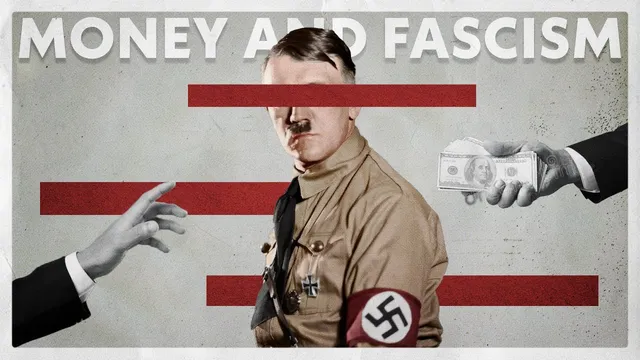
Rich People Want Fascism
Based on Second Thought's video on YouTube. If you like this content, support the original creators by watching, liking and subscribing to their content.
The transcript frames fascism as a profit-protection strategy implemented through austerity and repression when labor movements threaten capitalism.
Briefing
The central claim is that fascism has repeatedly served as a tool for protecting capitalist profits—so liberals’ cooperation with far-right power is portrayed not as a reluctant detour, but as a recurring strategy that becomes visible when workers threaten the existing economic order. Rather than treating fascism as an emergency response to chaos, the argument traces how austerity, repression, and technocratic economic planning were designed to roll back gains made by labor after World War I.
After World War I, many European governments abandoned aspects of free-market capitalism to mobilize production for the war effort, taking control of trade, resources, and labor markets while expanding social welfare and loosening constraints like the gold standard. That state involvement, the narrative says, made it harder to believe capitalism’s hierarchy was natural or democratic. Workers also gained leverage: with profit motives no longer the only way to get things done, labor organization surged. In Italy and Britain, strikes reached unprecedented scale—tens of millions of workdays lost in Britain in 1919 and millions in Italy in April 1919—helping drive a period often called the “red years” in Italy.
Those labor victories mattered economically and politically. The transcript argues that workers’ demands for social insurance and higher wages directly threatened the wealth concentration that benefited a tiny capitalist class. In Italy, only about 1.7% of people were capitalists in the early 1910s, yet they captured roughly a third of the wealth. The narrative then points to a reversal after 1922, when Mussolini’s rise is framed as the mechanism for restoring capitalist dominance.
A key turning point is placed in Brussels in 1920, where an International Financial Conference brought together economists, bankers, and treasury officials with little worker representation. The account depicts these wealthy technocrats as alarmed that postwar reforms were improving ordinary lives and eroding business profits. Their response, as described, was to engineer a new dictatorship that could punish workers while presenting the outcome as “objective necessity.” The policy package is identified as austerity—cutting social spending, shifting taxes toward consumption (like VAT) while lowering taxes on income and wealth, raising interest rates, privatizing state assets, deregulating labor protections, and union-busting.
The transcript links this technocratic program to both far-right and liberal economists, naming Clara Mate’s work (Capital Order) as the source for the claim that fascism began as a technocratic project. Mussolini is portrayed as the political vehicle willing to carry out the repression needed to implement these economic theories, including massacres of communists and unionists and attacks on labor organizations. Under fascism, unions were crushed and wages fell dramatically—by 1946 back to levels comparable to 1911—while liberal publications are described as whitewashing or applauding the repression.
The same pattern is extended to Germany: after the Wall Street crash and austerity politics, Hitler is framed as arriving when ruling elites needed protection for profits and feared workers would move toward communism. Under Nazi rule, collective bargaining and unions were outlawed, socialist and union activity was criminalized, and persecution expanded to many targeted groups.
The concluding thesis is blunt: liberals are not portrayed as being forced into fascism. Instead, fascism is depicted as a means to an end—tolerated or enabled when labor is manageable, then intensified when democratic hope grows. The transcript argues that the violence and repression are treated as a “price” that benefits elites while shifting suffering onto workers and marginalized communities.
Cornell Notes
The transcript argues that fascism functioned as a technocratic and economic project designed to protect capitalist profits when labor movements threatened them. After World War I, state intervention and worker organizing produced major gains in wages and workplace power, especially during Italy’s “red years.” In response, elites convened in places like Brussels (1920) and pursued austerity—cutting social spending, raising taxes on workers, increasing interest rates, privatizing assets, and crushing unions—to restore business dominance. Mussolini is portrayed as the political instrument that enabled these policies through mass repression, and the same logic is extended to Nazi Germany. The takeaway is that liberals are depicted as enabling fascism when it serves their economic interests, not as being coerced into it by circumstances.
What post–World War I conditions made worker gains possible, according to the transcript?
How does the transcript connect Brussels (1920) to the rise of fascism?
What austerity tools are listed as part of the plan to restore capitalist power?
Why does the transcript claim fascism was not primarily a mass-popular project?
How is Mussolini portrayed as enabling the economic agenda?
What is the transcript’s final claim about liberals and fascism?
Review Questions
- According to the transcript, what specific economic and political changes after World War I made labor organizing more effective?
- Which austerity components (fiscal, monetary, industrial) are described as restoring capitalist dominance, and how are they linked to repression?
- How does the transcript use Clara Mate’s framework to argue that fascism was technocratic rather than purely popular?
Key Points
- 1
The transcript frames fascism as a profit-protection strategy implemented through austerity and repression when labor movements threaten capitalism.
- 2
World War I-era state control of production and labor is presented as undermining the idea that capitalism’s hierarchy is natural or democratic.
- 3
Worker strikes and organizing after the war are described as producing major wage gains and workplace power, especially in Italy and Britain.
- 4
A Brussels conference in 1920 is used to connect elite technocratic planning to a later push for austerity and dictatorship.
- 5
Austerity is broken down into fiscal cuts to social spending, regressive tax shifts (including VAT), higher interest rates, privatization, deregulation, and union-busting.
- 6
Mussolini is portrayed as the political instrument that enabled technocrats’ economic agenda through mass violence against communists and unionists.
- 7
The conclusion argues liberals enable fascism when it benefits them, then intensify repression when democratic or socialist alternatives gain momentum.