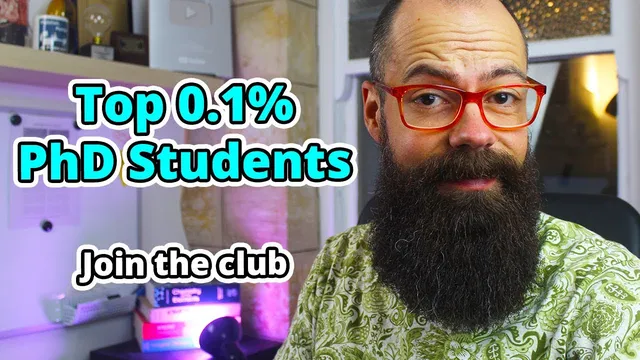
Rise to the Top: The Habits and Mindset of Top 0.1% PhD Students.
Based on Andy Stapleton's video on YouTube. If you like this content, support the original creators by watching, liking and subscribing to their content.
Treat “top 0.1%” as a first-author publication volume goal, supported by meaningful contribution reflected in author order.
Briefing
Breaking into the top 0.1% of PhD students is framed less as a mystery of talent and more as a numbers-and-system game: maximize first-author, peer-reviewed publications while building the conditions that make high output sustainable. The core benchmark is “as many first author peer-reviewed publications as possible,” with additional credit for being positioned in the author list where meaningful contribution is recognized. In this view, the author order signals who did the majority of the work and who is effectively steering the project—especially the corresponding author, who often becomes the main contact for questions about the paper.
The push for volume comes with a quality constraint: publishing can’t be random or in predatory venues that “will take you.” Instead, the strategy is to rely on quality control and aim for reputable journals, ideally Q1. For the rare “top of the top” outcome—Nature, Science, or PNAS—one standout paper can “make” a career for a long time. But most students will land somewhere in the middle, so the practical approach is to publish consistently across a range of reputable journals rather than waiting for perfection.
A major lever is choosing the right supervisor and field-specific publishing environment early. The recommended filter is a supervisor with a demonstrated publication record—checked via Google Scholar—and a history of frequent papers, ideally with a steady stream of recent output. The goal is momentum: being pulled into an established publication pipeline rather than trying to build one from scratch.
Another early move is developing a “go-to” skill that others in the department need but don’t want to do themselves. The transcript gives examples like Atomic Force microscopy, but the principle is broader: become the person who can deliver a valuable analysis, tool, or workflow (data analysis, searching, specific software). Once that skill becomes essential, authorship can follow with relatively little extra work, because the student is contributing a bottleneck resource that others depend on.
To keep publication output high, the strategy emphasizes short, publishable experiments—especially in fields where rapid cycles are feasible. The suggested workflow is to plan small experiments, run them quickly, analyze them, and then submit. If the paper doesn’t land immediately in the highest target journal, it can be “bounced” down a journal ranking list until it finds a home. The transcript also warns against being overly precious about quality at submission time: submit something “good enough,” incorporate reviewer feedback, and resubmit or redirect to another journal. The underlying logic is that repeated peer-review cycles improve the work while maintaining a steady publishing rhythm.
Finally, visibility is treated as part of the career equation. The top 0.1% student should be seen locally and within their field through awards—both university/department awards and obscure industry or society awards. The transcript describes tactics for getting nominated (approaching someone in the department, providing a ready-made achievements list, even drafting parts of applications). Awards may also come with money, which is framed as additional research income. Put together—first-author publishing, supervisor momentum, a department-needed skill, rapid publishable experiments, and award-driven visibility—forms the blueprint for reaching the top tier.
Cornell Notes
The transcript frames “top 0.1% PhD” performance as a repeatable publishing strategy: accumulate many first-author, peer-reviewed papers while staying inside reputable journal ecosystems (especially Q1). It argues that output depends heavily on structural advantages—choosing a supervisor with a strong publication track record and building an early “go-to” skill that others in the department need (e.g., Atomic Force microscopy or a key analysis/tool). For publication mechanics, it recommends short, publishable experiments and a submission approach that prioritizes momentum: submit good-enough work, use reviewer feedback, and resubmit or redirect to other journals rather than waiting for perfection. It also adds a visibility layer through awards, including obscure industry or society awards, sometimes requiring nomination.
What does “top 0.1%” mean in practical terms, and how is author order interpreted?
Why does supervisor choice matter so much, and how can it be checked early?
How does building a “go-to” skill translate into more papers with less extra work?
What submission strategy is recommended for maintaining high publication volume?
How should a student balance quality with speed during peer review?
What role do awards and publicity play in reaching the top tier?
Review Questions
- How does the transcript connect author order (first author vs corresponding author) to responsibility and career impact?
- What early actions are recommended to create publication momentum, and why are they linked to supervisor choice and “go-to” skills?
- What is the recommended approach to journal targeting and peer review when the highest target journal doesn’t accept the first submission?
Key Points
- 1
Treat “top 0.1%” as a first-author publication volume goal, supported by meaningful contribution reflected in author order.
- 2
Choose a supervisor with a strong, recent publication record; verify it using Google Scholar and recent output trends.
- 3
Build an early department-needed “go-to” skill (e.g., Atomic Force microscopy, data analysis, software/tool expertise) to earn authorship efficiently.
- 4
Plan short, publishable experiments that can generate multiple papers on a fast cycle, then maintain an overarching thesis umbrella.
- 5
Target reputable journals, prioritize Q1, and use journal ranking lists to submit and redirect until the work finds the right fit.
- 6
Submit work that is “good enough” to start the peer-review process, then iterate based on reviewer feedback rather than waiting for perfection.
- 7
Pursue awards and nominations to increase visibility; provide nominators with ready-to-use achievement summaries and look for awards that may include funding.