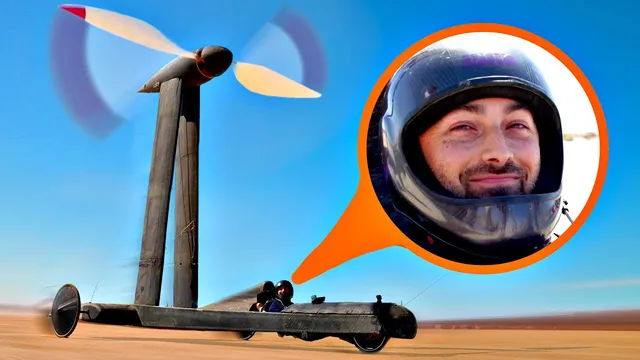
Risking My Life To Settle A Physics Debate
Based on Veritasium's video on YouTube. If you like this content, support the original creators by watching, liking and subscribing to their content.
Blackbird demonstrated straight downwind ground speed exceeding true wind speed, verified by telltale-string apparent wind behavior alongside a windsock.
Briefing
A custom propeller craft called Blackbird hit the core milestone of a long-running physics brainteaser: it can drive straight downwind faster than the wind itself. The ride was risky enough that the inventor and crew debated whether the shaking and wobble were safe, but the telltale string and windsock alignment during the final run showed the vehicle moving with an apparent headwind—evidence that its ground speed exceeded the true wind speed.
The debate began with a simple sailboat thought experiment. A boat sailing directly downwind can accelerate only until it matches the wind’s speed; at that point, the air and boat move together, leaving no “apparent wind” to keep pushing the sail. That reasoning makes it seem impossible to exceed the wind while staying pointed straight downwind. Blackbird’s claim challenged that intuition, and the team treated it like a wager against conservation-of-energy skepticism.
After hours at El Mirage—an arid dry lakebed known for shifting conditions—wind finally arrived in usable bursts. The craft’s downwind alignment relied on a telltale string on the front: when Blackbird reached wind speed, the string would hang straight down, indicating near-zero apparent wind. During earlier attempts, the telltale suggested the craft was hovering around roughly five to six miles per hour, close to wind speed but not enough to break past it. The difference came down to needing a little more wind—just a few extra miles per hour.
The vehicle’s mechanics also undercut the “windmill” picture people expected. The propeller doesn’t spin because the wind is simply pushing it like a rotor that passively harvests airflow. Instead, the wind pushes the bluff body forward slightly; that motion turns wheels, and the drivetrain spins the propeller in a direction that behaves like a fan pushing air backward. That fan action provides thrust even when the craft is moving quickly.
The team’s biggest practical hurdle was vibration. On a later run, the propeller looked unbalanced and the craft shook enough to worry about structural failure. The inventor ultimately took the driver’s seat first, then allowed the test rider to try once conditions and shaking were judged manageable. In the final, last-chance run as the sun set, Blackbird accelerated until the telltale flipped to point straight back—signaling apparent headwind—while the windsock confirmed the true wind direction was behind the craft. The result: Blackbird demonstrated downwind ground speeds exceeding the wind.
A key explanation followed: the propeller can still push air backward because the air behind it is slowed relative to the surrounding flow. In a ground-based frame, the craft can be moving faster than the wind while extracting energy from the wind by reducing the tailwind speed in the wake of the propeller. The team also reported prior performance reaching up to 2.8 times the wind speed, reinforcing that the effect is not a one-off anomaly. The takeaway wasn’t magic—just a counterintuitive energy transfer that depends on relative motion between the craft, the air, and the wake behind the propeller.
Cornell Notes
Blackbird was built to test whether a vehicle can go straight downwind faster than the wind. A sailboat thought experiment suggests that once a craft matches wind speed, apparent wind disappears and acceleration should stop, so exceeding the wind seems impossible. The ride at El Mirage used a telltale string and a windsock to verify direction and apparent wind: during the successful run, the telltale pointed back (apparent headwind) while the windsock showed true wind behind the craft, indicating ground speed above wind speed. The drivetrain matters: wind pushes the craft forward, wheels spin the propeller like a fan, and the propeller slows the tailwind in its wake, converting wind energy into the cart’s kinetic energy. The team previously reported reaching up to 2.8× wind speed.
Why can’t a sailboat going directly downwind simply keep accelerating forever?
What signals did the Blackbird team use to determine whether the craft was at wind speed or faster?
How does Blackbird’s propulsion differ from a “windmill” interpretation?
Where does the energy come from if the craft is moving faster than the wind?
Why did vibration and wobble become a safety concern during the test runs?
What was the outcome of the final attempt?
Review Questions
- How does the telltale string’s orientation relate to apparent wind, and why does that matter for determining whether Blackbird exceeded wind speed?
- Explain why a sailboat pointed directly downwind cannot exceed wind speed using the concept of apparent wind.
- Describe how Blackbird’s drivetrain turns wind push into propeller thrust, and why the propeller can still generate thrust when the craft is faster than the wind.
Key Points
- 1
Blackbird demonstrated straight downwind ground speed exceeding true wind speed, verified by telltale-string apparent wind behavior alongside a windsock.
- 2
A direct-downwind sailboat can accelerate only until it matches wind speed because apparent wind disappears at that point.
- 3
Blackbird’s propeller is driven through wheels and gearing rather than spinning like a simple windmill rotor.
- 4
The propeller functions like a fan, pushing air backward and producing thrust even when the craft is moving quickly.
- 5
Energy transfer comes from slowing the tailwind in the propeller’s wake, converting wind energy into the vehicle’s kinetic energy.
- 6
Safety decisions during testing depended on vibration levels and the risk of structural failure under higher wind conditions.
- 7
Reported performance includes reaching up to 2.8 times the wind speed in earlier attempts.