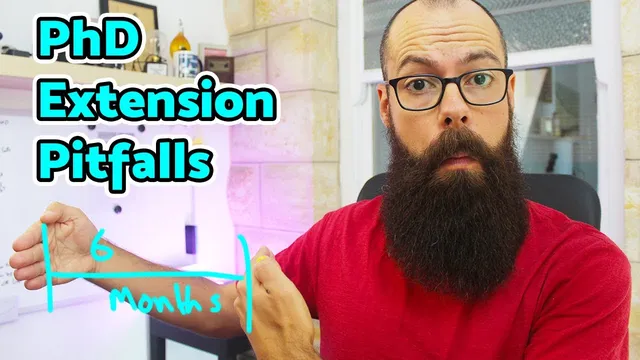
Risks and pitfalls of extending a PhD and how to avoid them
Based on Andy Stapleton's video on YouTube. If you like this content, support the original creators by watching, liking and subscribing to their content.
Treat a PhD extension as a targeted fix for a defined bottleneck, not a general delay tactic.
Briefing
Extending a PhD can be a practical way to finish “comfortably,” but it often becomes a trap when it’s used to buy time instead of solving a specific, finish-line problem. The core tradeoff is stark: rushing to the end without ramping up early creates stress and gaps, yet adding an extra six months late in the process rarely fixes a thesis that was underprepared from the start. Extensions are most defensible when they support a clear, bounded need—especially writing up—rather than when they become a default escape route from the hard work of completing the research and producing a coherent thesis.
Writing up is the most common reason people seek an extension, because the research work may be done and the remaining task is turning results into chapters, figures, and references. That phase has its own momentum problem: writing expands to fill the time available, so the extra months must be treated like a dedicated sprint. A key warning is that combining thesis writing with a near full-time job usually doesn’t work in practice; writing requires sustained focus, including figure preparation, reference cleanup, and repeated drafting. The recommended approach is a steady routine—show up consistently to write, keep the workflow tight, and use the extension only to complete the thesis deliverables.
Other reasons for extending are riskier. A poor thesis topic can force a pivot after preliminary investigations, sometimes pushing the timeline by six months to a year. That early “wasted” time is not entirely wasted—skills are built and the academic system is navigated—but it can still delay the end. When topic choice is the issue, the transcript points to Effective Thesis (effectivethesis.org) as a free, non-profit support option that helps students select topics with real-world impact and provides mentoring.
A third common justification—“just finishing up a few experiments”—is treated as especially suspicious. The transcript argues that supervisors sometimes use this rationale to extract free labor, particularly when the extension is unpaid. If the student already has enough data to defend the thesis and publish, filling minor gaps may not be worth the extra time. One example describes a student who removed an entire chapter rather than patching it, maintaining enough material for the PhD despite the supervisor’s request.
Supervision quality is another major driver of delays. The transcript describes cases where students get stuck at final hurdles because chapters aren’t reviewed, papers aren’t returned on time, or paperwork and bureaucracy are mishandled—sometimes due to supervisors struggling with administration rather than research. In those situations, an extension can be legitimate, but it must come with a plan.
Successful extension applications depend on convincing the university bureaucracy. That means submitting a timeline for the next six months, evidence that the earlier problem has been solved, and a clear explanation of what will be completed by when—whether that’s writing chapters, submitting corrections, or completing specific remaining tasks. Universities may say extensions aren’t guaranteed, but the transcript claims they’re often effectively obtainable when the department benefits from students graduating. The bottom line: extend only with a concrete finish strategy, not as a way to postpone the real work.
Cornell Notes
PhD extensions are most defensible when they solve a specific late-stage bottleneck—especially thesis write-up—rather than compensating for earlier underplanning. Writing up needs full commitment because it expands to fill available time; juggling it with a near full-time job typically undermines progress. Extensions for “a few more experiments” are often framed as unpaid extra labor requested by supervisors, so students should question whether the thesis already has enough data to finish and publish. Delays can also come from weak supervision and administrative failures (late reviews, slow paperwork), and those cases require a plan with timelines and evidence for the university. A strong extension request makes it easy for the institution to believe completion will happen within the added period.
Why is writing up the most common reason to extend a PhD, and what makes it succeed or fail?
What’s the risk of extending a PhD to “fill in gaps” with extra experiments?
How can poor topic choice lead to delays, and what’s the suggested response?
When supervision problems cause delays, what does a student need to do to justify an extension?
What makes a PhD extension application more likely to be approved?
Review Questions
- What specific conditions make a late-stage PhD extension more justified, and why is writing up treated differently from adding experiments?
- How should a student respond if a supervisor asks for extra experiments that may not be necessary for a complete thesis?
- What elements of a six-month plan and supporting evidence are most important for persuading a university to grant an extension?
Key Points
- 1
Treat a PhD extension as a targeted fix for a defined bottleneck, not a general delay tactic.
- 2
Commit fully to the write-up phase; writing expands to fill time and usually can’t be done effectively alongside near full-time work.
- 3
Be skeptical of extensions requested to “fill gaps” with extra experiments, especially when the work is unpaid and the thesis may already be sufficient.
- 4
If supervision and administration cause delays, document the problem and create a concrete plan for reviews, corrections, and paperwork.
- 5
A successful extension request makes completion easy to believe by submitting a timeline, evidence of resolved issues, and a clear letter describing the end result.
- 6
When topic choice is the issue, early pivoting matters; free mentoring resources like Effective Thesis can help align topics with real-world impact.