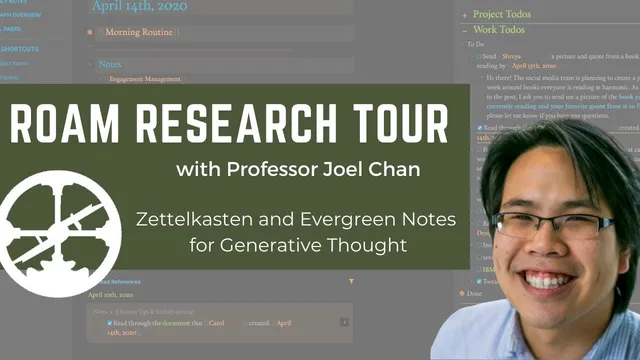
Roam Tour #1: Professor Joel Chan- Zettelkasten and Evergreen Notes for Generative Thought
Based on Robert Haisfield's video on YouTube. If you like this content, support the original creators by watching, liking and subscribing to their content.
Creative knowledge work depends on synthesis—building a structured understanding of a problem space—not just collecting sources.
Briefing
Evergreen notes in Roam aren’t just a storage habit—they’re a method for building “seeds” of synthesis that can be recombined into new problem formulations and theories. Professor Joel Chan, a cognitive psychology researcher focused on human-computer interaction and tools for assisted thinking, describes a workflow aimed at creative scholarship: first constructing a rich understanding of a problem space, then using small, reusable knowledge units to generate novel insights.
Chan’s core claim is that creative knowledge work depends on synthesis, not just collecting sources. It’s not enough to gather many papers and form a vague sense of the topic; the hard part is identifying what makes a problem worth solving, why it’s hard, what past attempts missed, and which assumptions must change. Tools for finding papers and increasing “productivity” exist, but the gap is support for the later stage—turning scattered inputs into a structured understanding that can support new thinking.
In Roam, Chan uses the original “sit beside knowledge” idea from the white paper: knowledge should accumulate as a growing repository of usable, synthesized material rather than staying trapped in silos. His most important output is a set of compact evergreen notes—often prefixed with “z:” as a namespace convention—that act like building blocks for larger theories. One example comes from drafting a paper on “requirements for a system that supports synthesis.” Instead of staying at the paragraph level, he breaks claims into smaller components and then converts key observations into evergreen notes, such as a “citation statement” style claim that can be revisited, audited, and recomposed.
The reason these notes stay concise is reusability. Chan ties compactness to atomicity: if a note is too complex, it becomes harder to recontextualize, combine, and apply elsewhere. In Roam, blocks can be remixed, but that only works if each block is self-contained and designed to be recomposed—an effort that requires discipline. He also frames note titles as “API-like” concept statements, similar to how literature reviews and review papers make claims that can be remade. Each evergreen note can include evidence (screenshots, citations, and context) so it remains meaningful when pulled into new writing.
As the collection grows, Chan expects the challenge of combining many notes and emphasizes “processing” rather than endless organization. His pipeline starts with daily notes as an inbox for raw inputs (papers, books, and ideas). Items that prove useful graduate into literature/reading notes and then into evergreen notes (“seeds”), which later feed drafts and larger theory-building pages. He rejects the idea that processing is tedious janitor work; it’s knowledge work because it turns connections into actionable understanding.
Chan also describes how he manages citations: each source paper gets its own page so the context of where a claim came from remains attached. He imports citations from Zotero via a script, using a format that preserves the paper title for quick scanning while still supporting queries. For Roam users, his advice is pragmatic: don’t over-engineer queries early, let structure grow from real pain points, and migrate gradually by following where attention and interest are actually moving. The goal isn’t a perfectly curated database—it’s generating new thought as a byproduct of disciplined synthesis.
Cornell Notes
Joel Chan uses Roam to support creative scholarship by turning sources into small, reusable evergreen notes that function as “seeds” for synthesis. The workflow starts with daily notes as an inbox, then processes promising material into literature/reading notes and finally into atomic evergreen notes (often prefixed with “z:”) that are designed to be remixed into larger theories. Chan argues that concise, self-contained notes are more reusable because they can be recontextualized and recombined without freezing ideas in one context. He also emphasizes that processing is knowledge work—returning to sources, auditing claims, and making connections—rather than mere cleanup. Gradual migration and resisting early over-optimization (like complex queries) are key to making the system work in practice.
Why does Chan treat evergreen notes as “building blocks” rather than just permanent storage?
What makes an evergreen note “atomic” in Chan’s approach, and why does that matter?
How does Chan structure note titles so they behave like something usable during writing?
What does Chan’s processing pipeline look like from raw inputs to novel thoughts?
How does Chan handle citations and why does each paper get its own page?
What advice does Chan give new Roam users about building the system?
Review Questions
- How does atomicity in Chan’s evergreen notes increase reusability, and what tradeoff does it require in practice?
- Trace Chan’s workflow from daily notes to evergreen “seeds” to larger theory drafts. Where does claim-auditing happen?
- Why does Chan prefer paper pages for citations, and how does that choice support later synthesis and verification?
Key Points
- 1
Creative knowledge work depends on synthesis—building a structured understanding of a problem space—not just collecting sources.
- 2
Evergreen notes should be designed as atomic, self-contained “seeds” that can be recombined into larger theories and problem formulations.
- 3
Concise notes improve recontextualization and recombination; overly complex notes become harder to reuse and can “freeze” ideas.
- 4
Roam’s value for synthesis comes from disciplined block design and remixing, not from storing large pages of undifferentiated material.
- 5
A practical pipeline moves from daily notes (inbox) to reading/literature notes to evergreen notes, then into drafts and higher-level theory pages.
- 6
Citations work best when each source paper has its own page so claims can be traced back for auditing and contextual understanding.
- 7
New users should migrate gradually, avoid over-engineering queries early, and let real workflow pain guide system improvements.