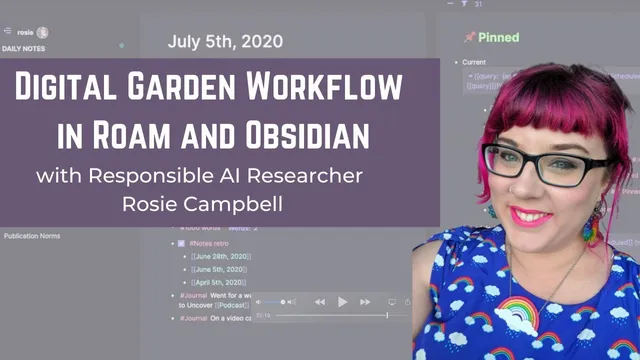
Roam Tour with Rosie Campbell- Roam and Obsidian Workflow with Digital Gardens
Based on Robert Haisfield's video on YouTube. If you like this content, support the original creators by watching, liking and subscribing to their content.
Capturing every thought in Roam’s daily pages reduces the friction that usually kills journaling habits and makes later writing easier.
Briefing
A Berkeley-based AI program lead credits a simple shift—capturing every thought immediately in Roam’s daily pages—for turning note-taking into a living system that helps her write, publish, and track how her thinking evolves. After struggling to maintain journaling and never sticking with notes in the past, she revisited Roam around December, committed to using it for a month, and then kept going once it became “indispensable.” The payoff wasn’t just organization; it was serendipity. Connections started forming faster, and the daily capture habit made it easier to find what mattered later without the usual “big export/import chore” that derails many tool migrations.
Her approach also avoids the common productivity trap of trying to dump everything into a new tool at once. Instead of wrestling with a massive backlog, she captured new material first, imported older notes gradually, and only moved content when she understood what Roam was best at. Roam became the messy, high-context workspace for interstitial journaling—short snippets tagged as they occur—while Obsidian served as the place for polished, publishable writing. That division of labor is central to her workflow: Roam is for rapid capture and block-level manipulation; Obsidian is for turning ideas into human-readable drafts.
She runs Roam tasks and notes primarily through daily pages, linking out to other pages when she needs to filter or “pull out specific things.” For publishing, she uses Obsidian vault files that also feed a personal website via blot.im, so edits can appear online immediately. She acknowledges the risk of perfectionism but mitigates it with a drafts folder: anything in the address folder gets served, while drafts stay private until moved. She’s comfortable sharing rough “stubs” because they function as public conversation starters rather than finished products.
A key theme is how Roam’s structure supports evolution over time. Instead of maintaining a single evergreen goals page that quickly becomes outdated, she tags time-specific goal sets (e.g., goals 2020) inside daily pages so she can see how priorities changed across months. She also uses date-tagged daily notes as a future-proofing mechanism, including ISO-style date formatting so her Roam history can map cleanly to Obsidian later.
The workflow isn’t without friction. She misses Roam’s database-like features in markdown land—especially transclusion-like reuse (updating one block reflected in multiple places) and Roam’s powerful filtering and query behavior. In Obsidian, she can search, but current search feels too literal, and she often ends up copying content into multiple locations. Her task system in Roam relies on pinned queries that pull relevant items into daily review, a pattern she says is hard to replicate in plain markdown without added complexity.
Overall, the conversation frames Roam and Obsidian not as competitors but as complementary tools: Roam for granular thinking, Obsidian for structured writing and publication. Her advice to newcomers is to lean hard on daily pages, watch many Roam tutorials to learn the “why” behind patterns, and experiment with exporting/importing to understand how links and structure carry over.
Cornell Notes
Roam becomes the messy capture layer for Rosie Campbell: every thought goes into daily pages, tagged as needed, and the system tracks how ideas change over time. Obsidian then acts as the polishing and publishing layer, where she turns Roam’s prompts, questions, and snippets into more formal writing. She avoids the “dump everything at once” migration problem by importing older material gradually and only when it fits Roam’s strengths. Roam’s block-level editing, filtering, and reuse-like behavior are the features she misses most when working in markdown. The workflow matters because it reduces friction for capturing ideas while preserving evolution, making later writing and retrieval easier.
Why does capturing everything in Roam’s daily pages matter more than perfect organization up front?
How does she split responsibilities between Roam and Obsidian?
What migration mistake does she try to avoid when switching tools?
How does she handle publishing when Roam/Obsidian content is automatically served online?
What Roam capabilities does she miss most when writing in markdown/Obsidian?
How does she use daily notes to preserve changing goals over time?
Review Questions
- How does the daily-pages-first approach change what she can retrieve and write later compared with maintaining a single evergreen page?
- What specific Roam features (beyond “backlinks”) does she say are hard to replicate in Obsidian, and why do they matter for her workflow?
- Describe her publishing pipeline and the role of drafts vs served folders in preventing premature publication.
Key Points
- 1
Capturing every thought in Roam’s daily pages reduces the friction that usually kills journaling habits and makes later writing easier.
- 2
She avoids “big-bang” imports by starting fresh, then importing older notes gradually once Roam’s best use cases become clear.
- 3
Roam functions as a messy, high-context workspace (interstitial journaling, tasks, tagged snippets), while Obsidian is reserved for polished, publishable drafts.
- 4
Automatic website updates can work if drafts are separated from served content; she uses a drafts folder to keep unfinished work private.
- 5
Time-tagged daily notes (including ISO-style date formatting) help preserve how thinking evolves and make future migration to other tools more feasible.
- 6
Roam’s block-level editing, filtering, and reuse-like behavior are the capabilities she most misses when working in plain markdown files.
- 7
Her workflow treats Roam and Obsidian as complementary rather than competing: one for granular thinking, the other for structured publishing.