RoamDemoJuly18
Based on Conor White-Sullivan's video on YouTube. If you like this content, support the original creators by watching, liking and subscribing to their content.
Rome aims to build a peer-to-peer map of the world’s knowledge, but it prioritizes mapping problem spaces first rather than relying on static document links.
Briefing
RoamDemoJuly18 centers on a plan to build “Rome”: a peer-to-peer map of the world’s knowledge that helps people find efficient routes through information toward the research frontier. The core claim is that such a map can’t be assembled from static, interconnected documents alone; it requires groups of people to first model their own problem spaces. That leads to a prerequisite tool—called a “personal Memex”—designed to let individuals flexibly organize concepts as they think, then reuse those organized pieces across many contexts.
The demo shows how the personal Memex works as an evolving knowledge workspace rather than a single document repository. One key feature is zooming between levels of abstraction, similar to outliners, so a user can move from a high-level view down to specific notes and back again. Another central capability is “mentions,” which allow the same idea to be referenced in multiple locations. Instead of duplicating content, the system tracks where an idea appears and lets users navigate across those references.
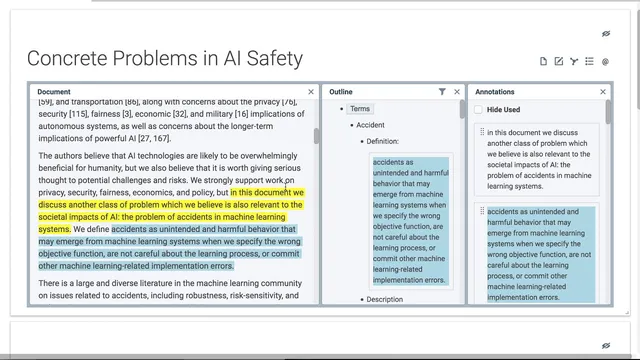
A concrete example uses a paper titled “Concrete Problems in AI Safety.” The workflow begins with document analysis: the user annotates the paper, applies filters to carve away questionable sections, and then navigates directly to relevant parts of the text. Those annotated sections can then be dragged into an outline, where they become reusable building blocks—referenced not only in the original document but also in other structures. The demo emphasizes that this supports charting a path through research papers while still allowing the user to reorganize and reuse insights as understanding changes.
The organizing philosophy is framed as “carving reality at the joints,” borrowing a quote about taking in scattered particulars under one idea, then separating the idea into parts “as nature directs” without breaking anything important. In practice, that means the system should help users aggregate potentially relevant information even when they don’t yet know the correct structure. The personal Memex therefore focuses on flexible organization: explicitly building a graph of concepts, surfacing related items, and letting users filter what’s relevant to a current question.
Graph-based organization is presented as a core feature. As the user works through an idea, they can zoom in on relevant relationships—such as items related to categories or items tied to a specific concept. The demo also illustrates how the same concept can be labeled differently depending on the user’s longer-term framing, including “single player mode” and “multiplayer mode,” with “personal Memex” and “dynamic knowledge repository” used as related labels in that roadmap.
Finally, the demo situates the tool in a larger research collaboration goal. Work with researchers aims to map problem spaces and understand what research teams need to collaborate more effectively, as the system moves toward a multiplayer mode. Feedback is solicited on the approach and features, particularly around how well the tool supports evolving, graph-based knowledge organization.
Cornell Notes
RoamDemoJuly18 presents “Rome,” a plan for a peer-to-peer map of the world’s knowledge, built to help people navigate efficiently toward research frontiers. The prerequisite is a “personal Memex,” a tool for flexibly organizing a problem space before trying to map the whole internet. The demo highlights zoomable outlines, “mentions” that let the same idea be referenced in multiple places, and document analysis with annotations and filters. Users can carve away questionable parts, navigate to relevant sections, and drag annotated content into outlines for reuse. A concept graph and relationship filters support “carving reality at the joints,” letting users aggregate scattered information without knowing the final structure upfront.
Why does the Rome project treat “problem space mapping” as a prerequisite to mapping the whole internet?
How do “mentions” change the way notes and ideas are reused across a workspace?
What does the demo’s “Concrete Problems in AI Safety” workflow demonstrate about document analysis?
What does “carving reality at the joints” mean operationally in the personal Memex design?
How does the concept graph support different kinds of exploration during research?
How is the personal Memex positioned relative to future collaboration features?
Review Questions
- What limitations of static document linking does the Rome plan try to overcome with problem-space mapping?
- How do mentions and outlines work together to support iterative research organization?
- In what ways do filters and graph zooming help a user explore a domain before knowing the final structure?
Key Points
- 1
Rome aims to build a peer-to-peer map of the world’s knowledge, but it prioritizes mapping problem spaces first rather than relying on static document links.
- 2
A personal Memex is designed as a prerequisite tool for flexibly organizing concepts while understanding is still forming.
- 3
Mentions enable the same idea to be referenced across multiple locations, supporting reuse without duplication.
- 4
Document analysis supports annotation, navigation to relevant sections, and filtering to remove questionable material.
- 5
Annotated content can be dragged into outlines, turning research paths into reusable structures.
- 6
A concept graph plus zooming and relationship filters help users focus on what’s relevant at each stage of thinking.
- 7
The long-term roadmap moves from “single player mode” toward “multiplayer mode,” informed by researcher collaboration needs.