RoB 2.0: A revised tool to assess risk of bias in randomized trials
Based on Evidence Synthesis Ireland's video on YouTube. If you like this content, support the original creators by watching, liking and subscribing to their content.
RoB 2 focuses on systematic error affecting a specific numerical outcome estimate, not on study-level “quality” or reporting completeness.
Briefing
Risk of Bias 2 (RoB 2) is a revised, more structured framework for judging bias in randomized trials—built to assess whether specific numerical results are likely affected by systematic error, not just whether a study was “well conducted.” The tool’s central shift is from broad judgments about trial quality to result-level assessments that map directly onto the mechanisms that can distort treatment effects. That matters because bias can vary across outcomes and across parts of a trial, so a single study-level label can miss the real risk to the estimate reviewers plan to use.
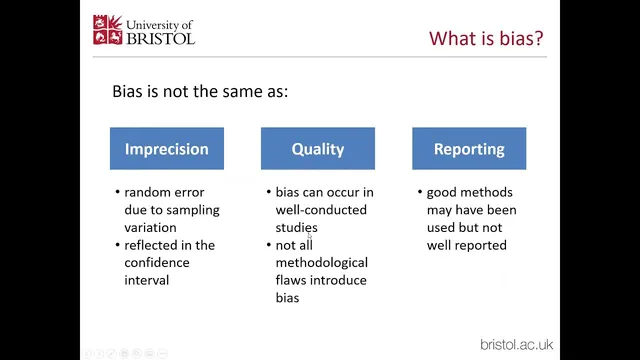
RoB 2 distinguishes bias from imprecision, reporting quality, and general study conduct. Imprecision reflects random error—often visible in wide confidence intervals—while bias reflects systematic error that can skew results. The framework also pushes back on the common conflation of “quality” with “bias.” A trial can be executed competently yet still be vulnerable to bias, such as when blinding participants and personnel is difficult (for example, in surgical trials). Likewise, poor reporting alone doesn’t automatically imply bias, since papers rarely contain exhaustive methodological detail; RoB 2 instead focuses on believability of the result.
The motivation for RoB 2 grew out of experience with the earlier RoB tool (RoB 1): inconsistent use, frequent “unclear” judgments, overly complex domains, weak fit for crossover and cluster designs, and the absence of an overall risk-of-bias judgment. RoB 2 was designed to be more comprehensive, more usable, and aligned with evolving bias science. It also aims to produce an overall risk-of-bias rating for each result, which can feed directly into sensitivity analyses.
A key design feature is that RoB 2 is “result-based.” Reviewers apply the tool to a specific numerical outcome estimate (e.g., a mean difference in depression score at 12 weeks in a cognitive behavior therapy trial), rather than to the study as a whole. The five mandatory domains correspond to major sources of systematic error: (1) bias arising from the randomization process, (2) bias due to deviations from intended interventions, (3) bias due to missing outcome data, (4) bias in measurement of the outcome, and (5) bias in selection of the reported result. Domain labels are intentionally framed around causes of bias rather than older terms like selection or performance bias.
RoB 2 uses signaling questions with structured response options (yes/probably yes/no/probably no/no information) to drive domain-level judgments of low risk, some concerns, or high risk. An algorithm then combines domain judgments into an overall rating for the specific result, with rules such as “low overall” requiring low risk across all five domains. The framework also includes preliminary steps that force reviewers to specify the study type, the comparison, the outcome, the exact numerical result, and the effect of interest.
For deviations from intended interventions (Domain 2), the tool differentiates between the effect of assignment to intervention (intention-to-treat) and the effect of adhering to intervention (per-protocol). Deviations matter differently depending on which estimand is targeted, and blinding of participants and trial personnel can change whether deviations are considered biasing. The webinar also highlighted practical implementation within Cochrane workflows, including guidance resources on riskofbias.info, visualization support via Rob Viz, and the use of RevMan Web for proper implementation. Cochrane’s rollout is planned as a managed, slow pilot focused on new reviews, with support for teams adopting RoB 2 through a pilot program and training materials.
Cornell Notes
RoB 2 is a result-based risk-of-bias tool for randomized trials that judges whether specific numerical outcome estimates are affected by systematic error. It separates bias from imprecision (random error), reporting quality, and general study conduct, emphasizing whether results are believable. The tool uses five mandatory domains—randomization, deviations from intended interventions, missing outcome data, outcome measurement, and selection of reported results—mapped to signaling questions that lead to domain judgments (low, some concerns, high) and then an overall judgment for the result. Domain 2 is especially sensitive to the estimand: deviations can matter for intention-to-treat differently than for per-protocol effects, and blinding of participants and personnel changes how deviations are interpreted. This structure aims to improve consistency and usability compared with RoB 1.
What does “result-based” mean in RoB 2, and why is it a major change from older approaches?
How does RoB 2 distinguish bias from related concepts like imprecision and study quality?
What are the five mandatory RoB 2 domains, and what do they correspond to?
How does RoB 2 handle deviations from intended interventions differently for intention-to-treat versus per-protocol effects?
What signaling-question logic drives RoB 2 judgments, and how do domain ratings become an overall rating?
What practical steps does RoB 2 require before starting the domain assessments?
Review Questions
- In RoB 2, why can a trial be “high quality” yet still receive a high risk-of-bias rating for a particular result?
- How would you decide whether Domain 2 should be assessed for the effect of assignment to intervention or the effect of adherence to intervention?
- What conditions must be met for an overall RoB 2 judgment to be “low risk of bias,” and how can “some concerns” in multiple domains lead to “high risk” overall?
Key Points
- 1
RoB 2 focuses on systematic error affecting a specific numerical outcome estimate, not on study-level “quality” or reporting completeness.
- 2
Bias is treated as distinct from imprecision (random error) and from general study conduct; blinding failures can create bias even in well-run trials.
- 3
The tool uses five mandatory domains—randomization, deviations from intended interventions, missing outcome data, outcome measurement, and selection of the reported result—with domain labels tied to bias causes.
- 4
Signaling questions with structured response options feed an algorithm to produce domain judgments (low, some concerns, high) and then an overall judgment for the result.
- 5
Domain 2 depends on the estimand: deviations can be biasing for per-protocol effects but may not bias intention-to-treat effects when deviations aren’t driven by trial context.
- 6
RoB 2 requires careful preliminary specification of study type, comparison, outcome, numerical result, and effect of interest (assignment vs adherence).
- 7
Cochrane implementation is supported through resources on riskofbias.info, visualization via Rob Viz, and proper workflow support using RevMan Web.