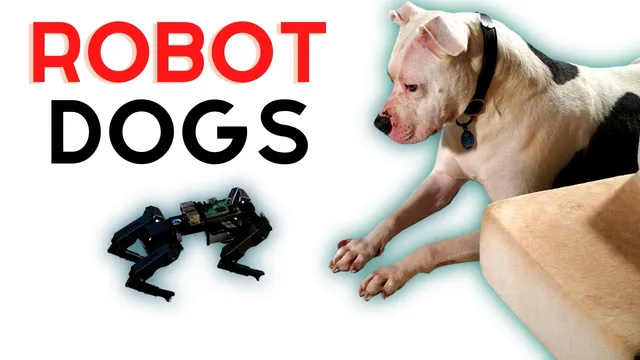
Robot Dogs: A Programmer's Best Friend
Based on sentdex's video on YouTube. If you like this content, support the original creators by watching, liking and subscribing to their content.
Quadrupeds are attractive because they bring software into the physical world, enabling rapid iteration on locomotion and autonomy.
Briefing
Quadruped “robot dogs” are drawing serious programmer attention because they turn software into something you can see, test, and iterate on in the physical world—especially in ways that cars and drones struggle to match. Unlike four-wheeled robots that can get derailed by minor surface changes, or quadcopters that are limited by short battery life and payload constraints, modern quadrupeds can handle varied terrain, cross transitions, and even climb over obstacles. The catch is that the real bottleneck isn’t hardware capability; it’s the AI and control software needed to keep a multi-legged machine stable enough to walk—and then fast enough to run, climb, or perform maneuvers.
That software barrier is also why getting started can feel expensive or slow. Spot-like systems can cost tens of thousands of dollars, and building a quadruped from scratch can take a year or more of R&D and trial-and-error. A practical on-ramp is to use an off-the-shelf quadruped with accessible control interfaces, then focus effort on gait, navigation, and higher-level behaviors rather than mechanical design.
The transcript centers on one such entry point: the Luwoo xGo Mini, a Kickstarter-backed quadruped that arrives with an app for quick Bluetooth control and an onboard AI module featuring a front camera and compute board. Out of the box, the app provides demo actions—some playful, but also useful for sparking ideas. The robot’s leg range of motion is described as surprisingly large, enabling behaviors like scratching its own back, and the creator suspects it could climb small ledges even if climbing isn’t included in the default demo set due to fall risk.
What excites the programmer most is the xGo Mini’s layered programmability through a serial protocol. At the top level, “whole body mode” accepts high-level commands such as moving forward/backward or rotating, relying on built-in gait algorithms rather than direct motor-by-motor control. For more custom actions, “single leg mode” lets users specify foot positions in XYZ coordinates, letting the robot’s internal algorithms handle the motor coordination needed to reach those targets—an approach the creator expects would be useful for stair-like climbing on the order of a few inches. At the deepest level, “individual motor control” enables experimentation with gait design itself, potentially improving speed or stability beyond the shipped walking pattern.
The transcript also details how the creator integrates a Raspberry Pi to communicate with the robot and run code. Depending on the task, commands can be sent over Wi‑Fi for live control or executed locally via saved scripts; higher-level perception and navigation could be offloaded to more powerful hardware or even a cloud machine, while time-critical gait control should run on the robot’s compute side. Finally, a concrete Python example demonstrates serial messaging: constructing packets with a prefix, message length, read/write flag, command/address bytes, a checksum computed from the packet fields, and a suffix. The example sends a whole-body forward command at a speed value (with 128 treated as “stand still”), then issues timed forward/stop/back/stop sequences—successfully making the robot move immediately after running the script.
In short, the xGo Mini is positioned as a software-first gateway into quadruped robotics: stable enough to start experimenting quickly, yet open enough—via serial protocol and multi-tier control—to support serious work on gait and autonomy.
Cornell Notes
Quadruped robots are compelling to programmers because they make control software tangible: walking, balancing, and navigation can be tested in the real world. The main challenge isn’t whether quadrupeds can move, but building the AI and control layers that keep them stable while walking, running, or climbing. The Luwoo xGo Mini is presented as a practical entry point because it supports multiple programming depths through a serial protocol: whole-body commands for navigation, single-leg XYZ control for custom maneuvers, and deeper motor-level control for gait experimentation. With a Raspberry Pi, serial packets can be generated in Python using a documented packet format (prefix/length/read-write/command/checksum/suffix), enabling immediate forward/stop/back behaviors and setting up more advanced work later.
Why are quadrupeds considered a better programming target than cars or drones for many real-world tasks?
What makes the xGo Mini more than a toy, despite having an app with demo tricks?
How do whole-body mode, single-leg mode, and motor-level control differ in what a programmer must specify?
What role does the Raspberry Pi play, and how can communication be structured?
How is the serial packet for whole-body movement constructed in the Python example?
What does the speed value mean in the whole-body forward/back command example?
Review Questions
- How does layered control (whole-body vs single-leg vs motor-level) change the programmer’s workload and the kinds of behaviors that are feasible?
- Why might a developer offload perception and navigation to external compute while keeping gait control local?
- In the serial protocol example, what fields must be correct for the robot to accept a command, and how does the checksum help detect errors?
Key Points
- 1
Quadrupeds are attractive because they bring software into the physical world, enabling rapid iteration on locomotion and autonomy.
- 2
Cars and drones often fail on minor terrain changes or have practical limits (e.g., drone battery life and payload constraints), while quadrupeds handle varied terrain more robustly.
- 3
The hardest part of quadruped robotics is not raw mechanical capability but stable, high-quality control software for walking and beyond.
- 4
The xGo Mini’s serial protocol enables a software-first approach through whole-body commands, single-leg XYZ control, and deeper motor-level access for gait experimentation.
- 5
A Raspberry Pi can serve as a control computer, sending serial commands over a mounted setup and optionally using Wi‑Fi for higher-level coordination.
- 6
Serial commands are built as structured packets (prefix/length/read-write/command/checksum/suffix), with checksum math used to validate message integrity.
- 7
A working Python example demonstrates timed whole-body movement by sending correctly formatted packets and using speed values where 128 represents standstill.