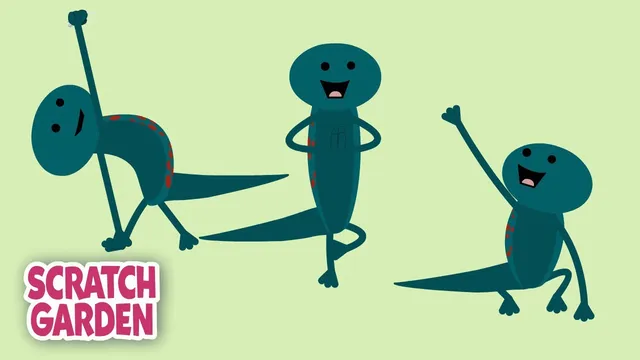
Salamander Yoga - Now with Scared Squirrels! | 5-minute Yoga Break | Scratch Garden
Based on Scratch Garden's video on YouTube. If you like this content, support the original creators by watching, liking and subscribing to their content.
The flow ties each movement to a story cue, keeping attention on calm, careful motion.
Briefing
A playful “Salamander Yoga” session turns a simple five-minute routine into a full-body story about staying calm, balancing, and helping frightened squirrels. The core idea is to treat each moment—ants, squirrels, wind, dropped “keys” and “nuts,” rain, and even a surprise apple—as a cue for specific yoga poses and controlled breathing, so kids practice focus while moving.
The practice begins with a slow outdoor walk and a crouch-down “listen” moment, then shifts into gentle, handshake-style stretches. One hand rests on the ground while the other reaches upward toward an imagined squirrel, then the routine repeats for the second squirrel. When the squirrels seem too scared, the session pivots to a “tree” variation: bodies rise, arms extend high like branches, and participants hold still to show quiet confidence. To soften the interaction, arms move away and hands come together at the chest, feet meet, and balance becomes the next challenge.
Balance work follows with a one-foot-to-leg pose, then a switch to the other side. Wind and wobbling are treated as part of the lesson—stay calm, steady, and balanced. The story then introduces “lost items” that become a functional stretch-and-reach sequence: one squirrel drops keys, prompting a hip-hinge forward bend with straight knees while one hand touches the sideways foot and the other hand “picks up” the keys and lifts them overhead. The same pattern returns for “nuts,” using the opposite side so both sides of the body get trained.
A storm changes the mood again. Participants move to hands-and-knees in a shelter-like posture—belly toward the ground, bum toward the sky—holding steady as the squirrels “arrive” to escape the rain. The routine adds a playful obstacle: an apple lands on the back. The fix is a controlled roll—pushing the back upward, letting the head come down to look at the belly—until the “apple” rolls off. After the rain stops, the session transitions to a rest on the back, then a final breathing game: a fuzzy tail on the face is “blown off” by slow inhale/exhale, watching it rise and fall.
The sequence ends with the five-minute yoga break complete, leaving participants with a compact set of movements—crouch, reach, tree balance, hip hinges, shelter pose, back roll, and breathing control—tied together by a narrative that keeps attention locked on calm, careful motion and steady breathing.
Cornell Notes
The routine uses a nature story to guide kids through a five-minute yoga flow focused on balance, gentle stretching, and breath control. It starts with crouching and reaching toward “squirrels,” then shifts to a tree pose where arms become branches and stillness matters. Balance is practiced by lifting one foot to the leg, then switching sides, while wind is treated as a reason to stay calm. Functional stretches appear when “keys” and “nuts” drop, requiring hip-hinge bends and overhead reaches on alternating sides. A storm triggers a hands-and-knees shelter pose, followed by a playful back roll for an “apple” on the back, then resting and breathing to “blow off” a fuzzy tail.
How does the session use “squirrels” to teach controlled reaching and stillness?
What balance skills are practiced, and how does the routine handle wobbling?
What do the “keys” and “nuts” sequences train physically?
How does the storm section turn into a yoga “shelter” pose and a recovery move?
What breathing technique is used at the end, and what is the goal?
Review Questions
- Which poses in the routine require holding still, and what cues are given to keep the body steady?
- How do the “keys” and “nuts” sequences differ in which side points sideways, and what stays the same about the movement?
- What changes when the storm starts, and how does the body transition from shelter pose to rest?
Key Points
- 1
The flow ties each movement to a story cue, keeping attention on calm, careful motion.
- 2
Hand-on-ground reaching and alternating stretches teach controlled upper-body extension without sudden movement.
- 3
Tree-style stillness and one-foot balance build stability, with wind treated as a reason to focus on steady breathing.
- 4
The “keys” and “nuts” sequences use a hip hinge with straight knees plus an overhead reach, alternating sides for symmetry.
- 5
A storm triggers a hands-and-knees shelter posture, emphasizing a stable, low-to-the-ground shape.
- 6
An “apple on the back” is handled with a controlled back roll to return to a belly-down/bum-up position.
- 7
The session ends with lying down and breath control—slow inhale and soft exhale—paired with a playful visual cue.