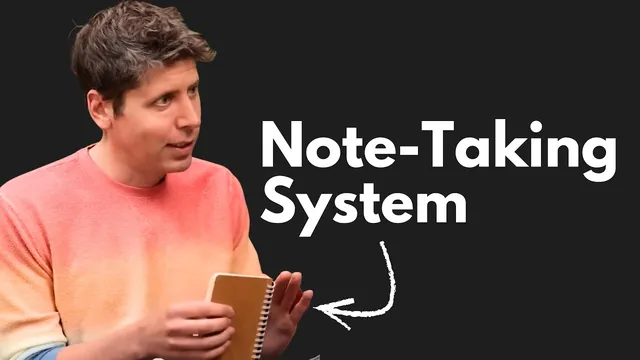
Sam Altman Changed How I Think (Not Just How I Take Notes)
Based on Greg Wheeler's video on YouTube. If you like this content, support the original creators by watching, liking and subscribing to their content.
Treat note-taking and idea systems as something to test and refine until they fit how you actually think, not as a copy-paste template from someone else.
Briefing
Sam Altman’s note-taking journey isn’t presented as a polished productivity system handed down fully formed—it’s treated as a set of thinking habits built through trial, pruning, and constant fit to real life. The central takeaway: effective systems are discovered, not pre-installed. Tools and workflows only matter insofar as they help ideas move, connect, and survive long enough to become useful.
A first principle is to stop romanticizing someone else’s setup. Altman’s process involved tinkering until the right physical notebook and pen “clicked,” rather than adopting a trendy arrangement and sticking with it. The transcript draws a parallel to David rejecting King Saul’s armor because it didn’t match his way of moving—then choosing a sling and mastering it. The practical challenge posed is to identify any “enduring” setup used mainly because it’s fashionable, and to run a small pivot quickly if it doesn’t support thinking.
Altman’s workflow also makes room for ideas to spread. Pages get ripped out so they can be laid out and viewed at once, enabling pattern-spotting and connection-making—an approach compared to the way whiteboards let thoughts scatter and then reveal trails. That same emphasis on visibility extends to a broader capture-and-harvest cycle: write freely, then harvest what earns future value while letting the rest go. The transcript uses a “100 pages down to 25” framing to stress that a workshop beats a museum—keeping only what continues to serve.
A non-negotiable constraint follows: ideas need an always-with-you net. The notebook has to fit in a pocket, because insight doesn’t wait for Wi‑Fi. Even when digital tools are used for capture (Sublime is mentioned), an offline backup in a wallet is treated as a safety measure for unexpected sparks.
The habits then shift from collecting to protecting. “Stop sinking” means staying with what works instead of chasing every new app or workflow tutorial. Writing is positioned as thinking itself: even messy notes or voice-to-text can force clarity and spark connections. Time protection matters too—Altman’s ideal is long quiet stretches, but the transcript emphasizes that even 11 minutes of peace can be enough to generate insights.
Finally, the transcript argues that creativity has modes. Altman’s generative mode leans toward writing, while David Pell is described as more voice-driven; the takeaway is to identify whether talking or writing best quiets the inner editor and then give that mode more room. The last balancing act is solitude plus conversation: solo time builds raw thinking, while conversations refine it—so schedule whichever ingredient is missing.
Taken together, the nine lessons form a single philosophy: cultivate a rich thought life by experimenting, pruning, and protecting the conditions where ideas can emerge, connect, and be carried forward—starting with what’s already available and staying in the boat when the next shiny tool appears.
Cornell Notes
Sam Altman’s note-taking approach is framed as a thinking system built through trial and pruning, not a perfect workflow adopted from someone else. The process emphasizes discovering tools that fit (right notebook and pen), giving ideas physical or visual space to spread for pattern-finding, and capturing broadly before harvesting only what earns future value. An always-with-you capture method prevents missed insights, while “stop sinking” discourages chasing every new app. Writing is treated as thinking, and protected quiet time—even 11 minutes—helps ideas surface. Finally, people should identify their generative mode (talking vs writing) and balance solitude with conversation to refine ideas.
Why does the transcript insist that systems are “discovered” rather than “pre-installed”?
How does “give your ideas space to spread” change what gets noticed?
What does “capture, harvest, and carry forward” mean in practice?
Why is having a pocket-sized capture tool treated as non-negotiable?
What does “stop sinking” warn against?
How should someone decide whether to generate ideas by talking or writing?
Review Questions
- Which part of the workflow would you test first: changing tools, changing how ideas are laid out, or changing how you harvest notes? Why?
- What evidence would convince you that your current capture method is “good enough” to stop chasing new apps?
- Do you generate more useful ideas by talking or writing—and what small scheduling change could give that mode more time this week?
Key Points
- 1
Treat note-taking and idea systems as something to test and refine until they fit how you actually think, not as a copy-paste template from someone else.
- 2
Make room for connections by spreading notes out—physically on a table or visually on a board—so patterns can emerge across multiple ideas at once.
- 3
Capture broadly, then harvest later; keep only the ideas that earn future use instead of storing everything indefinitely.
- 4
Use an always-with-you capture method (pocket notebook or equivalent) so insights aren’t lost waiting for Wi‑Fi or a specific device.
- 5
Protect quiet thinking time, even in small doses like 11 minutes, because sustained focus is where insights appear.
- 6
Stop abandoning working workflows to chase every new app; stay with what supports thinking long enough to deepen it.
- 7
Identify your generative mode (talking vs writing) and balance solitude with conversation to both create and refine ideas.