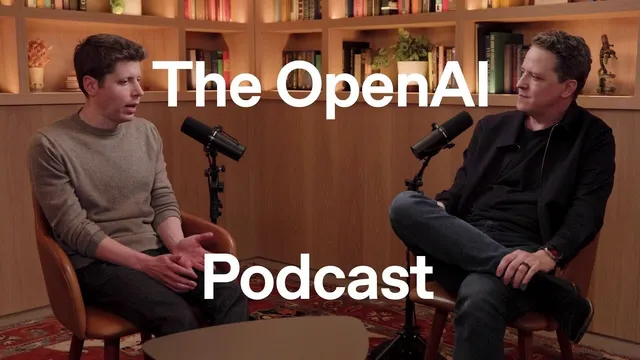
Sam Altman on AGI, GPT-5, and what’s next — the OpenAI Podcast Ep. 1
Based on OpenAI's video on YouTube. If you like this content, support the original creators by watching, liking and subscribing to their content.
Altman said GPT-5 is likely “sometime this summer,” but he emphasized that “AGI” benchmarks keep moving as models improve.
Briefing
Sam Altman pegged the next major leap in OpenAI’s model line—GPT-5—at “probably sometime this summer,” while arguing that the real milestone isn’t a fixed definition of AGI but the emergence of systems that can accelerate scientific discovery. In his framing, “AGI” keeps sliding as capabilities improve, so the more meaningful question becomes what would count as something like “superintelligence”: autonomous discovery of new science or a tool that dramatically boosts researchers’ ability to find new science. That distinction matters because it ties the pace of model progress directly to measurable human outcomes—faster breakthroughs in areas like medicine and fundamental research—rather than a single benchmark that gets outdated.
Altman also described how current AI tools are already shifting workflows in ways that feel “very AGI like,” especially when models can act on computers and gather information rather than only summarize it. He pointed to internal progress from o1 to o3 as a pattern of rapid iteration, and he cited “operator” on o3 as a personal turning point for seeing agentic behavior that doesn’t collapse when tasks get tricky. He contrasted that with earlier brittleness in agentic systems—promises of autonomy that fail the moment a problem falls outside the model’s comfort zone. Beyond internal benchmarks, he highlighted real-world adoption signals: ChatGPT’s classroom use can improve learning when paired with strong teaching and curriculum, while relying on it as a solitary homework crutch can encourage shallow copying.
A major theme was infrastructure and compute. Altman said Project Stargate is designed to finance and build an unprecedented amount of compute—he characterized it as a gap between what AI can do today and what it could do with 10x, and someday 100x more compute. He described Stargate as a global effort to coordinate capital, technology, and operations, with large-scale sites already under construction, including a first site in Abilene representing about 10% of initial commitments. The scale is so large—he referenced a figure around $500 billion—that it’s less about “having the money in the bank” and more about deploying it over the next few years, assuming the hardware can be built.
Altman connected compute constraints to the broader product roadmap: memory features are becoming central because they let models hold context about a user’s life, and he called it one of his favorite recent ChatGPT capabilities. He also addressed privacy and monetization pressures. On privacy, he said OpenAI would fight a New York Times request to preserve consumer ChatGPT records beyond a 30-day window, calling it an overreach and arguing privacy must be a core principle for AI systems handling sensitive conversations. On ads, he said OpenAI hasn’t launched an advertising product yet and warned that altering the LLM output in exchange for revenue would be trust-destroying; any future approach would need to keep the response stream uncompromised.
Finally, Altman discussed hardware and interaction design. He said OpenAI is exploring new devices because today’s computers were built for a world without AI, and he expects the interface to become more context-aware and less dependent on typing. He suggested a future where an AI can sit through meetings, understand what can be shared, and then handle follow-ups—while noting that a consumer-ready device is “gonna be a while.” He closed with practical advice for adults: learn to use AI tools in your role, and build resilience, adaptability, and creativity—skills that remain valuable even as AI capabilities expand.
Cornell Notes
Sam Altman said GPT-5 is likely “sometime this summer,” but he treated the bigger question as what it would take for AI to drive major scientific progress. He argued that “AGI” definitions keep shifting as models improve, so the more useful target is something like “superintelligence,” such as autonomous discovery of new science or tools that greatly increase researchers’ ability to find it. He described agentic progress as moving from brittle demos toward systems that can use computers more reliably, citing internal momentum from o1 to o3 and user-reported “operator with o3” moments. He also emphasized compute as the bottleneck, pointing to Project Stargate as a plan to finance and build massive infrastructure. Privacy and trust remain key constraints, especially around data retention and any future monetization approach.
Why does Altman treat “AGI” as a moving target rather than a single milestone?
What would “superintelligence” look like in practical terms?
How did Altman characterize the shift from brittle agentic systems to more reliable ones?
What role does compute play, and what is Project Stargate meant to do?
What constraints did Altman emphasize around privacy and monetization?
How does Altman connect product features like memory to the future of AI interaction?
Review Questions
- What definition shift makes “AGI” hard to pin down, and what alternative milestone did Altman propose instead?
- Which examples did Altman use to illustrate progress toward agentic behavior, and what failure mode did he say earlier systems had?
- How did Altman argue that privacy and monetization incentives could either preserve or damage user trust?
Key Points
- 1
Altman said GPT-5 is likely “sometime this summer,” but he emphasized that “AGI” benchmarks keep moving as models improve.
- 2
He reframed the key milestone as “superintelligence,” defined by autonomous scientific discovery or tools that greatly amplify researchers’ ability to discover new science.
- 3
Agentic reliability is improving, with o3-based “operator” described as a step toward systems that can use computers without immediate brittleness.
- 4
Compute is the central bottleneck; Project Stargate aims to finance and build massive infrastructure, with large sites already under construction such as in Abilene.
- 5
Altman argued privacy must be a core principle, including fighting a New York Times request to preserve ChatGPT records beyond a 30-day window.
- 6
Any future advertising approach must avoid altering the LLM’s output based on who pays, because that would destroy user trust.
- 7
Altman said new hardware is being explored to make AI more context-aware, but consumer-ready devices are expected to take time.