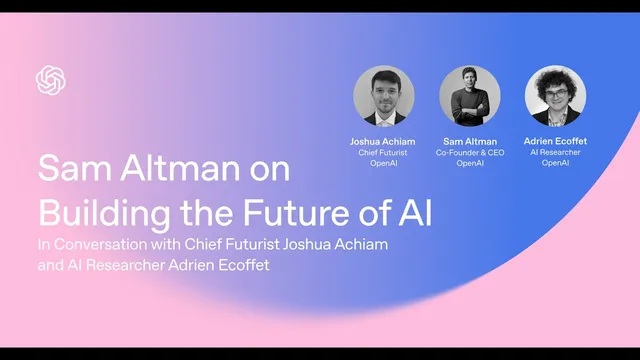
Sam Altman on Building the Future of AI
Based on OpenAI's video on YouTube. If you like this content, support the original creators by watching, liking and subscribing to their content.
Altman argues the debate and preparation window is shrinking because AI capability is accelerating and will ramp over the next few years, making early public discussion essential.
Briefing
AI progress is accelerating fast enough that society needs to debate and prepare for “extremely capable models” now—not later—because the public and political system typically needs time to digest changes before making consequential decisions. Sam Altman ties the urgency to a pipeline of increasingly powerful models over the next few years, arguing that this won’t be a one-off leap. The practical reason to start early: leaders and institutions are more likely to make better choices when they have time to discuss implications before deployment forces hard decisions.
Inside OpenAI’s blueprint work, researchers and policy-minded experts were pulled in early, and that process changed how technical staff think about risk and impact. Adrien Akafe describes the experience as humbling: researchers can hold abstract ideas about economic effects and safety, but writing concrete policy proposals for peers forces specificity. He also points to a cultural shift inside the research org—many researchers moved from writing most code themselves to having AI write much of it—creating a lived sense of speed and urgency.
The conversation contrasts the downsides with a long list of potential upsides that could arrive quickly if models keep improving. Altman frames AI as a tool that could compress a decade of scientific progress into a year, accelerate drug discovery and personalized medicine, and help design new materials for cheap, safe energy. Josh Aim emphasizes that these benefits should be treated as broadly distributable rather than reserved for the wealthy, arguing that AI and “super intelligence” could lower the cost of providing essentials—food, shelter, electricity, and healthcare—far below what society has historically assumed was affordable.
Resilience becomes the bridge between optimism and risk. Akafe argues for layered defenses: keep expanding safety evaluation and mitigations, but also plan for the reality that some actors may skip testing and that incidents can still occur. He highlights incident reporting modeled after aviation—capturing near misses in a shared database so companies can learn and adjust. Altman pushes the idea further: classical safety thinking assumed a small number of AIs and focused on aligning them; the emerging world looks more like many AIs interacting, requiring “emergent” defense across society.
Cybersecurity and biosecurity are the two major threat lanes discussed. Altman expects AI to find software vulnerabilities faster than humans can, making systems more brittle and easier to exploit. The response should include using AI to defend—starting with trusted defenders via differential access—because even if frontier models are restricted, open-source code-capable models will still enable exploitation. For bio, the blueprint logic is similar: restricting pathogen creation isn’t enough; society needs detection, rapid response, and treatment capacity, including for food supply chain risks.
Aim connects resilience to institutions and state capacity. He points to supply chains and democratic vulnerabilities as areas where AI could increase attackability, while also enabling more systematic identification and closure of weaknesses. He argues for new or expanded institutions that can prototype and scale defenses faster than government alone, and for ecosystems that make attacks too expensive to justify.
Finally, the discussion turns to economic transition and democratization. Altman and Aim describe AI as increasing individual agency—especially for small teams and startups—by lowering friction costs and enabling one-person or tiny teams to assemble businesses with AI assistance. But they also stress that prosperity and safety nets must keep pace: modernizing tax bases, expanding unemployment insurance and transition support, and exploring portable benefits. The group also argues that “democratization” has two parts: shared access to useful AI and a real voice in how it’s governed. The blueprint is offered as an early, debate-starting document, paired with a call for public feedback, fellowships, grants, and further workshops.
Cornell Notes
The central message is that AI capability is advancing quickly enough that society must start public debate and resilience planning now, before deployment forces irreversible decisions. OpenAI’s blueprint work is framed as an early set of ideas shaped by both builders and policy researchers, reflecting a lived sense of acceleration as AI increasingly writes code. The upside is substantial—faster scientific progress, better healthcare delivery, and new ways for individuals and small teams to create products and startups. The risk response requires layered, society-wide resilience: safety testing still matters, but incident reporting, stronger cybersecurity and bio defenses, and emergent coordination across institutions are needed. The economic transition also demands policy updates so benefits and protections extend beyond the wealthy and beyond traditional employer-based systems.
Why does the blueprint’s urgency matter, according to Altman?
What changed inside the research organization during the blueprint process?
What does “resilience in layers” mean in practice?
Why does Altman argue resilience must be “emergent” across society?
How does the conversation connect AI to economic transition and democratization?
What is the proposed approach to making healthcare and other care work more accessible?
Review Questions
- Which specific resilience mechanisms discussed go beyond pre-deployment safety testing, and why are they necessary?
- How do the speakers’ views on “emergent” defense differ from classical AI safety thinking?
- What policy and economic tools are proposed to ensure AI-driven prosperity and protections extend beyond traditional employer-based systems?
Key Points
- 1
Altman argues the debate and preparation window is shrinking because AI capability is accelerating and will ramp over the next few years, making early public discussion essential.
- 2
Early blueprint drafting involved researchers and policy experts together, and the process was shaped by a real internal shift toward AI-assisted coding.
- 3
The upside list is concrete: faster scientific progress, improved personalized medicine, and cheaper advances in materials and energy—alongside tools that can help people build and innovate.
- 4
Resilience is layered: safety evaluations and mitigations remain necessary, but society also needs incident reporting and defenses that assume some failures and some actors will move faster than safeguards.
- 5
Cyber defense should use AI to counter AI-enabled exploitation, with differential access for trusted defenders and stronger security practices across software ecosystems.
- 6
Biosecurity requires more than restricting model outputs; it also depends on detection, rapid response, and treatment capacity, including for food supply chain risks.
- 7
Economic transition policy is central: shared access to compute, worker participation in workplace AI decisions, and updates to taxes, benefits, and safety nets are needed to distribute gains fairly.