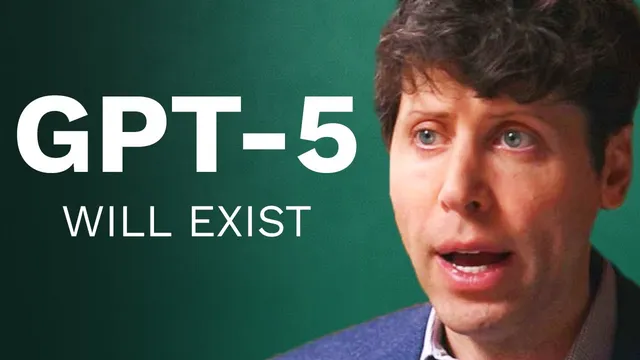
Sam Altman Talks GPT-5, AGI, ChatGPT, OpenAI...
Based on David Ondrej's video on YouTube. If you like this content, support the original creators by watching, liking and subscribing to their content.
Altman argues that the most important measure for GPT-5 and beyond is whether new generations unlock qualitatively new capabilities, not just higher scores on fixed tests.
Briefing
Sam Altman frames the GPT era as a once-in-a-lifetime scientific and technological shift—one that will be judged not by benchmark scores but by whether each new generation unlocks qualitatively new capabilities, including faster progress in discovering new science. He predicts that future GPT models (GPT-5, GPT-6, and GPT-7) will keep increasing “utility” and emerging properties, and he argues that the most meaningful milestone will be AI systems that can help humanity discover new science—potentially boosting the pace of scientific progress by orders of magnitude. In his view, this matters because technological shifts of this scale don’t arrive often, and waiting to get involved risks missing the moment when AI starts accelerating discovery rather than just automating tasks.
Altman also ties the speed of adoption to the product’s real-world usefulness. ChatGPT’s release is described as a rapid inflection point: early excitement among tech-forward users quickly turned into broader word-of-mouth, reaching a million users in about five days—far faster than Shopify’s own path to the same milestone. He credits viral growth to people actively telling others and trying it themselves, and he contrasts that with the slower, more typical adoption curve for major products.
A recurring theme is how public expectations have repeatedly missed the mark. Past predictions about AI’s trajectory—such as the idea that it would first replace physical labor, then gradually handle easier cognitive tasks, and only later (if ever) creative work—ended up reversing course. Altman uses that history to argue that the field’s “goal posts” keep moving: once models outperform expectations in one domain, skeptics adjust what counts as impressive. That pattern underpins his belief that AI could contribute to original science before advanced robotics arrive, especially because models can use code to verify claims.
The conversation also emphasizes how training data and modalities change what models can do. Altman highlights the importance of training on code, saying that learning to program improves reasoning—an effect he compares to how step-by-step work benefits people who use structured reasoning. He’s also excited about adding video to model inputs. While current systems can handle text (and, in the case of GPT-4, images), video would expand what models can learn and represent, potentially making the path to AGI faster than relying on language alone.
On risks, Altman acknowledges the seriousness of downsides but pushes for a more balanced focus on benefits. He argues that AI is delivering a rare, fundamental “toolbox reshaping” capability—bigger than the last major consumer technology shift, like the smartphone—because it increases what people can accomplish. He points to real adoption stories: doctors using AI to structure diagnoses and creatives integrating it into workflows.
Finally, Altman links optimism and “abundance” to how society integrates AI. He reflects on OpenAI’s earlier failures and dead ends before the language-model breakthrough, and he suggests that the interface itself—chat—makes powerful tools usable by children, older adults, and people who feel uncomfortable with technology. The discussion ends by stressing energy as a foundational constraint on progress, with the claim that many global problems ultimately reduce to energy—an argument that connects technological optimism to practical infrastructure choices.
Cornell Notes
Sam Altman predicts that GPT-5 and beyond will matter most for the new capabilities they unlock, not for how they score on narrow tests. He expects AI to accelerate scientific discovery—potentially increasing the rate of progress by large factors—before advanced robotics arrive. Adoption is portrayed as fast and driven by word of mouth: ChatGPT reached a million users in about five days, far quicker than typical product ramps. Altman also emphasizes that training on code improves reasoning and that adding video as an input modality could speed progress toward AGI. He argues that AI’s upside—real utility and abundance—should be discussed alongside serious risks, and he points to early real-world uses in medicine and creative work.
Why does Altman say benchmarks matter less than “emerging properties” in future GPT models?
What does the ChatGPT adoption story say about how products go viral?
How does Altman use past AI predictions to justify confidence in unexpected outcomes?
What role does training on code play in reasoning, according to the discussion?
Why is video seen as a potential acceleration step toward AGI?
What does Altman mean by “abundance,” and how does he connect it to optimism?
Review Questions
- Which distinction does Altman make between predicting benchmark performance and predicting qualitative new capabilities?
- What adoption mechanism is credited for ChatGPT’s rapid growth, and how fast did it reach a million users?
- How does the transcript connect training on code and multimodal inputs (like video) to improvements in reasoning and the path toward AGI?
Key Points
- 1
Altman argues that the most important measure for GPT-5 and beyond is whether new generations unlock qualitatively new capabilities, not just higher scores on fixed tests.
- 2
ChatGPT’s growth is attributed to word of mouth: excitement among early adopters quickly spread to people outside tech circles, reaching a million users in about five days.
- 3
Public expectations about AI have repeatedly failed, and that history supports the idea that AI progress will keep surprising people as “goal posts” shift.
- 4
Training on code is presented as a direct driver of better reasoning, because it teaches how computers interpret and process structured instructions.
- 5
Adding video as a model input is framed as a likely acceleration step toward AGI, since video can represent information more naturally than text alone.
- 6
Altman emphasizes balancing risk discussions with benefits, pointing to real-world uses in medicine and creative work as evidence of practical utility.
- 7
Energy is treated as a foundational constraint on progress, with many global problems linked back to energy availability and infrastructure choices.