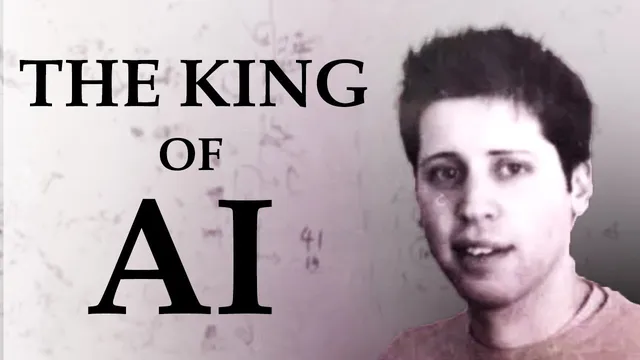
Sam Altman - The Man Who Owns Silicon Valley
Based on David Ondrej's video on YouTube. If you like this content, support the original creators by watching, liking and subscribing to their content.
Altman’s influence is portrayed as coming from a founder-first, high-agency approach: leaving unproductive paths early and building systems that find and fund ambitious founders.
Briefing
Sam Altman’s rise—from a Stanford dropout who co-founded a location-based app—to leading OpenAI and shaping the direction of modern AI—hinges on one through-line: an unusually aggressive, founder-first approach to risk, hiring, and timing. His influence matters because the companies and models he helped build (and the investment pipeline he ran) now sit at the center of how technology is moving, from language generation to image creation and the consumer chatbot boom.
Altman’s early pattern was to bet on momentum. He entered Stanford, but left at 19 after deciding the path wasn’t right, then co-founded Loopt, a mobile app that connected users by location. Loopt drew attention from Paul Graham of Y Combinator, leading to funding and rapid early traction; it later reached a $175 million valuation before being sold for $43 million. After a brief stint as a venture capitalist—where he reportedly found the work less thrilling than building—Graham brought him into Y Combinator as a partner, then promoted him to president. Under Altman, Y Combinator shifted toward a more open interview process: anyone with an idea could apply, resulting in more than 40,000 applications per year. The strategy helped scale YC’s portfolio to a combined valuation above $100 billion, and it earned admiration even from competitors, including Marc Andreessen.
Altman’s next leap was AI. In 2014, he identified artificial intelligence as the next major wave and pushed to “go all in,” teaming up with Elon Musk to start OpenAI. The early obstacle wasn’t just research—it was talent concentration and capital. With much of the best AI engineering talent concentrated at Google, OpenAI recruited aggressively, reportedly hiring nine of the top ten researchers it targeted by offering strong compensation. Funding also proved difficult because OpenAI began as a non-profit; Musk’s promised $1 billion helped, but disagreements led to Musk leaving in 2018. That year became a turning point: Altman sought Microsoft’s help, meeting with CEO Satya Nadella and securing a strategic partnership that effectively changed OpenAI’s financial structure.
Once Microsoft-backed, OpenAI’s product cadence accelerated. GPT-1 was described as competent but not transformative; GPT-2 improved sharply and impressed major AI figures like Geoffrey Hinton. GPT-3 expanded capabilities to text generation, summarization, and translation, while DALL·E demonstrated image generation across styles. The biggest inflection came with ChatGPT, built by putting GPT-3 into a simple chatbot interface—an approach that many engineers initially resisted. ChatGPT’s adoption was portrayed as explosive, reaching 100 million users in under two months.
The transcript also frames Altman’s leadership as inseparable from risk management. It highlights his belief that AI could reduce suffering and expand abundance, but it flags two existential concerns: job displacement and, more critically, alignment—ensuring AI systems share human goals. The story ends with OpenAI’s continued escalation, including GPT-4’s strong performance on medical licensing exams, and the claim that Altman is still pushing for what comes next.
Cornell Notes
Sam Altman’s power in Silicon Valley is portrayed as the result of a consistent playbook: bet early, prioritize founders, hire top talent, and move fast when the timing is right. After dropping out of Stanford at 19, he co-founded Loopt, later sold it, and then helped scale Y Combinator by opening up access to interviews—driving massive application volume and portfolio growth. In 2014 he pivoted to AI, co-founding OpenAI and recruiting elite researchers while navigating funding constraints that followed OpenAI’s non-profit structure. After Musk left in 2018, Altman secured Microsoft’s partnership, enabling rapid model releases culminating in ChatGPT’s explosive adoption. The transcript ties Altman’s influence to the central stakes of AI: benefits like reduced suffering, alongside urgent risks such as job disruption and alignment.
What early decisions set up Altman’s later influence in tech and AI?
How did Altman change Y Combinator’s approach, and why did it matter?
What were OpenAI’s biggest early constraints, and how were they handled?
What product milestones are used to show OpenAI’s acceleration?
Why is alignment presented as the most serious AI risk?
How does the transcript connect Altman’s leadership style to outcomes?
Review Questions
- Which specific YC policy change is credited with dramatically increasing application volume, and what outcome does the transcript tie to it?
- What sequence of OpenAI model/product releases is used to justify the claim that ChatGPT was the decisive breakthrough?
- How does the transcript distinguish job displacement from alignment as an AI risk, and what does it say alignment requires?
Key Points
- 1
Altman’s influence is portrayed as coming from a founder-first, high-agency approach: leaving unproductive paths early and building systems that find and fund ambitious founders.
- 2
At Y Combinator, opening interviews to anyone with an idea drove massive application volume (over 40,000 per year) and helped scale YC’s portfolio valuation.
- 3
OpenAI’s early bottlenecks were talent concentration and non-profit funding constraints, which were addressed through aggressive recruiting and later a Microsoft partnership.
- 4
The transcript frames OpenAI’s product momentum as a stepwise leap from GPT-1 to GPT-2 and GPT-3, then to multimodal capabilities with DALL·E, culminating in ChatGPT’s consumer adoption.
- 5
ChatGPT’s success is attributed to turning GPT-3 into a simple chatbot interface, despite internal resistance to building a mass-market product.
- 6
The biggest existential concern highlighted is alignment—ensuring AI goals match human goals—because misalignment could threaten humanity.
- 7
The transcript pairs optimism about AI reducing suffering with warnings about near-term disruption, especially job displacement.