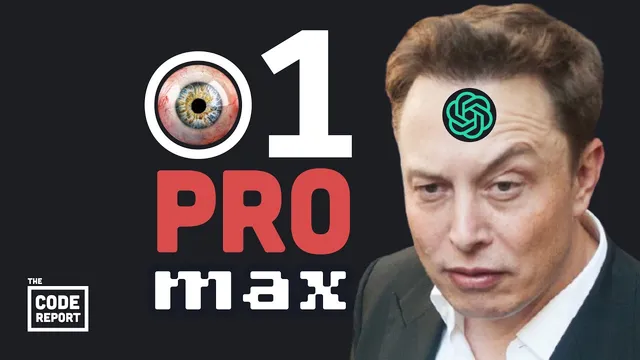
Sam Altman's new $200 ChatGPT has a big Elon problem...
Based on Fireship's video on YouTube. If you like this content, support the original creators by watching, liking and subscribing to their content.
ChatGPT Pro Max costs $200 per month and is positioned for power users, primarily by removing o1 message limits and adding “Pro mode.”
Briefing
OpenAI’s latest subscription—ChatGPT Pro Max at $200 per month—signals a push to monetize “reasoning” at scale, but the business case sits on shaky ground as OpenAI’s financial strain and competitive pressure intensify. The plan targets power users with “unlimited access” to OpenAI’s new o1 model, plus a “Pro mode” meant to improve performance on coding and math benchmarks. Yet the transcript stresses that this tier doesn’t introduce brand-new model capabilities beyond what existing $20-plus subscribers already get; it mainly removes message limits and adds higher-end tuning for o1.
The o1 model is framed as OpenAI’s reasoning workhorse: it performs well on coding and math benchmarks and can repeatedly generate reasoning tokens using a chain-of-thought style technique to tackle more complex problems. On the $20 plan, o1 access is capped at 50 messages per week, while Pro Max lifts that restriction. Early testing is described as impressive—citing an example of nearly correct spelling for a “5 app”—but the price is positioned as hard to justify for casual users.
Behind the product, the transcript argues OpenAI’s valuation depends on growth that the company may struggle to sustain. OpenAI is said to be valued around $157 billion while generating roughly $300 million per month in revenue, with billions lost annually on infrastructure and compute costs. That gap creates pressure to keep scaling subscriptions and usage. At the same time, the transcript claims OpenAI lacks a durable “moat,” pointing to competitors like Claude and Gemini that are described as comparable or better in some situations, and open models such as Llama that are “not far behind.”
Regulatory strategy also enters the picture. The transcript claims OpenAI previously tried to use government channels to gain regulatory capture and reduce competitive threats, but that approach is portrayed as arriving too late. The “big Elon problem” is then introduced as a mix of legal conflict and political leverage.
Elon Musk is described as an original OpenAI co-founder who donated more than $44 million to the nonprofit, later opposing OpenAI’s transition to a for-profit structure. The transcript highlights a rumor that Sam Altman could receive a 7% stake in OpenAI worth about $11 billion, which Musk is said to view as unfair. It also alleges that OpenAI told investors not to fund competitors like xAI, while Musk’s camp points to Altman’s controversial posts about Grok—leading to Musk’s “swindley Sam” nickname.
The transcript ties the dispute to a court injunction filed by Musk’s “Doge” effort, seeking to block OpenAI from becoming for-profit, accusing OpenAI and affiliates including Microsoft of anti-competitive practices. Altman’s response is quoted as a refusal to use political power against competitors, even while acknowledging uncertainty. The overall takeaway: OpenAI’s premium pricing and reasoning model push arrive amid financial losses, intensifying competition, and a high-stakes legal fight that could reshape its corporate future.
Cornell Notes
ChatGPT Pro Max launches at $200 per month with “unlimited access” to OpenAI’s o1 reasoning model and added “Pro mode” performance tuning for coding and math benchmarks. The transcript emphasizes that Pro Max doesn’t unlock brand-new models beyond what $20-plus subscribers already have; it mainly removes o1’s weekly message cap (50 messages/week on Plus) and boosts results via Pro mode. Financially, OpenAI faces a mismatch between a ~$157B valuation and relatively modest monthly revenue (~$300M), alongside billions in annual compute losses, increasing pressure for sustained growth. Competitive headwinds are portrayed as real, with Claude, Gemini, and open models like Llama closing gaps. A separate legal and political dispute involving Elon Musk, Sam Altman, and OpenAI’s nonprofit-to-for-profit transition adds further uncertainty.
What exactly does ChatGPT Pro Max change compared with the $20-plus plan?
Why is o1 treated as a “reasoning” model, and what technique is mentioned?
What financial pressure does the transcript claim OpenAI is under?
How does the transcript frame competition against OpenAI’s models?
What is the “Elon problem” described, and how does it connect to OpenAI’s structure?
Review Questions
- How does the transcript distinguish ChatGPT Pro Max from the $20-plus plan in terms of model access and usage limits?
- What role does chain-of-thought style prompting play in o1’s performance, and what tradeoff is mentioned?
- Which factors—financial, competitive, and legal—are presented as the main risks to OpenAI’s future?
Key Points
- 1
ChatGPT Pro Max costs $200 per month and is positioned for power users, primarily by removing o1 message limits and adding “Pro mode.”
- 2
o1 is described as a reasoning model that uses chain-of-thought style generation of reasoning tokens to handle more complex coding and math tasks.
- 3
Pro Max doesn’t introduce entirely new model families beyond what Plus subscribers already have; it mainly upgrades access and performance tuning.
- 4
OpenAI’s valuation is portrayed as strained by compute-heavy losses, with ~$157B valuation contrasted against ~$300M monthly revenue and billions in annual infrastructure costs.
- 5
Competition is framed as intensifying, with Claude, Gemini, and open models like Llama narrowing gaps in performance.
- 6
A legal dispute involving Elon Musk, OpenAI’s nonprofit-to-for-profit transition, and alleged anti-competitive practices adds uncertainty to OpenAI’s corporate trajectory.