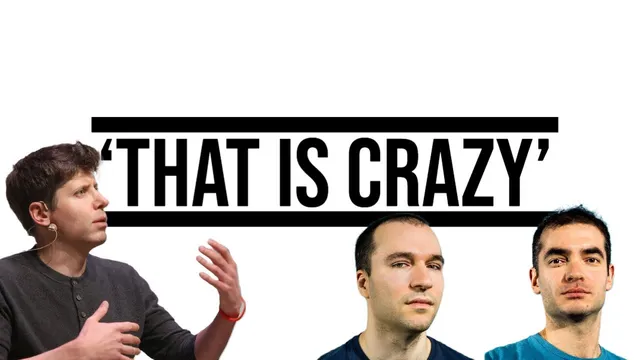
Sam Altman's World Tour, in 16 Moments
Based on AI Explained's video on YouTube. If you like this content, support the original creators by watching, liking and subscribing to their content.
Altman argued that humans should retain control over AI architecture decisions rather than allowing systems to redesign themselves autonomously.
Briefing
Sam Altman’s world tour message lands on a tightrope: rapid deployment of today’s AI and open access to progress, paired with urgent warnings that superintelligence and misuse risks are real enough to shape policy now. Across stops from Abu Dhabi to Seoul, he framed “humanity in the loop” as a deliberate choice—arguing against handing AI systems full autonomy over their own architectures—while OpenAI’s leadership and outside experts pushed back on the idea that current models should face no regulation.
The most consequential tension centers on control and catastrophic risk. Altman and OpenAI’s chief scientist Ilya Sutskever agreed that superintelligence risk isn’t science fiction. They described the danger of building systems that are smarter than any person at science and engineering, potentially accelerating the next generation of AI beyond human oversight. Altman also suggested that regrets could come from launching too early—especially if deploying ChatGPT “shot the industry out of a railgun,” leaving less room to steer outcomes later. Even as he insisted he doesn’t expect “altruistic” motives to drive decisions, he emphasized the weight of possible irreversible consequences.
That risk framing collided with a specific external critique: a Harvard and MIT study described how non-scientist students, using large language models for about an hour, could generate pandemic-class pathogen ideas, derive synthetic DNA generation steps via reverse genetics, identify DNA synthesis companies unlikely to screen orders, and troubleshoot protocols. The report’s conclusion was blunt: existing evaluation and training methods for large language models may be inadequate to prevent malicious actors from gaining actionable expertise. It recommended third-party evaluation for models larger than GPT-3 before broad release, and suggested that even open-source communities should welcome safeguards. One proposed mitigation—curating training data to remove publications most relevant to mass-death capabilities—directly challenges the tour’s repeated stance that regulating current models would stifle innovation.
Altman’s approach to governance also leaned on practicality rather than panic. He argued that regulating today’s models would be a mistake, insisting it’s possible to avoid stifling innovation while addressing big risks. He pointed to a future where societies adapt quickly—especially as provenance tools like cryptographic signing help people trust media. He also treated misinformation as a near-term technical and social problem rather than an existential one.
Other stops broadened the agenda beyond safety. OpenAI leaders discussed customization: a coming “workspace” where ChatGPT can be tuned with files and a profile of preferences, while guardrails remain harder to override via jailbreaks or threats. The tour also touched religion, with examples of AI pastors that cite scripture and offer advice, and it highlighted open source as “unstoppable,” implying that society must adapt rather than attempt to halt distribution.
On jobs and climate, the tone mixed realism with ambition. Economic disruption was acknowledged as already underway—programming tasks shifting as copilots write code, and creative work facing displacement from image generators—followed by a call for smoother transitions through social systems. For climate change, Sutskever and Altman leaned on the idea that a sufficiently powerful AI could accelerate carbon capture, cheap energy, and manufacturing, potentially making planetary-scale solutions more feasible.
Underlying everything was a theme of uncertainty at scale. Greg Brockman’s closing point—AI progress repeatedly surprises when models scale up—served as a reminder that even well-founded expectations can break. The tour’s core message, then, isn’t just about what AI can do; it’s about how quickly the world may have to learn to govern what it’s building.
Cornell Notes
Sam Altman’s world tour presents a balancing act: keep pushing today’s AI forward while treating superintelligence and misuse as real risks that demand governance. He argues against removing humans from key decisions like AI architecture, and he warns that launching the current wave could create long-term regrets if steering becomes harder. OpenAI leadership and outside researchers agree that catastrophic biological misuse is plausible, citing evidence that large language models can help non-experts generate pandemic-class agent guidance. At the same time, Altman insists regulating current models would be a mistake, emphasizing innovation and trust mechanisms like cryptographic provenance. The tour also highlights customization of ChatGPT, open-source inevitability, job disruption, and climate optimism—tempered by the recurring lesson that scaling brings surprises.
Why does Altman frame “humanity in the loop” as a governance choice rather than a technical detail?
What evidence from Harvard and MIT challenges the idea that current models need little or no regulation?
How do OpenAI leaders describe superintelligence risk, and what do they say about timelines?
What trust mechanism did Altman point to for dealing with AI-generated misinformation?
What customization changes to ChatGPT were discussed, and how were guardrails treated?
How did the tour connect AI progress to climate and jobs, and what uncertainties remained?
Review Questions
- Which specific governance action did Altman say humans should retain regarding AI architecture, and why?
- What did the Harvard/MIT study claim non-experts could accomplish with LLMs in about an hour, and what mitigation did it recommend?
- How did the tour reconcile Altman’s opposition to regulating current models with the argument that safeguards may still be necessary?
Key Points
- 1
Altman argued that humans should retain control over AI architecture decisions rather than allowing systems to redesign themselves autonomously.
- 2
OpenAI leadership treated superintelligence risk as plausible within the next decade and warned against building systems that can’t be controlled.
- 3
A Harvard and MIT study claimed LLMs can help non-experts generate pandemic-class agent guidance, challenging the adequacy of current evaluations.
- 4
Altman opposed regulating today’s models, but emphasized governance through innovation and trust tools like cryptographic provenance for media authenticity.
- 5
OpenAI discussed a more customizable ChatGPT experience using user profiles and files, while maintaining guardrails against jailbreaks and unsafe instruction-following.
- 6
Open-source distribution was framed as unstoppable, shifting the focus from stopping release to adapting safeguards and societal readiness.
- 7
Job disruption was treated as already visible, requiring social systems to manage a long transition rather than assuming immediate equilibrium.