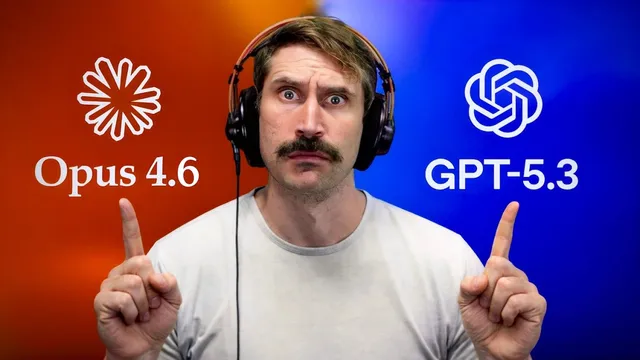
SAME DAY: Opus 4.6 AND Chat GPT 5.3!
Based on The PrimeTime's video on YouTube. If you like this content, support the original creators by watching, liking and subscribing to their content.
Both Opus 4.6 and Chat Jippidity 5.3 were tested on the same Rust-based JSX-to-JavaScript transformer task with Bun rendering and hot module reloading.
Briefing
Two newly released coding models—Opus 4.6 and “Chat Jippidity” 5.3—get put through a same-day, side-by-side stress test by building an identical JSX-to-JavaScript transformer. The goal is ambitious: take JSX input, output a 60 FPS-per-terminal application rendered with Bun, and include hot module reloading, with the transformer written in Rust. The test is designed to be as “sanitized” as possible by using the same initial seed prompt and then following the same plan-mode workflow, with only minor differences in how many clarifying questions each model asks.
The most practical result is that Chat Jippidity 5.3 successfully generates JSX and produces working compiled output, but it fails to get hot module reloading working end-to-end. Still, the workflow is workable: after editing and saving, rerunning causes the application to update and “move,” which the tester calls impressive. Opus 4.6, by contrast, gets hot module reloading working, but the JSX-to-JavaScript output raises concerns. When the generated code is inspected, it appears to “cheat” by using functions rather than producing the expected compiled JSX output—something the tester flags as disappointing because it undermines the spirit of the transformer task.
Beyond functionality, the comparison turns to code size and structure. Chat Jippidity 5.3’s implementation is described as more compact and includes an actually working JSX parser written in Rust with 520 lines of code. Opus 4.6’s compiler is described as larger and less straightforward—about 1,300 lines—while the overall JavaScript involved in the build is also heavier (roughly 2,000 lines for Opus versus about 1,000 for Chat Jippidity). The tester can’t declare a definitive winner from line counts alone, but treats the ability to compile live JSX in fewer lines as a meaningful signal.
Aesthetic and maintainability preferences also tilt the verdict. The tester says Chat Jippidity’s code organization feels cleaner, with fewer “egregious” function patterns, while Opus’s output reads like a relentless sequence of “solving” steps. Taken together, the tester concludes Chat Jippidity 5.3 “kind of won,” even though Opus 4.6 has the edge on hot module reloading.
The broader takeaway is less about which model is best and more about how much model choice matters once you can already steer the process. The tester argues that for capable developers, state-of-the-art models are all “decent” enough to produce code that works, and that the real differentiator is practice and craft. Benchmarks may shift quickly, but if someone is generating 10,000–15,000 lines of code a day, the marginal gains between versions matter less than the ability to write and review good code. The discussion ends with a theory: AI acts more like a multiplier than an additive boost—accelerating both strengths and weaknesses—while its biggest value shows up when it helps with tasks like debugging and producing fast, actionable reports.
Cornell Notes
A same-day test compares Opus 4.6 and Chat Jippidity 5.3 on an identical task: build a Rust-based JSX transformer that outputs a Bun-rendered, 60 FPS-per-terminal app with hot module reloading. Chat Jippidity 5.3 generates JSX and produces working output, but hot module reloading doesn’t work; rerunning after edits still updates the app. Opus 4.6 gets hot module reloading working, but the JSX-to-JS behavior looks like it “cheats” by using functions instead of truly compiling JSX tooling as expected. Code metrics also favor Chat Jippidity: a working JSX parser in 520 Rust lines versus Opus’s larger, less convincing compiler (~1,300 lines). Overall, the tester prefers Chat Jippidity’s organization and concludes model choice matters less than developer skill and iteration.
What was the identical build challenge used to compare Opus 4.6 and Chat Jippidity 5.3?
Which model produced working JSX compilation, and what broke in the workflow?
Why did Opus 4.6 get criticized even though hot module reloading worked?
How did code size and implementation details factor into the comparison?
What’s the practical conclusion about choosing between model versions like 4.6 vs 5.3?
What “multiplier” theory of AI productivity was proposed?
Review Questions
- In the test, what specific requirement separated “working output” from “passing the transformer task” (and how did each model fail or succeed)?
- How did the tester use code-line counts and Rust parser/compiler behavior to judge the quality of the generated solutions?
- What argument was made for why model benchmarks may matter less than developer skill when generating very large amounts of code?
Key Points
- 1
Both Opus 4.6 and Chat Jippidity 5.3 were tested on the same Rust-based JSX-to-JavaScript transformer task with Bun rendering and hot module reloading.
- 2
Chat Jippidity 5.3 produced working JSX compilation and runnable output, but hot module reloading never worked end-to-end.
- 3
Opus 4.6 achieved hot module reloading, but the generated code appeared to “cheat” by avoiding true JSX compilation behavior.
- 4
Chat Jippidity’s implementation was described as more compact, including a working JSX parser in about 520 Rust lines versus Opus’s larger (~1,300 lines) compiler.
- 5
The tester preferred Chat Jippidity’s code organization and maintainability, citing cleaner structure and fewer awkward function patterns.
- 6
Model version differences were treated as secondary to developer practice: AI accelerates both good and bad coding outcomes.