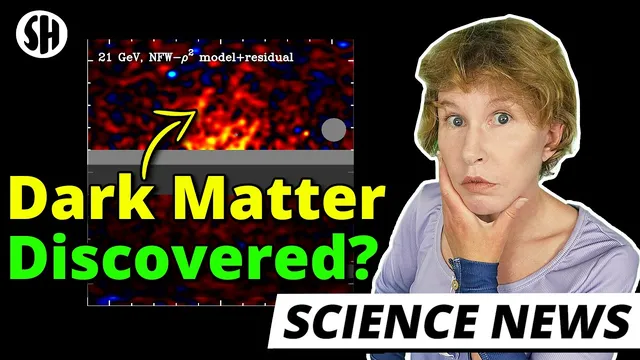
Scientists may have detected dark matter.
Based on Sabine Hossenfelder's video on YouTube. If you like this content, support the original creators by watching, liking and subscribing to their content.
The dark matter claim relies on a spherical gamma-ray component around 20 GeV seen in Fermi satellite data from 2008–2023.
Briefing
A widely circulated claim that scientists “may have detected dark matter” hinges on a reanalysis of gamma-ray data from the Fermi satellite, but the evidence is far from settled. The core idea is that a roughly spherical glow of high-energy gamma rays—around 20 GeV—could trace a dark matter halo around the Milky Way. If dark matter particles annihilate when they meet, they could produce gamma rays, and the expected signal would be strongest toward the Galactic center where the halo density is highest.
The new analysis reportedly finds that the gamma-ray emission’s spatial pattern matches a dark matter halo model with a statistical significance quoted as 13–19 sigma, depending on assumptions. The argument is that the numbers “line up” and that no alternative explanation fits as well. The press release frames this as potentially the first direct “sighting” of dark matter, implying a new particle not included in the Standard Model of particle physics.
Skepticism centers on how easily a spherical component can appear in complex astrophysical data. The Milky Way is already known to host multiple sources of energetic gamma rays, including the large-scale “Fermi bubbles” linked to activity near the central black hole, plus the nearby Loop I bubble, thought to be related to a past supernova, along with other contributions in the GeV range. In the reported approach, the analysis fits these known components and then assigns any remaining spherical emission to a dark matter halo. That modeling strategy can effectively guarantee a spherical residual—because many plausible foreground/background shapes can leave behind something that looks halo-like once the fit is tuned.
There’s also a track record problem. Earlier “dark matter” explanations for various cosmic-ray and gamma-ray anomalies have later been replaced by conventional astrophysical sources. Examples cited include an apparent excess of very high-energy cosmic rays from the Galactic center that later pointed to millisecond pulsars, and a past positron excess that was later attributed to supernovae or active galactic nuclei. Even more pointedly, a previously discussed spectral feature in hydrogen emission from the Galactic center—also claimed to be dark matter—would require a different kind of dark matter than the one implied by the new gamma-ray interpretation.
Overall, the takeaway is cautious: the claim may reflect an analysis artifact or an incomplete accounting of astrophysical backgrounds, and a conventional explanation could still be hiding in the data. The headline matters because it’s exactly the kind of extraordinary result that deserves scrutiny rather than dismissal—but, based on the reasoning presented, the discovery is not yet convincing enough to treat as dark matter detection. The message is to stay open-minded while demanding stronger, more robust confirmation before declaring victory.
Cornell Notes
The claim of a dark matter detection rests on a reanalysis of Fermi satellite gamma-ray data from 2008–2023. The analysis identifies a spherical distribution of high-energy gamma rays near 20 GeV and interprets it as the signature of dark matter annihilation in a Milky Way halo. The reported fit is strong (quoted 13–19 sigma), with the signal strongest toward the Galactic center where halo density peaks. Major doubts come from the difficulty of separating dark matter from known gamma-ray foregrounds like the Fermi bubbles and Loop I, plus a history of earlier “dark matter” anomalies later explained by pulsars, supernovae, or active galactic nuclei. The result therefore remains unconfirmed rather than definitive evidence.
What observational pattern is being used as the potential dark matter signal?
Why does the analysis claim the signal is statistically compelling?
What makes the result vulnerable to false positives in this context?
How does past experience with “dark matter” anomalies affect confidence here?
Why is consistency with other claimed dark matter signals a problem?
Review Questions
- What specific gamma-ray energy range and spatial morphology are central to the dark matter claim?
- How do known Galactic gamma-ray sources (e.g., Fermi bubbles and Loop I) complicate interpreting a residual spherical component?
- What kinds of earlier anomalies were once attributed to dark matter but later reassigned to conventional astrophysical sources?
Key Points
- 1
The dark matter claim relies on a spherical gamma-ray component around 20 GeV seen in Fermi satellite data from 2008–2023.
- 2
The interpretation assumes dark matter annihilation produces gamma rays, with the halo density making the signal strongest toward the Galactic center.
- 3
Multiple known gamma-ray foregrounds (Fermi bubbles, Loop I, and other GeV sources) make it hard to isolate a unique dark matter contribution.
- 4
Fitting known components and assigning remaining spherical emission to a halo can bias results toward finding a halo-like residual.
- 5
Earlier “dark matter” explanations for cosmic-ray and gamma-ray anomalies have frequently been replaced by conventional sources like millisecond pulsars, supernovae, or active galactic nuclei.
- 6
A previously claimed dark matter-related hydrogen spectral feature would require a different dark matter model than the one implied by the new gamma-ray analysis.
- 7
The evidence is therefore best treated as suggestive at most, pending more robust confirmation and alternative explanations.